 Add to Chrome
 Add to Firefox
 Add to Edge
Inconsistent dialogue responses and how to recover from them
Jan 18, 2024
One critical issue for chat systems is to stay consistent about preferences, opinions, beliefs and facts of itself, which has been shown a difficult problem. In this work, we study methods to assess and bolster utterance consistency of chat systems. A dataset is first developed for studying the inconsistencies, where inconsistent dialogue responses, explanations of the inconsistencies, and recovery utterances are authored by annotators. This covers the life span of inconsistencies, namely introduction, understanding, and resolution. Building on this, we introduce a set of tasks centered on dialogue consistency, specifically focused on its detection and resolution. Our experimental findings indicate that our dataset significantly helps the progress in identifying and resolving conversational inconsistencies, and current popular large language models like ChatGPT which are good at resolving inconsistencies however still struggle with detection.

Response Enhanced Semi-Supervised Dialogue Query Generation
Dec 20, 2023Leveraging vast and continually updated knowledge from the Internet has been considered an important ability for a dialogue system. Therefore, the dialogue query generation task is proposed for generating search queries from dialogue histories, which will be submitted to a search engine for retrieving relevant websites on the Internet. In this regard, previous efforts were devoted to collecting conversations with annotated queries and training a query producer (QP) via standard supervised learning. However, these studies still face the challenges of data scarcity and domain adaptation. To address these issues, in this paper, we propose a semi-supervised learning framework -- SemiDQG, to improve model performance with unlabeled conversations. Based on the observation that the search query is typically related to the topic of dialogue response, we train a response-augmented query producer (RA) to provide rich and effective training signals for QP. We first apply a similarity-based query selection strategy to select high-quality RA-generated pseudo queries, which are used to construct pseudo instances for training QP and RA. Then, we adopt the REINFORCE algorithm to further enhance QP, with RA-provided rewards as fine-grained training signals. Experimental results and in-depth analysis of three benchmarks show the effectiveness of our framework in cross-domain and low-resource scenarios. Particularly, SemiDQG significantly surpasses ChatGPT and competitive baselines. Our code is available at \url{https://github.com/DeepLearnXMU/SemiDQG}.
The Trickle-down Impact of Reward consistency on RLHF
Sep 28, 2023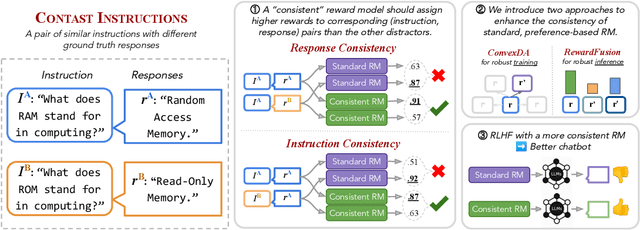
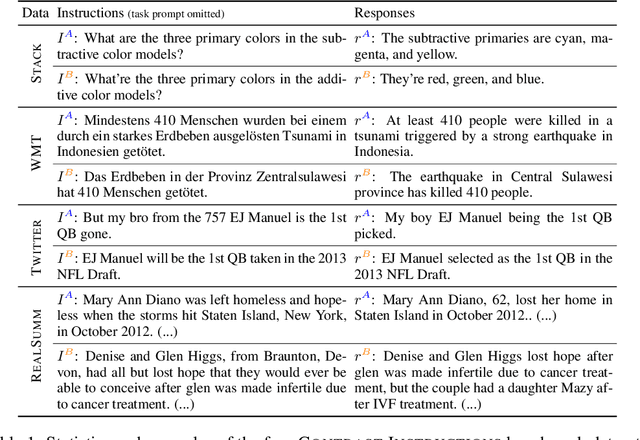
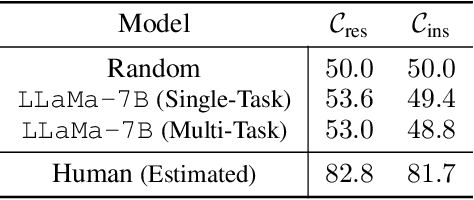
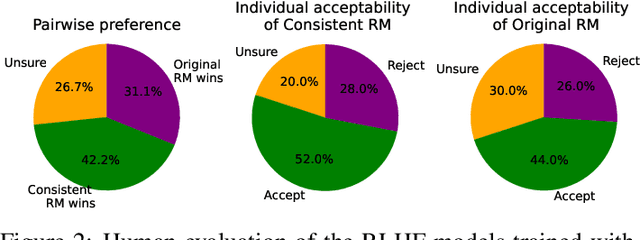
Standard practice within Reinforcement Learning from Human Feedback (RLHF) involves optimizing against a Reward Model (RM), which itself is trained to reflect human preferences for desirable generations. A notable subject that is understudied is the (in-)consistency of RMs -- whether they can recognize the semantic changes to different prompts and appropriately adapt their reward assignments -- and their impact on the downstream RLHF model. In this paper, we visit a series of research questions relevant to RM inconsistency: (1) How can we measure the consistency of reward models? (2) How consistent are the existing RMs and how can we improve them? (3) In what ways does reward inconsistency influence the chatbots resulting from the RLHF model training? We propose Contrast Instructions -- a benchmarking strategy for the consistency of RM. Each example in Contrast Instructions features a pair of lexically similar instructions with different ground truth responses. A consistent RM is expected to rank the corresponding instruction and response higher than other combinations. We observe that current RMs trained with the standard ranking objective fail miserably on Contrast Instructions compared to average humans. To show that RM consistency can be improved efficiently without using extra training budget, we propose two techniques ConvexDA and RewardFusion, which enhance reward consistency through extrapolation during the RM training and inference stage, respectively. We show that RLHF models trained with a more consistent RM yield more useful responses, suggesting that reward inconsistency exhibits a trickle-down effect on the downstream RLHF process.
Stabilizing RLHF through Advantage Model and Selective Rehearsal
Sep 18, 2023Large Language Models (LLMs) have revolutionized natural language processing, yet aligning these models with human values and preferences using RLHF remains a significant challenge. This challenge is characterized by various instabilities, such as reward hacking and catastrophic forgetting. In this technical report, we propose two innovations to stabilize RLHF training: 1) Advantage Model, which directly models advantage score i.e., extra reward compared to the expected rewards and regulates score distributions across tasks to prevent reward hacking. 2) Selective Rehearsal, which mitigates catastrophic forgetting by strategically selecting data for PPO training and knowledge rehearsing. Our experimental analysis on public and proprietary datasets reveals that the proposed methods not only increase stability in RLHF training but also achieve higher reward scores and win rates.
Discrete Conditional Diffusion for Reranking in Recommendation
Aug 14, 2023
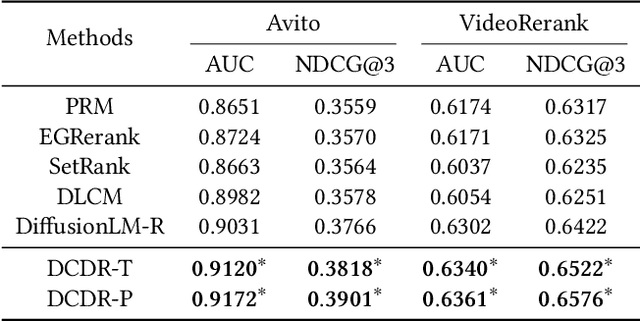


Reranking plays a crucial role in modern multi-stage recommender systems by rearranging the initial ranking list to model interplay between items. Considering the inherent challenges of reranking such as combinatorial searching space, some previous studies have adopted the evaluator-generator paradigm, with a generator producing feasible sequences and a evaluator selecting the best one based on estimated listwise utility. Inspired by the remarkable success of diffusion generative models, this paper explores the potential of diffusion models for generating high-quality sequences in reranking. However, we argue that it is nontrivial to take diffusion models as the generator in the context of recommendation. Firstly, diffusion models primarily operate in continuous data space, differing from the discrete data space of item permutations. Secondly, the recommendation task is different from conventional generation tasks as the purpose of recommender systems is to fulfill user interests. Lastly, real-life recommender systems require efficiency, posing challenges for the inference of diffusion models. To overcome these challenges, we propose a novel Discrete Conditional Diffusion Reranking (DCDR) framework for recommendation. DCDR extends traditional diffusion models by introducing a discrete forward process with tractable posteriors, which adds noise to item sequences through step-wise discrete operations (e.g., swapping). Additionally, DCDR incorporates a conditional reverse process that generates item sequences conditioned on expected user responses. Extensive offline experiments conducted on public datasets demonstrate that DCDR outperforms state-of-the-art reranking methods. Furthermore, DCDR has been deployed in a real-world video app with over 300 million daily active users, significantly enhancing online recommendation quality.
Tree based Progressive Regression Model for Watch-Time Prediction in Short-video Recommendation
Jun 06, 2023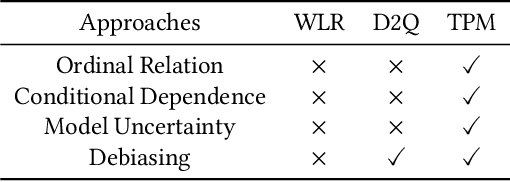
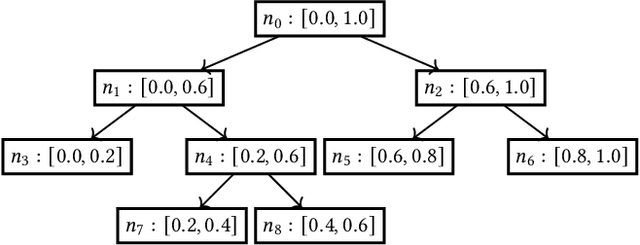
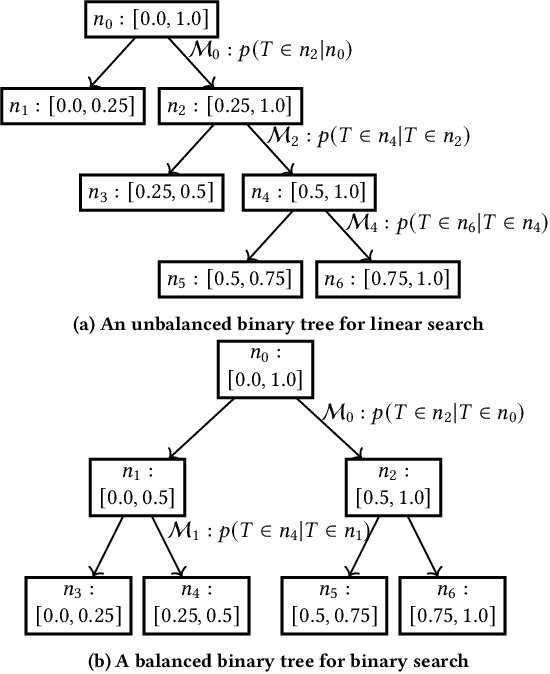
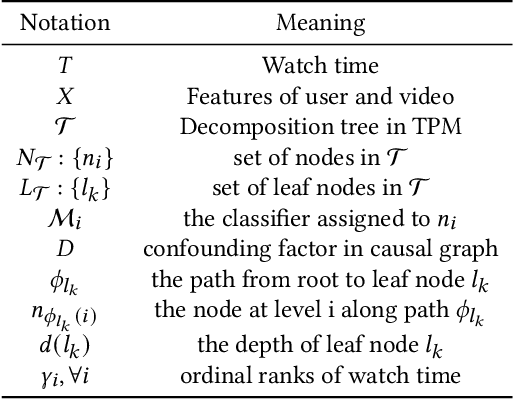
An accurate prediction of watch time has been of vital importance to enhance user engagement in video recommender systems. To achieve this, there are four properties that a watch time prediction framework should satisfy: first, despite its continuous value, watch time is also an ordinal variable and the relative ordering between its values reflects the differences in user preferences. Therefore the ordinal relations should be reflected in watch time predictions. Second, the conditional dependence between the video-watching behaviors should be captured in the model. For instance, one has to watch half of the video before he/she finishes watching the whole video. Third, modeling watch time with a point estimation ignores the fact that models might give results with high uncertainty and this could cause bad cases in recommender systems. Therefore the framework should be aware of prediction uncertainty. Forth, the real-life recommender systems suffer from severe bias amplifications thus an estimation without bias amplification is expected. Therefore we propose TPM for watch time prediction. Specifically, the ordinal ranks of watch time are introduced into TPM and the problem is decomposed into a series of conditional dependent classification tasks which are organized into a tree structure. The expectation of watch time can be generated by traversing the tree and the variance of watch time predictions is explicitly introduced into the objective function as a measurement for uncertainty. Moreover, we illustrate that backdoor adjustment can be seamlessly incorporated into TPM, which alleviates bias amplifications. Extensive offline evaluations have been conducted in public datasets and TPM have been deployed in a real-world video app Kuaishou with over 300 million DAUs. The results indicate that TPM outperforms state-of-the-art approaches and indeed improves video consumption significantly.
A Survey on Zero Pronoun Translation
May 17, 2023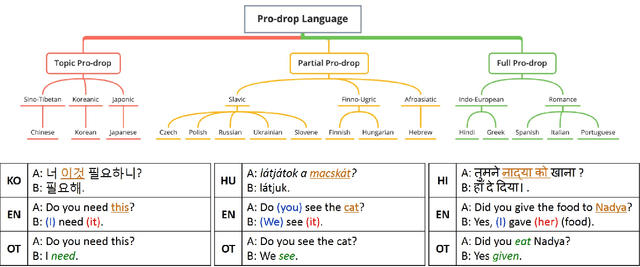
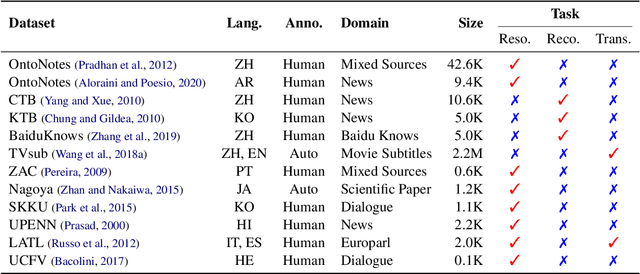
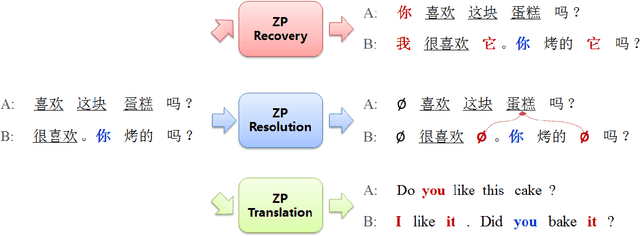
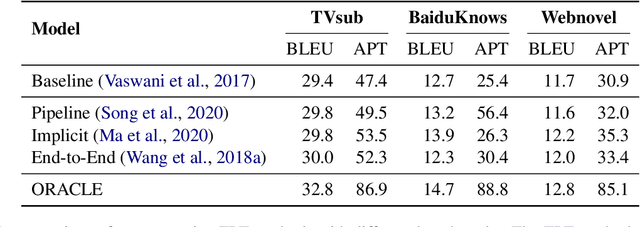
Zero pronouns (ZPs) are frequently omitted in pro-drop languages (e.g. Chinese, Hungarian, and Hindi), but should be recalled in non-pro-drop languages (e.g. English). This phenomenon has been studied extensively in machine translation (MT), as it poses a significant challenge for MT systems due to the difficulty in determining the correct antecedent for the pronoun. This survey paper highlights the major works that have been undertaken in zero pronoun translation (ZPT) after the neural revolution, so that researchers can recognise the current state and future directions of this field. We provide an organisation of the literature based on evolution, dataset, method and evaluation. In addition, we compare and analyze competing models and evaluation metrics on different benchmarks. We uncover a number of insightful findings such as: 1) ZPT is in line with the development trend of large language model; 2) data limitation causes learning bias in languages and domains; 3) performance improvements are often reported on single benchmarks, but advanced methods are still far from real-world use; 4) general-purpose metrics are not reliable on nuances and complexities of ZPT, emphasizing the necessity of targeted metrics; 5) apart from commonly-cited errors, ZPs will cause risks of gender bias.
Search-Engine-augmented Dialogue Response Generation with Cheaply Supervised Query Production
Feb 16, 2023Knowledge-aided dialogue response generation aims at augmenting chatbots with relevant external knowledge in the hope of generating more informative responses. The majority of previous work assumes that the relevant knowledge is given as input or retrieved from a static pool of knowledge. However, this assumption violates the real-world situation, where knowledge is continually updated and a chatbot has to dynamically retrieve useful knowledge. We propose a dialogue model that can access the vast and dynamic information from any search engine for response generation. As the core module, a query producer is used to generate queries from a dialogue context to interact with a search engine. We design a training algorithm using cheap noisy supervision for the query producer, where the signals are obtained by comparing retrieved articles with the next dialogue response. As the result, the query producer is adjusted without any human annotation of gold queries, making it easily transferable to other domains and search engines. Experiments show that our query producer can achieve R@1 and R@5 rates of 62.4% and 74.8% for retrieving gold knowledge, and the overall model generates better responses over strong knowledge-aided baselines using BART and other typical systems.
Friend-training: Learning from Models of Different but Related Tasks
Jan 31, 2023Current self-training methods such as standard self-training, co-training, tri-training, and others often focus on improving model performance on a single task, utilizing differences in input features, model architectures, and training processes. However, many tasks in natural language processing are about different but related aspects of language, and models trained for one task can be great teachers for other related tasks. In this work, we propose friend-training, a cross-task self-training framework, where models trained to do different tasks are used in an iterative training, pseudo-labeling, and retraining process to help each other for better selection of pseudo-labels. With two dialogue understanding tasks, conversational semantic role labeling and dialogue rewriting, chosen for a case study, we show that the models trained with the friend-training framework achieve the best performance compared to strong baselines.
Getting the Most out of Simile Recognition
Nov 11, 2022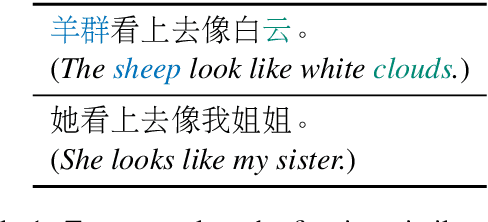
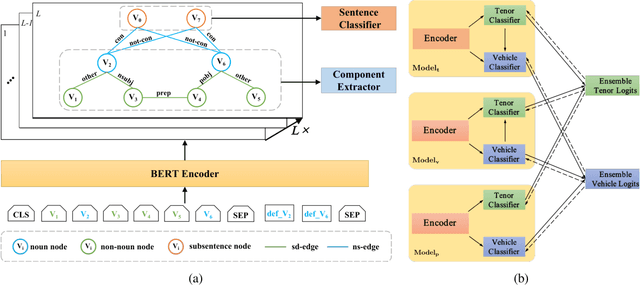
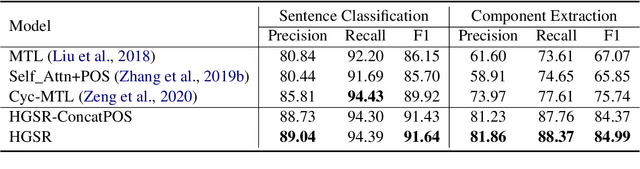
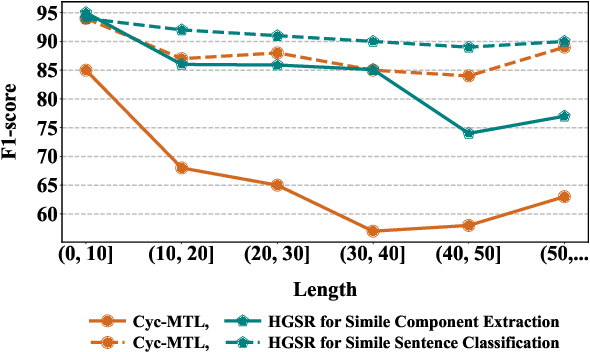
Simile recognition involves two subtasks: simile sentence classification that discriminates whether a sentence contains simile, and simile component extraction that locates the corresponding objects (i.e., tenors and vehicles). Recent work ignores features other than surface strings. In this paper, we explore expressive features for this task to achieve more effective data utilization. Particularly, we study two types of features: 1) input-side features that include POS tags, dependency trees and word definitions, and 2) decoding features that capture the interdependence among various decoding decisions. We further construct a model named HGSR, which merges the input-side features as a heterogeneous graph and leverages decoding features via distillation. Experiments show that HGSR significantly outperforms the current state-of-the-art systems and carefully designed baselines, verifying the effectiveness of introduced features. Our code is available at https://github.com/DeepLearnXMU/HGSR.