 Add to Chrome
 Add to Firefox
 Add to Edge
Efficient Privacy-Preserving KAN Inference Using Homomorphic Encryption
Sep 12, 2024
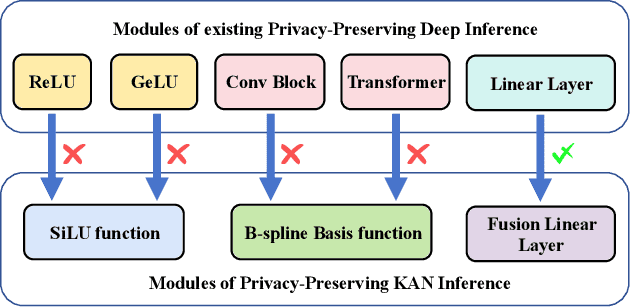
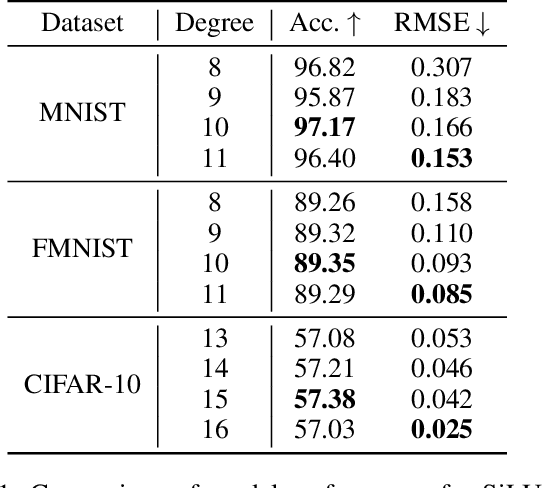

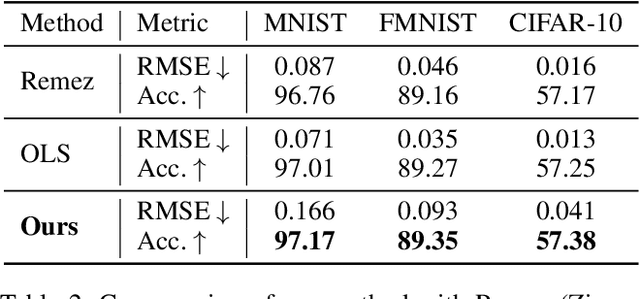
The recently proposed Kolmogorov-Arnold Networks (KANs) offer enhanced interpretability and greater model expressiveness. However, KANs also present challenges related to privacy leakage during inference. Homomorphic encryption (HE) facilitates privacy-preserving inference for deep learning models, enabling resource-limited users to benefit from deep learning services while ensuring data security. Yet, the complex structure of KANs, incorporating nonlinear elements like the SiLU activation function and B-spline functions, renders existing privacy-preserving inference techniques inadequate. To address this issue, we propose an accurate and efficient privacy-preserving inference scheme tailored for KANs. Our approach introduces a task-specific polynomial approximation for the SiLU activation function, dynamically adjusting the approximation range to ensure high accuracy on real-world datasets. Additionally, we develop an efficient method for computing B-spline functions within the HE domain, leveraging techniques such as repeat packing, lazy combination, and comparison functions. We evaluate the effectiveness of our privacy-preserving KAN inference scheme on both symbolic formula evaluation and image classification. The experimental results show that our model achieves accuracy comparable to plaintext KANs across various datasets and outperforms plaintext MLPs. Additionally, on the CIFAR-10 dataset, our inference latency achieves over 7 times speedup compared to the naive method.

QD-VMR: Query Debiasing with Contextual Understanding Enhancement for Video Moment Retrieval
Aug 23, 2024Video Moment Retrieval (VMR) aims to retrieve relevant moments of an untrimmed video corresponding to the query. While cross-modal interaction approaches have shown progress in filtering out query-irrelevant information in videos, they assume the precise alignment between the query semantics and the corresponding video moments, potentially overlooking the misunderstanding of the natural language semantics. To address this challenge, we propose a novel model called \textit{QD-VMR}, a query debiasing model with enhanced contextual understanding. Firstly, we leverage a Global Partial Aligner module via video clip and query features alignment and video-query contrastive learning to enhance the cross-modal understanding capabilities of the model. Subsequently, we employ a Query Debiasing Module to obtain debiased query features efficiently, and a Visual Enhancement module to refine the video features related to the query. Finally, we adopt the DETR structure to predict the possible target video moments. Through extensive evaluations of three benchmark datasets, QD-VMR achieves state-of-the-art performance, proving its potential to improve the accuracy of VMR. Further analytical experiments demonstrate the effectiveness of our proposed module. Our code will be released to facilitate future research.
VLMEvalKit: An Open-Source Toolkit for Evaluating Large Multi-Modality Models
Jul 16, 2024
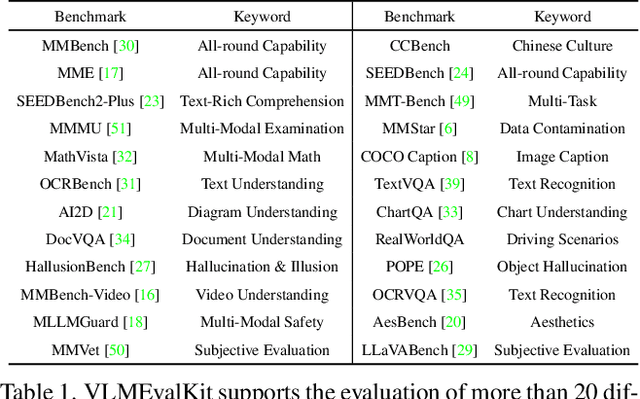

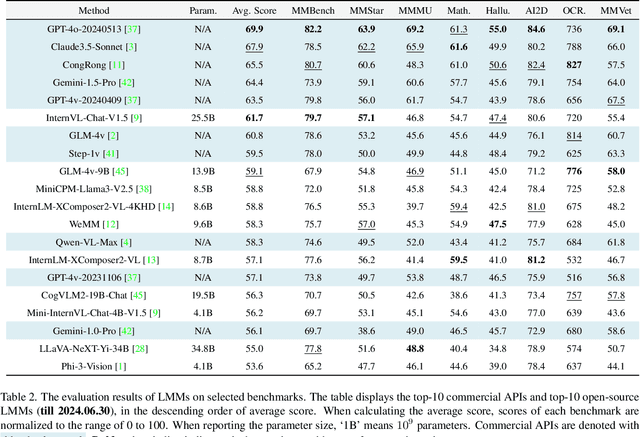
We present VLMEvalKit: an open-source toolkit for evaluating large multi-modality models based on PyTorch. The toolkit aims to provide a user-friendly and comprehensive framework for researchers and developers to evaluate existing multi-modality models and publish reproducible evaluation results. In VLMEvalKit, we implement over 70 different large multi-modality models, including both proprietary APIs and open-source models, as well as more than 20 different multi-modal benchmarks. By implementing a single interface, new models can be easily added to the toolkit, while the toolkit automatically handles the remaining workloads, including data preparation, distributed inference, prediction post-processing, and metric calculation. Although the toolkit is currently mainly used for evaluating large vision-language models, its design is compatible with future updates that incorporate additional modalities, such as audio and video. Based on the evaluation results obtained with the toolkit, we host OpenVLM Leaderboard, a comprehensive leaderboard to track the progress of multi-modality learning research. The toolkit is released at https://github.com/open-compass/VLMEvalKit and is actively maintained.
InternLM-XComposer-2.5: A Versatile Large Vision Language Model Supporting Long-Contextual Input and Output
Jul 03, 2024

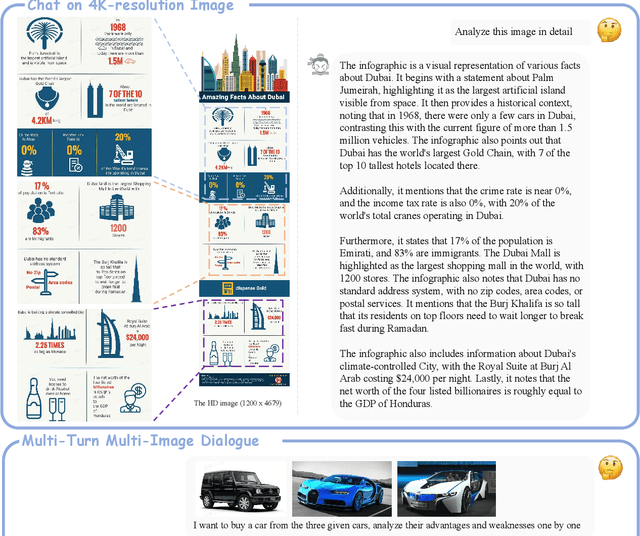
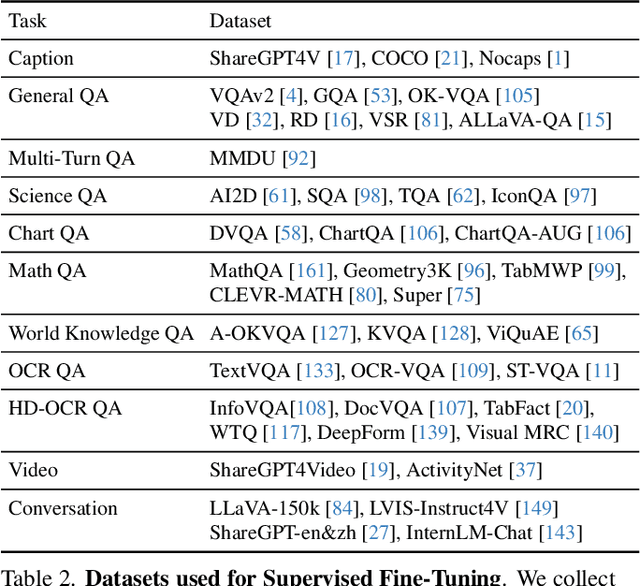
We present InternLM-XComposer-2.5 (IXC-2.5), a versatile large-vision language model that supports long-contextual input and output. IXC-2.5 excels in various text-image comprehension and composition applications, achieving GPT-4V level capabilities with merely 7B LLM backend. Trained with 24K interleaved image-text contexts, it can seamlessly extend to 96K long contexts via RoPE extrapolation. This long-context capability allows IXC-2.5 to excel in tasks requiring extensive input and output contexts. Compared to its previous 2.0 version, InternLM-XComposer-2.5 features three major upgrades in vision-language comprehension: (1) Ultra-High Resolution Understanding, (2) Fine-Grained Video Understanding, and (3) Multi-Turn Multi-Image Dialogue. In addition to comprehension, IXC-2.5 extends to two compelling applications using extra LoRA parameters for text-image composition: (1) Crafting Webpages and (2) Composing High-Quality Text-Image Articles. IXC-2.5 has been evaluated on 28 benchmarks, outperforming existing open-source state-of-the-art models on 16 benchmarks. It also surpasses or competes closely with GPT-4V and Gemini Pro on 16 key tasks. The InternLM-XComposer-2.5 is publicly available at https://github.com/InternLM/InternLM-XComposer.
Prism: A Framework for Decoupling and Assessing the Capabilities of VLMs
Jun 20, 2024


Vision Language Models (VLMs) demonstrate remarkable proficiency in addressing a wide array of visual questions, which requires strong perception and reasoning faculties. Assessing these two competencies independently is crucial for model refinement, despite the inherent difficulty due to the intertwined nature of seeing and reasoning in existing VLMs. To tackle this issue, we present Prism, an innovative framework designed to disentangle the perception and reasoning processes involved in visual question solving. Prism comprises two distinct stages: a perception stage that utilizes a VLM to extract and articulate visual information in textual form, and a reasoning stage that formulates responses based on the extracted visual information using a Large Language Model (LLM). This modular design enables the systematic comparison and assessment of both proprietary and open-source VLM for their perception and reasoning strengths. Our analytical framework provides several valuable insights, underscoring Prism's potential as a cost-effective solution for vision-language tasks. By combining a streamlined VLM focused on perception with a powerful LLM tailored for reasoning, Prism achieves superior results in general vision-language tasks while substantially cutting down on training and operational expenses. Quantitative evaluations show that Prism, when configured with a vanilla 2B LLaVA and freely accessible GPT-3.5, delivers performance on par with VLMs $10 \times$ larger on the rigorous multimodal benchmark MMStar. The project is released at: https://github.com/SparksJoe/Prism.
Design and Optimization of Hierarchical Gradient Coding for Distributed Learning at Edge Devices
Jun 16, 2024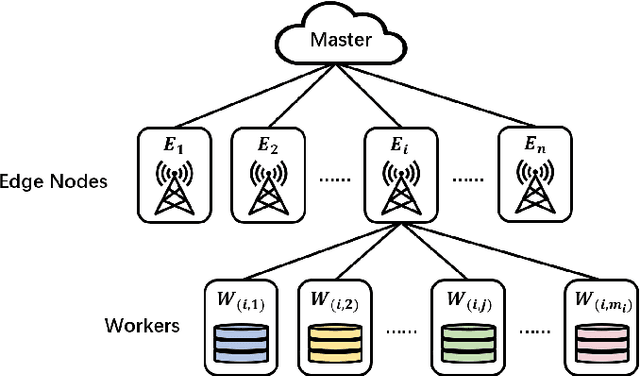
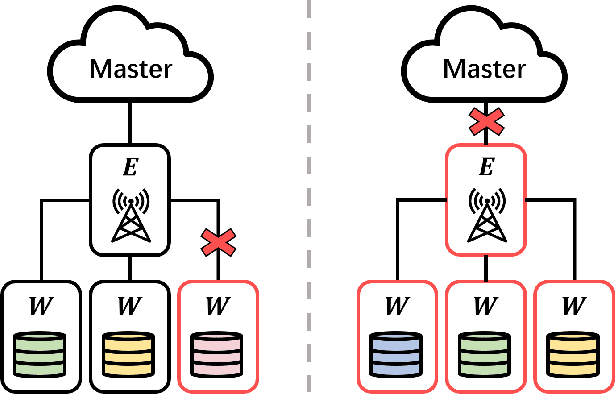
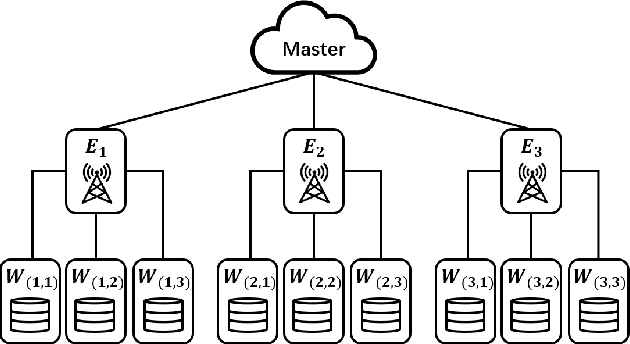
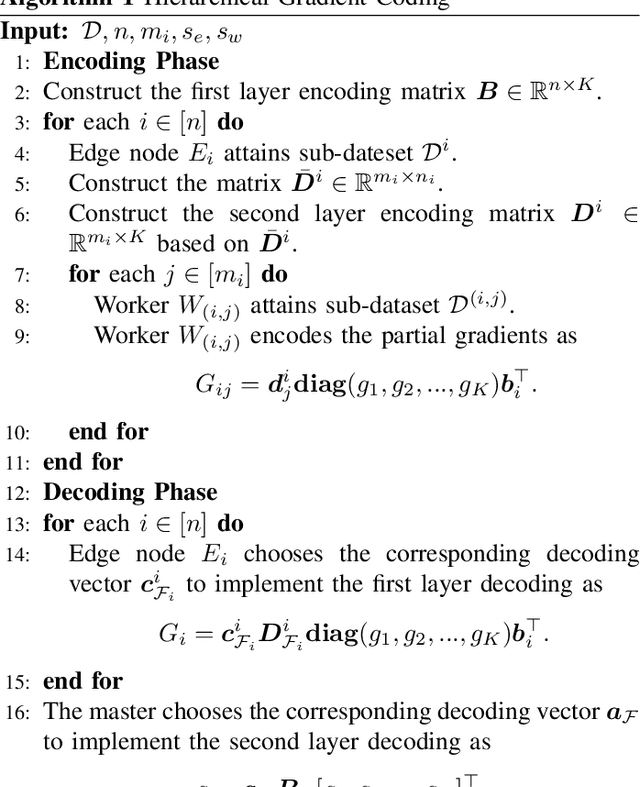
Edge computing has recently emerged as a promising paradigm to boost the performance of distributed learning by leveraging the distributed resources at edge nodes. Architecturally, the introduction of edge nodes adds an additional intermediate layer between the master and workers in the original distributed learning systems, potentially leading to more severe straggler effect. Recently, coding theory-based approaches have been proposed for stragglers mitigation in distributed learning, but the majority focus on the conventional workers-master architecture. In this paper, along a different line, we investigate the problem of mitigating the straggler effect in hierarchical distributed learning systems with an additional layer composed of edge nodes. Technically, we first derive the fundamental trade-off between the computational loads of workers and the stragglers tolerance. Then, we propose a hierarchical gradient coding framework, which provides better stragglers mitigation, to achieve the derived computational trade-off. To further improve the performance of our framework in heterogeneous scenarios, we formulate an optimization problem with the objective of minimizing the expected execution time for each iteration in the learning process. We develop an efficient algorithm to mathematically solve the problem by outputting the optimum strategy. Extensive simulation results demonstrate the superiority of our schemes compared with conventional solutions.
ShareGPT4Video: Improving Video Understanding and Generation with Better Captions
Jun 06, 2024


We present the ShareGPT4Video series, aiming to facilitate the video understanding of large video-language models (LVLMs) and the video generation of text-to-video models (T2VMs) via dense and precise captions. The series comprises: 1) ShareGPT4Video, 40K GPT4V annotated dense captions of videos with various lengths and sources, developed through carefully designed data filtering and annotating strategy. 2) ShareCaptioner-Video, an efficient and capable captioning model for arbitrary videos, with 4.8M high-quality aesthetic videos annotated by it. 3) ShareGPT4Video-8B, a simple yet superb LVLM that reached SOTA performance on three advancing video benchmarks. To achieve this, taking aside the non-scalable costly human annotators, we find using GPT4V to caption video with a naive multi-frame or frame-concatenation input strategy leads to less detailed and sometimes temporal-confused results. We argue the challenge of designing a high-quality video captioning strategy lies in three aspects: 1) Inter-frame precise temporal change understanding. 2) Intra-frame detailed content description. 3) Frame-number scalability for arbitrary-length videos. To this end, we meticulously designed a differential video captioning strategy, which is stable, scalable, and efficient for generating captions for videos with arbitrary resolution, aspect ratios, and length. Based on it, we construct ShareGPT4Video, which contains 40K high-quality videos spanning a wide range of categories, and the resulting captions encompass rich world knowledge, object attributes, camera movements, and crucially, detailed and precise temporal descriptions of events. Based on ShareGPT4Video, we further develop ShareCaptioner-Video, a superior captioner capable of efficiently generating high-quality captions for arbitrary videos...
Optimistic Rates for Learning from Label Proportions
Jun 01, 2024We consider a weakly supervised learning problem called Learning from Label Proportions (LLP), where examples are grouped into ``bags'' and only the average label within each bag is revealed to the learner. We study various learning rules for LLP that achieve PAC learning guarantees for classification loss. We establish that the classical Empirical Proportional Risk Minimization (EPRM) learning rule (Yu et al., 2014) achieves fast rates under realizability, but EPRM and similar proportion matching learning rules can fail in the agnostic setting. We also show that (1) a debiased proportional square loss, as well as (2) a recently proposed EasyLLP learning rule (Busa-Fekete et al., 2023) both achieve ``optimistic rates'' (Panchenko, 2002); in both the realizable and agnostic settings, their sample complexity is optimal (up to log factors) in terms of $\epsilon, \delta$, and VC dimension.
Are We on the Right Way for Evaluating Large Vision-Language Models?
Apr 09, 2024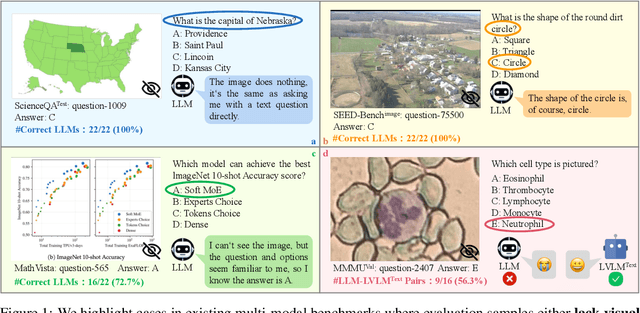
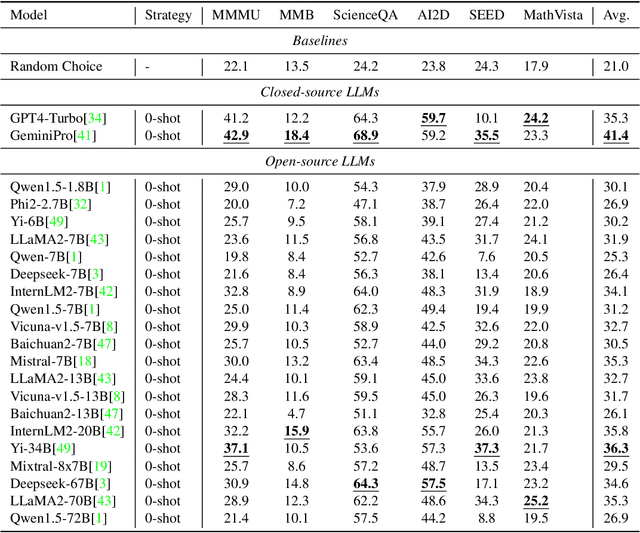
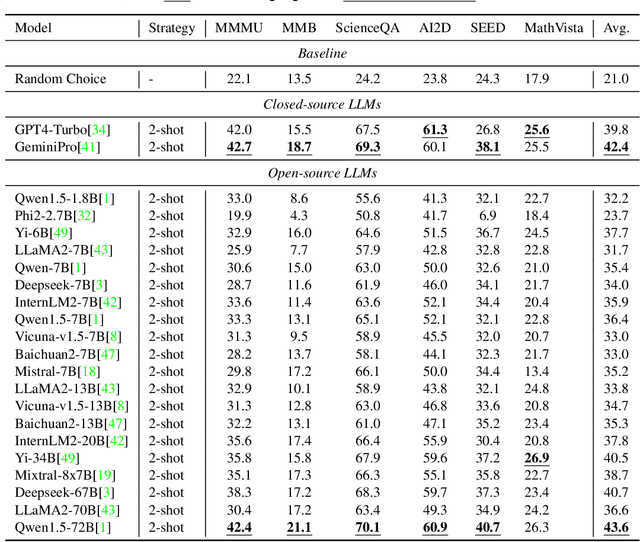
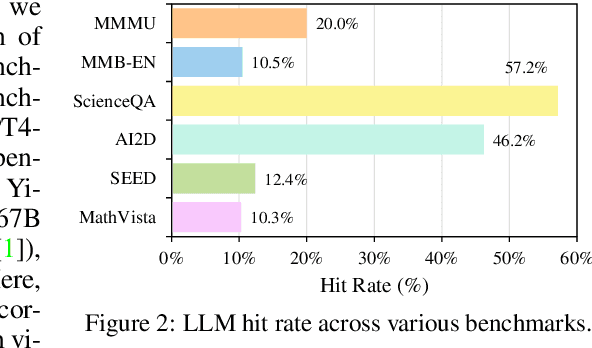
Large vision-language models (LVLMs) have recently achieved rapid progress, sparking numerous studies to evaluate their multi-modal capabilities. However, we dig into current evaluation works and identify two primary issues: 1) Visual content is unnecessary for many samples. The answers can be directly inferred from the questions and options, or the world knowledge embedded in LLMs. This phenomenon is prevalent across current benchmarks. For instance, GeminiPro achieves 42.9% on the MMMU benchmark without any visual input, and outperforms the random choice baseline across six benchmarks over 24% on average. 2) Unintentional data leakage exists in LLM and LVLM training. LLM and LVLM could still answer some visual-necessary questions without visual content, indicating the memorizing of these samples within large-scale training data. For example, Sphinx-X-MoE gets 43.6% on MMMU without accessing images, surpassing its LLM backbone with 17.9%. Both problems lead to misjudgments of actual multi-modal gains and potentially misguide the study of LVLM. To this end, we present MMStar, an elite vision-indispensable multi-modal benchmark comprising 1,500 samples meticulously selected by humans. MMStar benchmarks 6 core capabilities and 18 detailed axes, aiming to evaluate LVLMs' multi-modal capacities with carefully balanced and purified samples. These samples are first roughly selected from current benchmarks with an automated pipeline, human review is then involved to ensure each curated sample exhibits visual dependency, minimal data leakage, and requires advanced multi-modal capabilities. Moreover, two metrics are developed to measure data leakage and actual performance gain in multi-modal training. We evaluate 16 leading LVLMs on MMStar to assess their multi-modal capabilities, and on 7 benchmarks with the proposed metrics to investigate their data leakage and actual multi-modal gain.
Point-DETR3D: Leveraging Imagery Data with Spatial Point Prior for Weakly Semi-supervised 3D Object Detection
Mar 25, 2024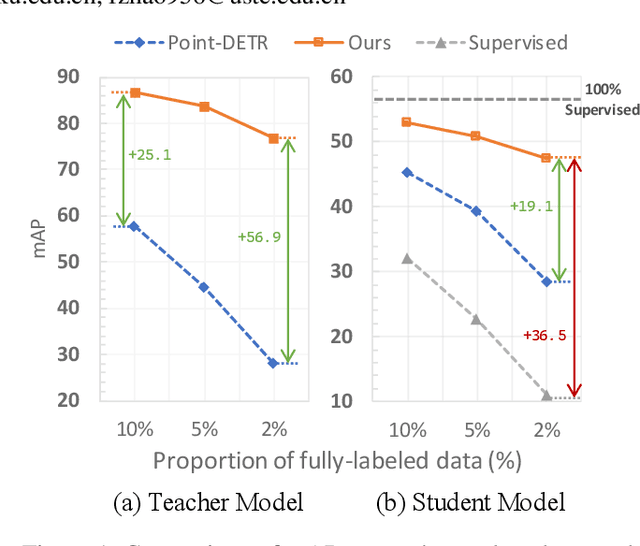
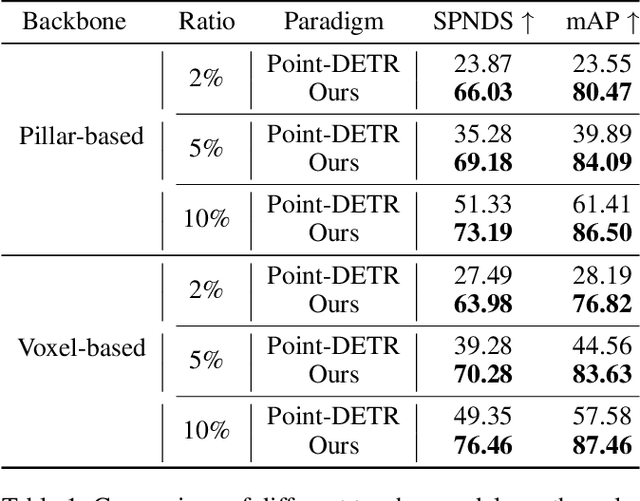
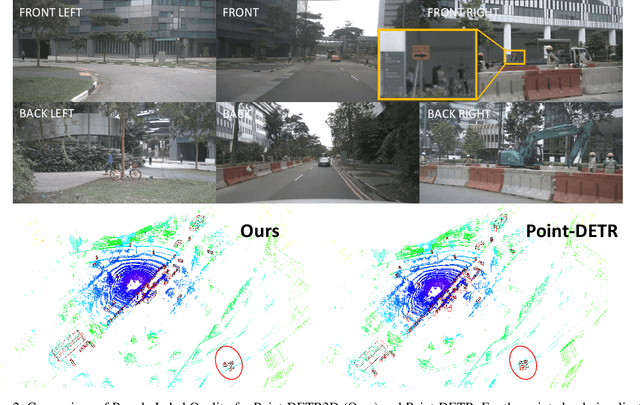
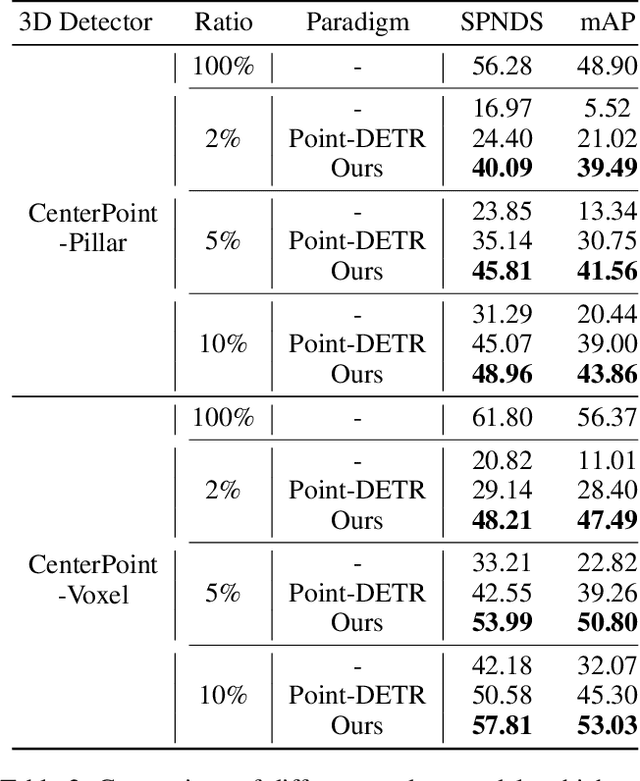
Training high-accuracy 3D detectors necessitates massive labeled 3D annotations with 7 degree-of-freedom, which is laborious and time-consuming. Therefore, the form of point annotations is proposed to offer significant prospects for practical applications in 3D detection, which is not only more accessible and less expensive but also provides strong spatial information for object localization. In this paper, we empirically discover that it is non-trivial to merely adapt Point-DETR to its 3D form, encountering two main bottlenecks: 1) it fails to encode strong 3D prior into the model, and 2) it generates low-quality pseudo labels in distant regions due to the extreme sparsity of LiDAR points. To overcome these challenges, we introduce Point-DETR3D, a teacher-student framework for weakly semi-supervised 3D detection, designed to fully capitalize on point-wise supervision within a constrained instance-wise annotation budget.Different from Point-DETR which encodes 3D positional information solely through a point encoder, we propose an explicit positional query initialization strategy to enhance the positional prior. Considering the low quality of pseudo labels at distant regions produced by the teacher model, we enhance the detector's perception by incorporating dense imagery data through a novel Cross-Modal Deformable RoI Fusion (D-RoI).Moreover, an innovative point-guided self-supervised learning technique is proposed to allow for fully exploiting point priors, even in student models.Extensive experiments on representative nuScenes dataset demonstrate our Point-DETR3D obtains significant improvements compared to previous works. Notably, with only 5% of labeled data, Point-DETR3D achieves over 90% performance of its fully supervised counterpart.