 Add to Chrome
 Add to Firefox
 Add to Edge
Downstream-Pretext Domain Knowledge Traceback for Active Learning
Jul 20, 2024


Active learning (AL) is designed to construct a high-quality labeled dataset by iteratively selecting the most informative samples. Such sampling heavily relies on data representation, while recently pre-training is popular for robust feature learning. However, as pre-training utilizes low-level pretext tasks that lack annotation, directly using pre-trained representation in AL is inadequate for determining the sampling score. To address this problem, we propose a downstream-pretext domain knowledge traceback (DOKT) method that traces the data interactions of downstream knowledge and pre-training guidance for selecting diverse and instructive samples near the decision boundary. DOKT consists of a traceback diversity indicator and a domain-based uncertainty estimator. The diversity indicator constructs two feature spaces based on the pre-training pretext model and the downstream knowledge from annotation, by which it locates the neighbors of unlabeled data from the downstream space in the pretext space to explore the interaction of samples. With this mechanism, DOKT unifies the data relations of low-level and high-level representations to estimate traceback diversity. Next, in the uncertainty estimator, domain mixing is designed to enforce perceptual perturbing to unlabeled samples with similar visual patches in the pretext space. Then the divergence of perturbed samples is measured to estimate the domain uncertainty. As a result, DOKT selects the most diverse and important samples based on these two modules. The experiments conducted on ten datasets show that our model outperforms other state-of-the-art methods and generalizes well to various application scenarios such as semantic segmentation and image captioning.

Temporal Correlation Meets Embedding: Towards a 2nd Generation of JDE-based Real-Time Multi-Object Tracking
Jul 19, 2024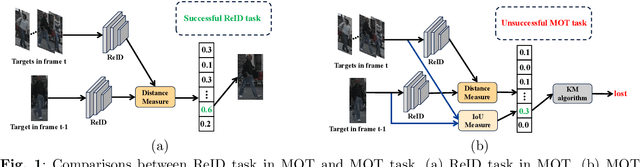
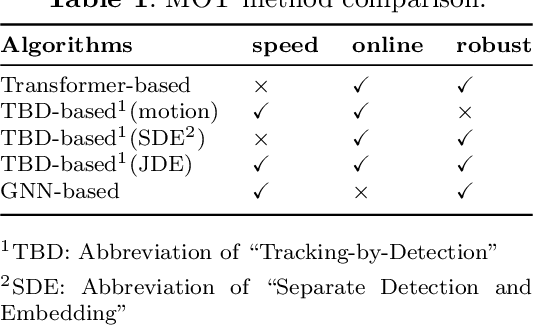
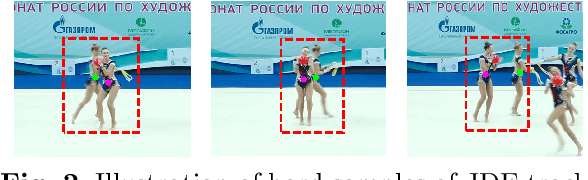
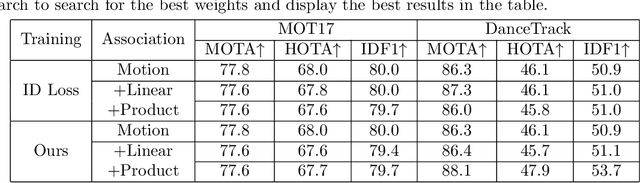
Joint Detection and Embedding(JDE) trackers have demonstrated excellent performance in Multi-Object Tracking(MOT) tasks by incorporating the extraction of appearance features as auxiliary tasks through embedding Re-Identification task(ReID) into the detector, achieving a balance between inference speed and tracking performance. However, solving the competition between the detector and the feature extractor has always been a challenge. Also, the issue of directly embedding the ReID task into MOT has remained unresolved. The lack of high discriminability in appearance features results in their limited utility. In this paper, we propose a new learning approach using cross-correlation to capture temporal information of objects. The feature extraction network is no longer trained solely on appearance features from each frame but learns richer motion features by utilizing feature heatmaps from consecutive frames, addressing the challenge of inter-class feature similarity. Furthermore, we apply our learning approach to a more lightweight feature extraction network, and treat the feature matching scores as strong cues rather than auxiliary cues, employing a appropriate weight calculation to reflect the compatibility between our obtained features and the MOT task. Our tracker, named TCBTrack, achieves state-of-the-art performance on multiple public benchmarks, i.e., MOT17, MOT20, and DanceTrack datasets. Specifically, on the DanceTrack test set, we achieve 56.8 HOTA, 58.1 IDF1 and 92.5 MOTA, making it the best online tracker that can achieve real-time performance. Comparative evaluations with other trackers prove that our tracker achieves the best balance between speed, robustness and accuracy.
Distractors-Immune Representation Learning with Cross-modal Contrastive Regularization for Change Captioning
Jul 16, 2024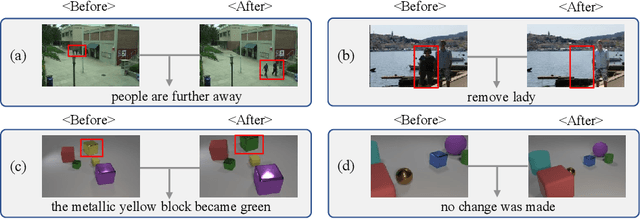
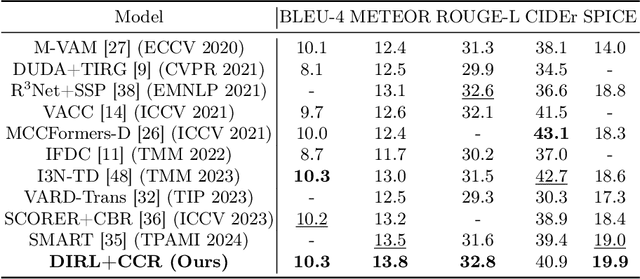
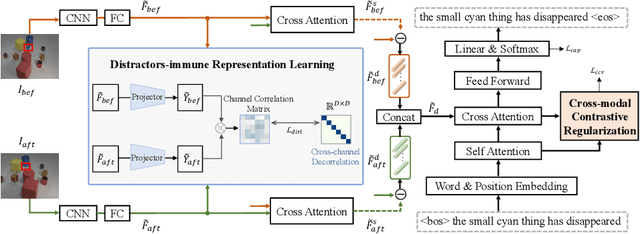
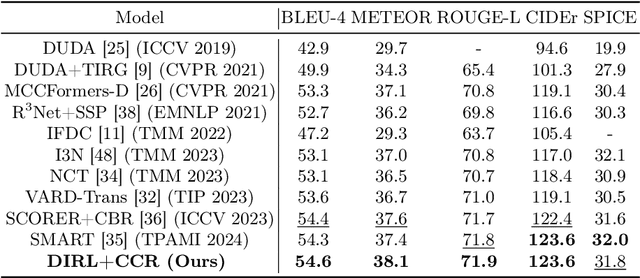
Change captioning aims to succinctly describe the semantic change between a pair of similar images, while being immune to distractors (illumination and viewpoint changes). Under these distractors, unchanged objects often appear pseudo changes about location and scale, and certain objects might overlap others, resulting in perturbational and discrimination-degraded features between two images. However, most existing methods directly capture the difference between them, which risk obtaining error-prone difference features. In this paper, we propose a distractors-immune representation learning network that correlates the corresponding channels of two image representations and decorrelates different ones in a self-supervised manner, thus attaining a pair of stable image representations under distractors. Then, the model can better interact them to capture the reliable difference features for caption generation. To yield words based on the most related difference features, we further design a cross-modal contrastive regularization, which regularizes the cross-modal alignment by maximizing the contrastive alignment between the attended difference features and generated words. Extensive experiments show that our method outperforms the state-of-the-art methods on four public datasets. The code is available at https://github.com/tuyunbin/DIRL.
FedEx: Expediting Federated Learning over Heterogeneous Mobile Devices by Overlapping and Participant Selection
Jul 02, 2024Training latency is critical for the success of numerous intrigued applications ignited by federated learning (FL) over heterogeneous mobile devices. By revolutionarily overlapping local gradient transmission with continuous local computing, FL can remarkably reduce its training latency over homogeneous clients, yet encounter severe model staleness, model drifts, memory cost and straggler issues in heterogeneous environments. To unleash the full potential of overlapping, we propose, FedEx, a novel \underline{fed}erated learning approach to \underline{ex}pedite FL training over mobile devices under data, computing and wireless heterogeneity. FedEx redefines the overlapping procedure with staleness ceilings to constrain memory consumption and make overlapping compatible with participation selection (PS) designs. Then, FedEx characterizes the PS utility function by considering the latency reduced by overlapping, and provides a holistic PS solution to address the straggler issue. FedEx also introduces a simple but effective metric to trigger overlapping, in order to avoid model drifts. Experimental results show that compared with its peer designs, FedEx demonstrates substantial reductions in FL training latency over heterogeneous mobile devices with limited memory cost.
Failure-Resilient Distributed Inference with Model Compression over Heterogeneous Edge Devices
Jun 20, 2024
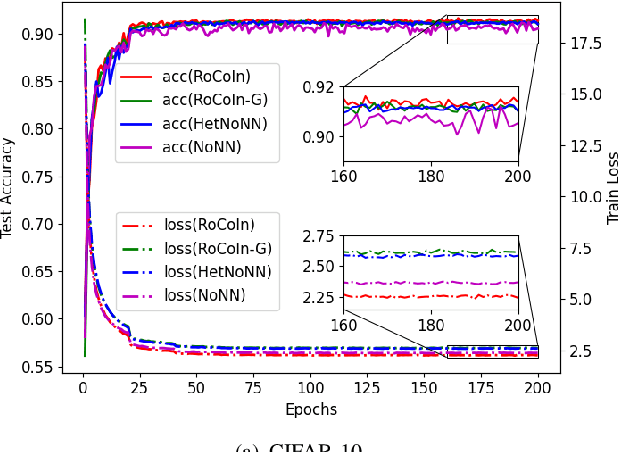
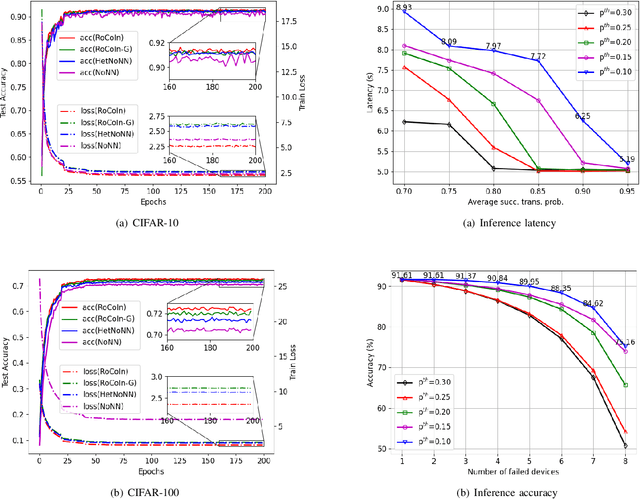
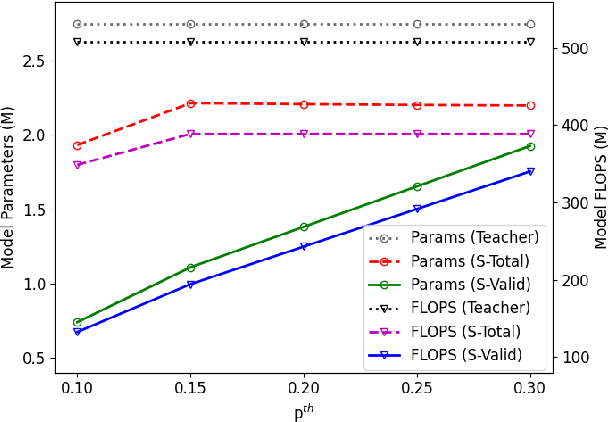
The distributed inference paradigm enables the computation workload to be distributed across multiple devices, facilitating the implementations of deep learning based intelligent services on extremely resource-constrained Internet of Things (IoT) scenarios. Yet it raises great challenges to perform complicated inference tasks relying on a cluster of IoT devices that are heterogeneous in their computing/communication capacity and prone to crash or timeout failures. In this paper, we present RoCoIn, a robust cooperative inference mechanism for locally distributed execution of deep neural network-based inference tasks over heterogeneous edge devices. It creates a set of independent and compact student models that are learned from a large model using knowledge distillation for distributed deployment. In particular, the devices are strategically grouped to redundantly deploy and execute the same student model such that the inference process is resilient to any local failures, while a joint knowledge partition and student model assignment scheme are designed to minimize the response latency of the distributed inference system in the presence of devices with diverse capacities. Extensive simulations are conducted to corroborate the superior performance of our RoCoIn for distributed inference compared to several baselines, and the results demonstrate its efficacy in timely inference and failure resiliency.
Technique Report of CVPR 2024 PBDL Challenges
Jun 15, 2024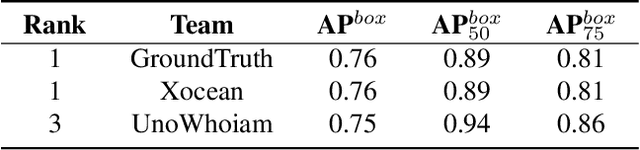
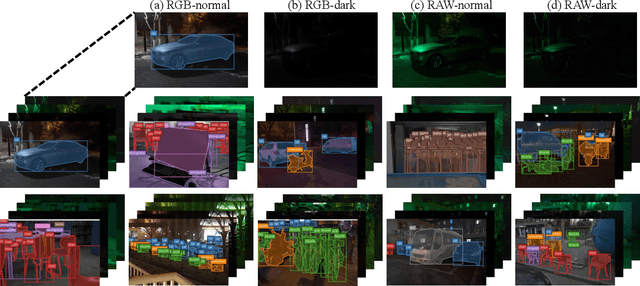
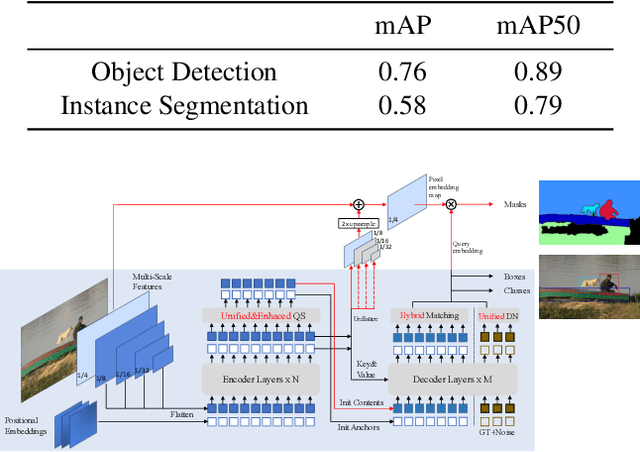

The intersection of physics-based vision and deep learning presents an exciting frontier for advancing computer vision technologies. By leveraging the principles of physics to inform and enhance deep learning models, we can develop more robust and accurate vision systems. Physics-based vision aims to invert the processes to recover scene properties such as shape, reflectance, light distribution, and medium properties from images. In recent years, deep learning has shown promising improvements for various vision tasks, and when combined with physics-based vision, these approaches can enhance the robustness and accuracy of vision systems. This technical report summarizes the outcomes of the Physics-Based Vision Meets Deep Learning (PBDL) 2024 challenge, held in CVPR 2024 workshop. The challenge consisted of eight tracks, focusing on Low-Light Enhancement and Detection as well as High Dynamic Range (HDR) Imaging. This report details the objectives, methodologies, and results of each track, highlighting the top-performing solutions and their innovative approaches.
Context-aware Difference Distilling for Multi-change Captioning
May 31, 2024Multi-change captioning aims to describe complex and coupled changes within an image pair in natural language. Compared with single-change captioning, this task requires the model to have higher-level cognition ability to reason an arbitrary number of changes. In this paper, we propose a novel context-aware difference distilling (CARD) network to capture all genuine changes for yielding sentences. Given an image pair, CARD first decouples context features that aggregate all similar/dissimilar semantics, termed common/difference context features. Then, the consistency and independence constraints are designed to guarantee the alignment/discrepancy of common/difference context features. Further, the common context features guide the model to mine locally unchanged features, which are subtracted from the pair to distill locally difference features. Next, the difference context features augment the locally difference features to ensure that all changes are distilled. In this way, we obtain an omni-representation of all changes, which is translated into linguistic sentences by a transformer decoder. Extensive experiments on three public datasets show CARD performs favourably against state-of-the-art methods.The code is available at https://github.com/tuyunbin/CARD.
Progressive Depth Decoupling and Modulating for Flexible Depth Completion
May 15, 2024Image-guided depth completion aims at generating a dense depth map from sparse LiDAR data and RGB image. Recent methods have shown promising performance by reformulating it as a classification problem with two sub-tasks: depth discretization and probability prediction. They divide the depth range into several discrete depth values as depth categories, serving as priors for scene depth distributions. However, previous depth discretization methods are easy to be impacted by depth distribution variations across different scenes, resulting in suboptimal scene depth distribution priors. To address the above problem, we propose a progressive depth decoupling and modulating network, which incrementally decouples the depth range into bins and adaptively generates multi-scale dense depth maps in multiple stages. Specifically, we first design a Bins Initializing Module (BIM) to construct the seed bins by exploring the depth distribution information within a sparse depth map, adapting variations of depth distribution. Then, we devise an incremental depth decoupling branch to progressively refine the depth distribution information from global to local. Meanwhile, an adaptive depth modulating branch is developed to progressively improve the probability representation from coarse-grained to fine-grained. And the bi-directional information interactions are proposed to strengthen the information interaction between those two branches (sub-tasks) for promoting information complementation in each branch. Further, we introduce a multi-scale supervision mechanism to learn the depth distribution information in latent features and enhance the adaptation capability across different scenes. Experimental results on public datasets demonstrate that our method outperforms the state-of-the-art methods. The code will be open-sourced at [this https URL](https://github.com/Cisse-away/PDDM).
WHALE-FL: Wireless and Heterogeneity Aware Latency Efficient Federated Learning over Mobile Devices via Adaptive Subnetwork Scheduling
May 01, 2024As a popular distributed learning paradigm, federated learning (FL) over mobile devices fosters numerous applications, while their practical deployment is hindered by participating devices' computing and communication heterogeneity. Some pioneering research efforts proposed to extract subnetworks from the global model, and assign as large a subnetwork as possible to the device for local training based on its full computing and communications capacity. Although such fixed size subnetwork assignment enables FL training over heterogeneous mobile devices, it is unaware of (i) the dynamic changes of devices' communication and computing conditions and (ii) FL training progress and its dynamic requirements of local training contributions, both of which may cause very long FL training delay. Motivated by those dynamics, in this paper, we develop a wireless and heterogeneity aware latency efficient FL (WHALE-FL) approach to accelerate FL training through adaptive subnetwork scheduling. Instead of sticking to the fixed size subnetwork, WHALE-FL introduces a novel subnetwork selection utility function to capture device and FL training dynamics, and guides the mobile device to adaptively select the subnetwork size for local training based on (a) its computing and communication capacity, (b) its dynamic computing and/or communication conditions, and (c) FL training status and its corresponding requirements for local training contributions. Our evaluation shows that, compared with peer designs, WHALE-FL effectively accelerates FL training without sacrificing learning accuracy.
Multi-Level Sequence Denoising with Cross-Signal Contrastive Learning for Sequential Recommendation
Apr 22, 2024Sequential recommender systems (SRSs) aim to suggest next item for a user based on her historical interaction sequences. Recently, many research efforts have been devoted to attenuate the influence of noisy items in sequences by either assigning them with lower attention weights or discarding them directly. The major limitation of these methods is that the former would still prone to overfit noisy items while the latter may overlook informative items. To the end, in this paper, we propose a novel model named Multi-level Sequence Denoising with Cross-signal Contrastive Learning (MSDCCL) for sequential recommendation. To be specific, we first introduce a target-aware user interest extractor to simultaneously capture users' long and short term interest with the guidance of target items. Then, we develop a multi-level sequence denoising module to alleviate the impact of noisy items by employing both soft and hard signal denoising strategies. Additionally, we extend existing curriculum learning by simulating the learning pattern of human beings. It is worth noting that our proposed model can be seamlessly integrated with a majority of existing recommendation models and significantly boost their effectiveness. Experimental studies on five public datasets are conducted and the results demonstrate that the proposed MSDCCL is superior to the state-of-the-art baselines. The source code is publicly available at https://github.com/lalunex/MSDCCL/tree/main.