 Add to Chrome
 Add to Firefox
 Add to Edge
FastDSAC: Enhancing Policy Plasticity via Constrained Exploration for Scalable Humanoid Locomotion
Jun 30, 2026
Scalable reinforcement learning has popularized high-throughput sampling architectures, which significantly compresses the training time for off-policy methods in robotic locomotion. However, the rapid increase of data volume and update frequency undermines the stability of value-based methods and diminishes the plasticity of policy networks. To address these challenges, this work presents FastDSAC, a fast and high-performance variant of the Distributional Actor-Critic algorithm designed for parallel sampling scenarios. Specifically, we introduce a truncated Gaussian distribution to approximate the learned policy, which effectively excludes out-of-distribution actions that strain target value estimation while keeping necessary stochasticity for exploration. The proposed action constraint functions as an implicit regularization, which counteracts the plasticity loss typically caused by aggressive gradient updates. This preservation of network adaptability enhances sample efficiency, particularly in scenarios with a high update-to-data ratio, and accelerates the early training process. In contrast to prior fast reinforcement learning approaches that rely on discrete value distributions, our method utilizes a continuous Gaussian representation equipped with adaptive variance regulation, which improves value estimation accuracy by sampling confident and informative transitions. Extensive experiments on MuJoCo Playground and HumanoidBench demonstrate that FastDSAC not only stabilizes the overall training process but also achieves superior asymptotic performance and faster convergence compared to state-of-the-art baselines.

FAST: A Framework for Aligned Sampling and Training in Parallel Reinforcement Learning for Autonomous Driving
Jun 19, 2026Deep reinforcement learning is pivotal for closed-loop autonomous driving yet remains constrained by severe bottlenecks in sampling efficiency. Standard parallel sampling mitigates this but suffers from the straggler effect, where the premature termination of a single environment necessitates a synchronized batch re-initialization, leading to suboptimal sample utilization and prohibitive re-initialization latency. To address this, we propose FAST, a synchronous parallel framework tailored for closed-loop simulation. Specifically, FAST employs Dynamic Parallel Sampling Alignment (DPSA) to maintain vectorization synchronization by extending terminated episodes via virtual continuation, thereby decoupling the sampling loop from individual terminations. By dynamically triggering global truncation based on the termination rate of parallel clips, FAST effectively eliminates the bottleneck of premature resets without sacrificing data diversity. Furthermore, to strictly preserve theoretical consistency, we incorporate a Scaled Mask-Padding Optimization (SMPO) that leverages validity masking and adaptive loss normalization to nullify the bias from auxiliary padding data. Empirical evaluations demonstrate that FAST achieves at least a 1.78 times wall-clock speedup over the single-clip baseline while preserving statistical unbiasedness.
Real-Time Generative Policy via Langevin-Guided Flow Matching for Autonomous Driving
Mar 03, 2026Reinforcement learning (RL) is a fundamental methodology in autonomous driving systems, where generative policies exhibit considerable potential by leveraging their ability to model complex distributions to enhance exploration. However, their inherent high inference latency severely impedes their deployment in real-time decision-making and control. To address this issue, we propose diffusion actor-critic with entropy regulator via flow matching (DACER-F) by introducing flow matching into online RL, enabling the generation of competitive actions in a single inference step. By leveraging Langevin dynamics and gradients of the Q-function, DACER-F dynamically optimizes actions from experience replay toward a target distribution that balances high Q-value information with exploratory behavior. The flow policy is then trained to efficiently learn a mapping from a simple prior distribution to this dynamic target. In complex multi-lane and intersection simulations, DACER-F outperforms baselines diffusion actor-critic with entropy regulator (DACER) and distributional soft actor-critic (DSAC), while maintaining an ultra-low inference latency. DACER-F further demonstrates its scalability on standard RL benchmark DeepMind Control Suite (DMC), achieving a score of 775.8 in the humanoid-stand task and surpassing prior methods. Collectively, these results establish DACER-F as a high-performance and computationally efficient RL algorithm.
STAPO: Stabilizing Reinforcement Learning for LLMs by Silencing Rare Spurious Tokens
Feb 17, 2026Reinforcement Learning (RL) has significantly improved large language model reasoning, but existing RL fine-tuning methods rely heavily on heuristic techniques such as entropy regularization and reweighting to maintain stability. In practice, they often experience late-stage performance collapse, leading to degraded reasoning quality and unstable training. We derive that the magnitude of token-wise policy gradients in RL is negatively correlated with token probability and local policy entropy. Building on this result, we prove that training instability is driven by a tiny fraction of tokens, approximately 0.01\%, which we term \emph{spurious tokens}. When such tokens appear in correct responses, they contribute little to the reasoning outcome but inherit the full sequence-level reward, leading to abnormally amplified gradient updates. Motivated by this observation, we propose Spurious-Token-Aware Policy Optimization (STAPO) for large-scale model refining, which selectively masks such updates and renormalizes the loss over valid tokens. Across six mathematical reasoning benchmarks using Qwen 1.7B, 8B, and 14B base models, STAPO consistently demonstrates superior entropy stability and achieves an average performance improvement of 7.13\% over GRPO, 20-Entropy and JustRL.
Mean Flow Policy with Instantaneous Velocity Constraint for One-step Action Generation
Feb 14, 2026Learning expressive and efficient policy functions is a promising direction in reinforcement learning (RL). While flow-based policies have recently proven effective in modeling complex action distributions with a fast deterministic sampling process, they still face a trade-off between expressiveness and computational burden, which is typically controlled by the number of flow steps. In this work, we propose mean velocity policy (MVP), a new generative policy function that models the mean velocity field to achieve the fastest one-step action generation. To ensure its high expressiveness, an instantaneous velocity constraint (IVC) is introduced on the mean velocity field during training. We theoretically prove that this design explicitly serves as a crucial boundary condition, thereby improving learning accuracy and enhancing policy expressiveness. Empirically, our MVP achieves state-of-the-art success rates across several challenging robotic manipulation tasks from Robomimic and OGBench. It also delivers substantial improvements in training and inference speed over existing flow-based policy baselines.
Conformal Symplectic Optimization for Stable Reinforcement Learning
Dec 03, 2024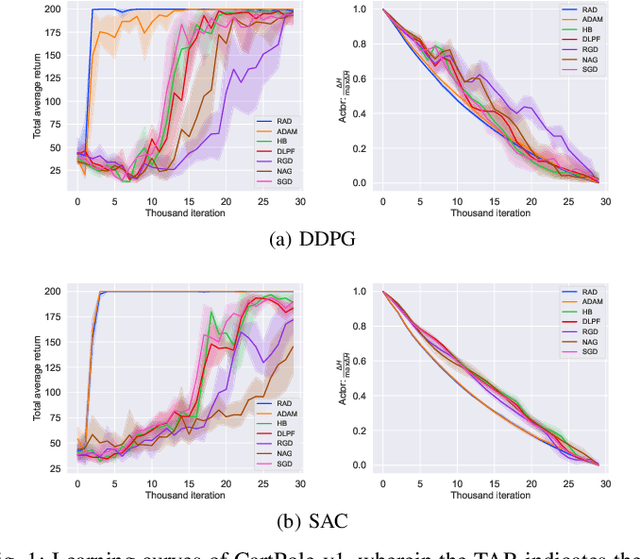
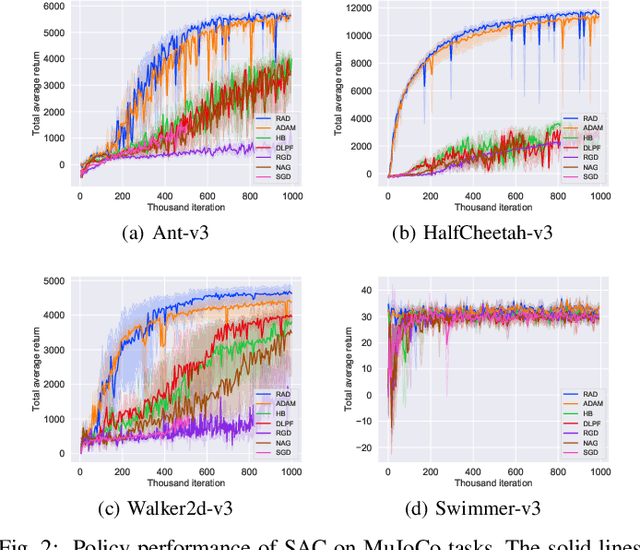


Training deep reinforcement learning (RL) agents necessitates overcoming the highly unstable nonconvex stochastic optimization inherent in the trial-and-error mechanism. To tackle this challenge, we propose a physics-inspired optimization algorithm called relativistic adaptive gradient descent (RAD), which enhances long-term training stability. By conceptualizing neural network (NN) training as the evolution of a conformal Hamiltonian system, we present a universal framework for transferring long-term stability from conformal symplectic integrators to iterative NN updating rules, where the choice of kinetic energy governs the dynamical properties of resulting optimization algorithms. By utilizing relativistic kinetic energy, RAD incorporates principles from special relativity and limits parameter updates below a finite speed, effectively mitigating abnormal gradient influences. Additionally, RAD models NN optimization as the evolution of a multi-particle system where each trainable parameter acts as an independent particle with an individual adaptive learning rate. We prove RAD's sublinear convergence under general nonconvex settings, where smaller gradient variance and larger batch sizes contribute to tighter convergence. Notably, RAD degrades to the well-known adaptive moment estimation (ADAM) algorithm when its speed coefficient is chosen as one and symplectic factor as a small positive value. Experimental results show RAD outperforming nine baseline optimizers with five RL algorithms across twelve environments, including standard benchmarks and challenging scenarios. Notably, RAD achieves up to a 155.1% performance improvement over ADAM in Atari games, showcasing its efficacy in stabilizing and accelerating RL training.