 Add to Chrome
 Add to Firefox
 Add to Edge
On the Identifiability of Controlled World Models
Jul 27, 2026
World model serves as a promising tool to infer environment dynamics under high-dimensional observations and candidate actions. Recently, LeCun's JEPA provides a compelling framework for learning such models in representation space. Its action-conditioned extension plays a central role in visual control and latent-space planning, but leaves a fundamental question: can it recover the controlled dynamics from nonlinear observations? This paper presents a joint identifiability condition for controlled world models with Gaussian latent states, which consists of two coupled components: (1) representation identifiability and (2) transition identifiability. The former depends on the spectral separation property while the latter is related to non-degenerate variation of conditional action. We prove that when this condition holds, minimizing the LeJEPA-style predictive objective can recover both latent states and controlled dynamics in the sense of orthogonal transformation. We further prove that the upper bound of transition prediction error is inversely proportional to the spectral separation margin. We also characterize an attainable amplification of counterfactual prediction error that scales inversely with the weakest conditional action-excitation margin. The theoretical predictions are empirically supported across four nonlinear observation settings.

Conformal Symplectic Optimization for Stable Reinforcement Learning
Dec 03, 2024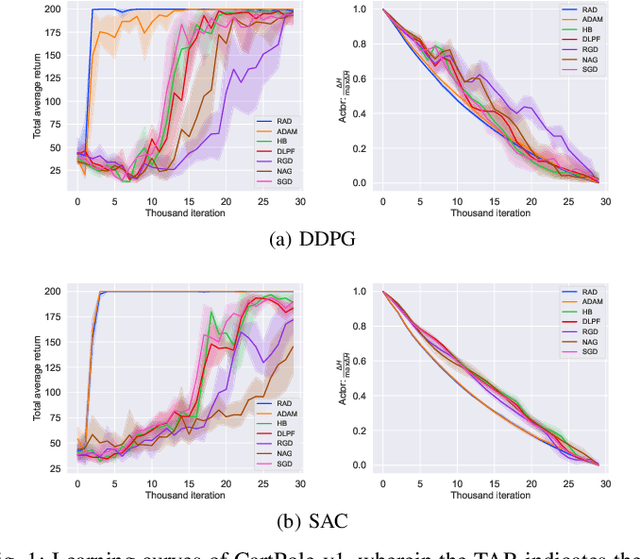
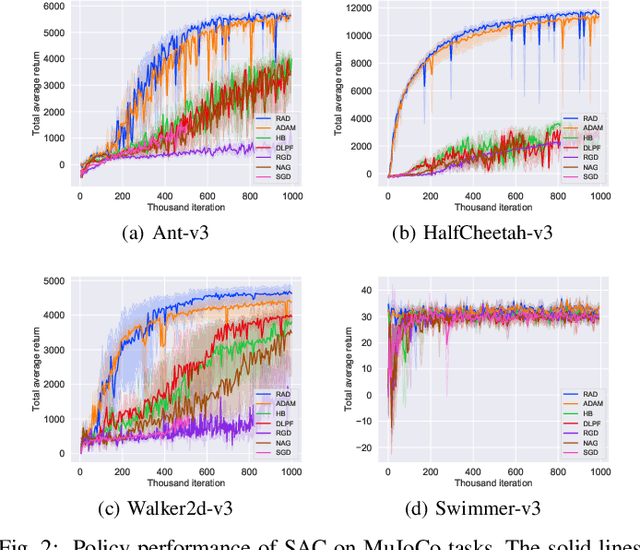


Training deep reinforcement learning (RL) agents necessitates overcoming the highly unstable nonconvex stochastic optimization inherent in the trial-and-error mechanism. To tackle this challenge, we propose a physics-inspired optimization algorithm called relativistic adaptive gradient descent (RAD), which enhances long-term training stability. By conceptualizing neural network (NN) training as the evolution of a conformal Hamiltonian system, we present a universal framework for transferring long-term stability from conformal symplectic integrators to iterative NN updating rules, where the choice of kinetic energy governs the dynamical properties of resulting optimization algorithms. By utilizing relativistic kinetic energy, RAD incorporates principles from special relativity and limits parameter updates below a finite speed, effectively mitigating abnormal gradient influences. Additionally, RAD models NN optimization as the evolution of a multi-particle system where each trainable parameter acts as an independent particle with an individual adaptive learning rate. We prove RAD's sublinear convergence under general nonconvex settings, where smaller gradient variance and larger batch sizes contribute to tighter convergence. Notably, RAD degrades to the well-known adaptive moment estimation (ADAM) algorithm when its speed coefficient is chosen as one and symplectic factor as a small positive value. Experimental results show RAD outperforming nine baseline optimizers with five RL algorithms across twelve environments, including standard benchmarks and challenging scenarios. Notably, RAD achieves up to a 155.1% performance improvement over ADAM in Atari games, showcasing its efficacy in stabilizing and accelerating RL training.
Feasible Actor-Critic: Constrained Reinforcement Learning for Ensuring Statewise Safety
May 28, 2021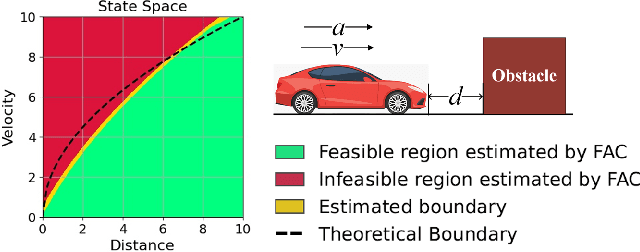

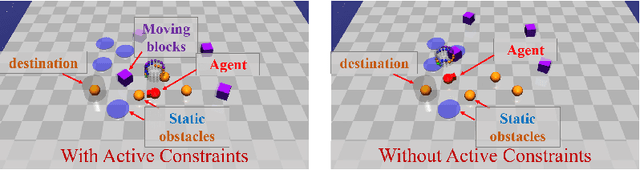
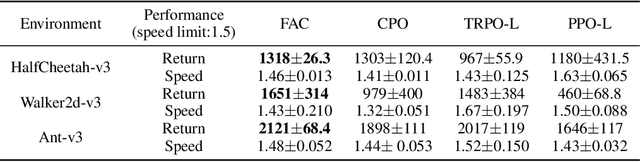
The safety constraints commonly used by existing safe reinforcement learning (RL) methods are defined only on expectation of initial states, but allow each certain state to be unsafe, which is unsatisfying for real-world safety-critical tasks. In this paper, we introduce the feasible actor-critic (FAC) algorithm, which is the first model-free constrained RL method that considers statewise safety, e.g, safety for each initial state. We claim that some states are inherently unsafe no matter what policy we choose, while for other states there exist policies ensuring safety, where we say such states and policies are feasible. By constructing a statewise Lagrange function available on RL sampling and adopting an additional neural network to approximate the statewise Lagrange multiplier, we manage to obtain the optimal feasible policy which ensures safety for each feasible state and the safest possible policy for infeasible states. Furthermore, the trained multiplier net can indicate whether a given state is feasible or not through the statewise complementary slackness condition. We provide theoretical guarantees that FAC outperforms previous expectation-based constrained RL methods in terms of both constraint satisfaction and reward optimization. Experimental results on both robot locomotive tasks and safe exploration tasks verify the safety enhancement and feasibility interpretation of the proposed method.