 Add to Chrome
 Add to Firefox
 Add to Edge
Capacity Analysis of OFDM Systems with a Swarm of Network-Controlled Repeaters
Apr 15, 2026
This paper investigates the uplink capacity of single-input single-output (SISO) systems assisted by a swarm of network-controlled repeaters (NCRs). We develop a rigorous wideband formulation based on OFDM signaling. Starting from the continuous-time passband model, we derive the capacity expression for the repeater-assisted OFDM channel, accounting for amplified noise contributions from multiple repeaters. Numerical results demonstrate that NCRs can substantially enhance system capacity even with simple activation strategies, and that activating only the closest repeater yields nearly the same performance as activating all repeaters, thereby offering significant energy-saving opportunities. These findings highlight the potential of NCR swarms as a cost-effective and scalable solution for coverage extension and capacity enhancement in wideband wireless networks.

Energy Saving for Cell-Free Massive MIMO Networks: A Multi-Agent Deep Reinforcement Learning Approach
Apr 08, 2026This paper focuses on energy savings in downlink operation of cell-free massive MIMO (CF mMIMO) networks under dynamic traffic conditions. We propose a multi-agent deep reinforcement learning (MADRL) algorithm that enables each access point (AP) to autonomously control antenna re-configuration and advanced sleep mode (ASM) selection. After the training process, the proposed framework operates in a fully distributed manner, eliminating the need for centralized control and allowing each AP to dynamically adjust to real-time traffic fluctuations. Simulation results show that the proposed algorithm reduces power consumption (PC) by 56.23% compared to systems without any energy-saving scheme and by 30.12% relative to a non-learning mechanism that only utilizes the lightest sleep mode, with only a slight increase in drop ratio. Moreover, compared to the widely used deep Q-network (DQN) algorithm, it achieves a similar PC level but with a significantly lower drop ratio.
Unlocking the Energy-Saving Potential in O-RAN Cell-Free Massive MIMO by Joint Orchestration of Radio, Wireless Fronthaul, and Cloud Resources
Apr 05, 2026Network virtualization and cloudification in Open Radio Access Networks (O-RAN) enable joint orchestration of the processing and fronthaul resources, which are essential for realizing the energy-saving potential of cell-free massive MIMO networks. To harness this potential, we investigate cell-free massive MIMO deployed over an O-RAN architecture with a wireless fronthaul that removes the need for fiber deployment. We first model the end-to-end power consumption under wireless fronthaul. Then, we propose a joint orchestration framework for radio, fronthaul, and processing resources that minimizes end-to-end power consumption while satisfying user-equipment (UE) rate requirements and wireless-fronthaul constraints. Two algorithms are developed: a scenario-sampling/group-Lasso method for centralized precoding and a block-coordinate descent method for distributed precoding. Numerical results show that centralized precoding significantly outperforms distributed precoding. End-to-end resource orchestration provides up to 70% energy-savings compared to cloud-only orchestration and up to 15% compared to radio-only orchestration. Moreover, distributing the same total number of antennas across the coverage area, rather than concentrating them at a few radio units (RUs), substantially reduces network power consumption, demonstrating that cell-free massive MIMO can deliver both high performance and high energy efficiency in future mobile networks.
NCR vs. Passive/Active RIS: How Much NCR Amplification is Required to Beat RIS?
Mar 20, 2026This paper investigates the fundamental tradeoff between reconfigurable intelligent surfaces (RISs) and network-controlled repeaters (NCRs) in terms of achievable signal-to-noise ratio (SNR). Considering an uplink system with a multi-antenna base station (BS) and a single-antenna user equipment (UE), we derive closed-form SNR expressions for passive RIS-, active RIS-, and NCR-assisted communication under line-of-sight propagation between the BS-RIS/NCR and RIS/NCR-UE. Both narrowband and wideband transmissions are analyzed, with and without the presence of a direct BS--UE link. Our analysis reveals a key structural difference: while the SNR achieved with RISs grows unboundedly with the number of RIS elements, the SNR provided by an NCR is fundamentally limited by the UE--repeater channel due to noise amplification. Nevertheless, we show that NCRs can outperform both passive and active RISs when deployed close to the UE, provided that sufficient amplification is available. Numerical results based on realistic path loss models quantify the amplification levels required for NCRs to outperform RISs across different deployment geometries and system dimensions. These findings provide clear design guidelines for the practical integration of RISs and NCRs in future wireless networks.
EARL: Energy-Aware Adaptive Antenna Control with Reinforcement Learning in O-RAN Cell-Free Massive MIMO Networks
Feb 13, 2026Cell-free massive multi-input multi-output (MIMO) promises uniform high performance across the network, but also brings a high energy cost due to joint transmission from distributed radio units (RUs) and centralized processing in the cloud. Leveraging the resource-sharing capabilities of Open Radio Access Network (O-RAN), we propose EARL, an energy-aware adaptive antenna control framework based on reinforcement learning. EARL dynamically configures antenna elements in RUs to minimize radio, optical fronthaul, and cloud processing power consumption while meeting user spectral efficiency demands. Numerical results show power savings of up to 81% and 50% over full-on and heuristic baselines, respectively. The RL-based approach operates within 220 ms, satisfying O-RAN's near-real-time limit, and a greedy refinement further halves power consumption at a 2 s runtime.
Feasibility Study Regarding Self-sustainable Reconfigurable Intelligent Surfaces
Jan 08, 2026Without requiring operational costs such as cabling and powering while maintaining reconfigurable phase-shift capability, self-sustainable reconfigurable intelligent surfaces (ssRISs) can be deployed in locations inaccessible to conventional relays or base stations, offering a novel approach to enhance wireless coverage. This study assesses the feasibility of ssRIS deployment by analyzing two harvest-and-reflect (HaR) schemes: element-splitting (ES) and time-splitting (TS). We examine how element requirements scale with key system parameters, transmit power, data rate demands, and outage constraints under both line-of-sight (LOS) and non-line-of-sight (NLOS) ssRIS-to-user equipment (UE) channels. Analytical and numerical results reveal distinct feasibility characteristics. The TS scheme demonstrates better channel hardening gain, maintaining stable element requirements across varying outage margins, making it advantageous for indoor deployments with favorable harvesting conditions and moderate data rates. However, TS exhibits an element requirement that exponentially scales to harvesting difficulty and data rate. Conversely, the ES scheme shows only linear growth with harvesting difficulty, providing better feasibility under challenging outdoor scenarios. These findings establish that TS excels in benign environments, prioritizing reliability, while ES is preferable for demanding conditions requiring operational robustness.
Green One-Bit Quantized Precoding in Cell-Free Massive MIMO
Jul 30, 2025Cell-free massive MIMO (multiple-input multiple-output) is expected to be one of the key technologies in sixth-generation (6G) and beyond wireless communications, offering enhanced spectral efficiency for cell-edge user equipments by employing joint transmission and reception with a large number of antennas distributed throughout the region. However, high-resolution RF chains associated with these antennas significantly increase power consumption. To address this issue, the use of low-resolution analog-to-digital and digital-to-analog converters (ADCs/DACs) has emerged as a promising approach to balance power efficiency and performance in massive MIMO networks. In this work, we propose a novel quantized precoding algorithm tailored for cell-free massive MIMO systems, where the proposed method dynamically deactivates unnecessary antennas based on the structure of each symbol vector, thereby enhancing energy efficiency. Simulation results demonstrate that our algorithm outperforms existing methods such as squared-infinity norm Douglas-Rachford splitting (SQUID) and regularized zero forcing (RZF), achieving superior performance while effectively reducing power consumption.
Fair and Energy-Efficient Activation Control Mechanisms for Repeater-Assisted Massive MIMO
Apr 04, 2025Massive multiple-input multiple-output (mMIMO) has been the core of 5G due to its ability to improve spectral efficiency and spatial multiplexing significantly; however, cell-edge users still experience performance degradation due to inter-cell interference and uneven signal distribution. While cell-free mMIMO (cfmMIMO) addresses this issue by providing uniform coverage through distributed antennas, it requires significantly more deployment cost due to the fronthaul and tight synchronization requirements. Alternatively, repeater-assisted massive MIMO (RA-MIMO) has recently been proposed to extend the coverage of cellular mMIMO by densely deploying low-cost single-antenna repeaters capable of amplifying and forwarding signals. In this work, we investigate amplification control for the repeaters for two different goals: (i) providing a fair performance among users, and (ii) reducing the extra energy consumption by the deployed repeaters. We propose a max-min amplification control algorithm using the convex-concave procedure for fairness and a joint sleep mode and amplification control algorithm for energy efficiency, comparing long- and short-term strategies. Numerical results show that RA-MIMO, with maximum amplification, improves signal-to-interference-plus-noise ratio (SINR) by over 20 dB compared to mMIMO and performs within 1 dB of cfmMIMO when deploying the same number of repeaters as access points in cfmMIMO. Additionally, our majority-rule-based long-term sleep mechanism reduces repeater power consumption by 70% while maintaining less than 1% spectral efficiency outage.
UAV-Based Cell-Free Massive MIMO: Joint Placement and Power Optimization under Fronthaul Capacity Limitations
Feb 07, 2025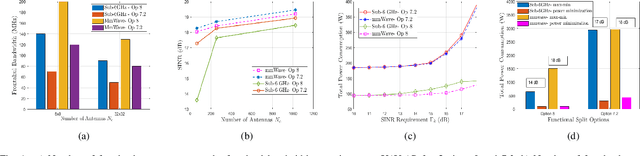
We consider a cell-free massive multiple-input multiple-output (mMIMO) network, where unmanned aerial vehicles (UAVs) equipped with multiple antennas serve as distributed UAV-access points (UAV-APs). These UAV-APs provide seamless coverage by jointly serving user equipments (UEs) with out predefined cell boundaries. However, high-capacity wireless networks face significant challenges due to fronthaul limitations in UAV-assisted architectures. This letter proposes a novel UAV-based cell-free mMIMO framework that leverages distributed UAV-APs to serve UEs while addressing the capacity constraints of wireless fronthaul links. We evaluate functional split Options 7.2 and 8 for the fronthaul links, aiming to maximize the minimum signal-to-interference-plus-noise ratio (SINR) among the UEs and minimize the power consumption by optimizing the transmit powers of UAV-APs and selectively activating them. Our analysis compares sub-6 GHz and millimeter wave (mmWave) bands for the fronthaul, showing that mmWave achieves superior SINR with lower power consumption, particularly under Option 8. Additionally, we determine the minimum fronthaul bandwidth required to activate a single UAV-AP under different split options.
Detecting Unauthorized Drones with Cell-Free Integrated Sensing and Communication
Jan 25, 2025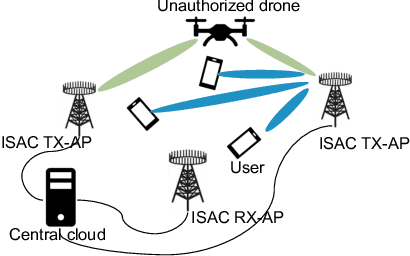
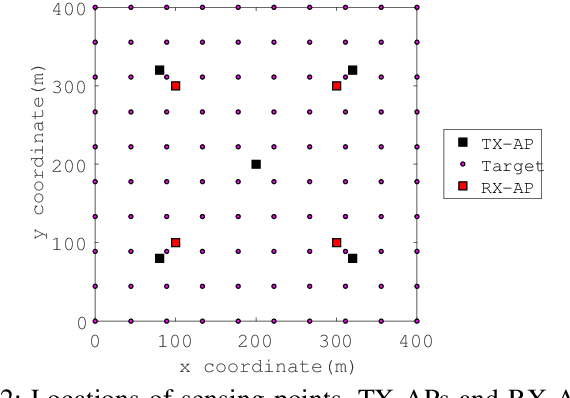
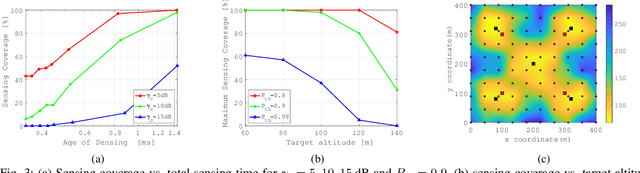
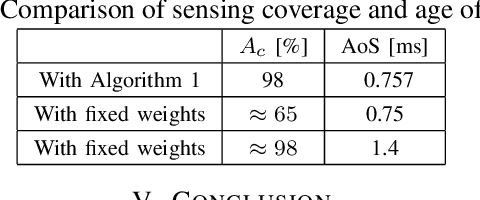
Integrated sensing and communication (ISAC) boosts network efficiency by using existing resources for diverse sensing applications. In this work, we propose a cell-free massive MIMO (multiple-input multiple-output)-ISAC framework to detect unauthorized drones while simultaneously ensuring communication requirements. We develop a detector to identify passive aerial targets by analyzing signals from distributed access points (APs). In addition to the precision of the sensing, timeliness of the sensing information is also crucial due to the risk of drones leaving the area before the sensing procedure is finished. We introduce the age of sensing (AoS) and sensing coverage as our sensing performance metrics and propose a joint sensing blocklength and power optimization algorithm to minimize AoS and maximize sensing coverage while meeting communication requirements. Moreover, we propose an adaptive weight selection algorithm based on concave-convex procedure to balance the inherent trade-off between AoS and sensing coverage. Our numerical results show that increasing the communication requirements would significantly reduce both the sensing coverage and the timeliness of the sensing. Furthermore, the proposed adaptive weight selection algorithm can provide high sensing coverage and reduce the AoS by 45% compared to the fixed weights, demonstrating efficient utilization of both power and sensing blocklength.