 Add to Chrome
 Add to Firefox
 Add to Edge
Explainable quantum-compressed machine learning for complex fluid flows
Jul 23, 2026
Machine-learning surrogates of physical systems face a paradox: explainable models facing the challenge of expressivity to capture complex nonlinear flows, whereas expressive deep surrogates match high-fidelity simulations only through massive parameterisations that turn the learned dynamics into a black box. Here, we introduce quantum-compressed machine learning (QCML), which resolves this tension by compressing the latent propagator of a flow surrogate from $524{,}288$ trainable parameters to no more than $8$. This parameter reduction brings the learned dynamical law to the parameter scale of a physical constitutive relation rather than a black-box neural network, making the surrogate directly interpretable and controllable without sacrificing expressivity. The compression is realised by a structured quantum circuit whose unitary propagator constrains the latent spectrum to the unit circle exactly and by construction, replacing exponential error growth with linear accumulation over autoregressive rollouts. Classical regularisation only approximates this constraint: even a quantum-inspired classical baseline penalised towards unitarity collapses within one Lyapunov time on turbulent channel flow, whereas QCML remains stable over the full rollout. Shared phase and coupling angles parameterising the circuit correspond directly to modal frequencies and inter-mode interactions, giving the learned dynamics a physical interpretation in spectral space. On two patient-specific cardiovascular benchmarks, the structured QCML propagator matches the predictive accuracy of its classical counterpart on surface pressure spectra, pressure drop, and wall shear stress. These results establish QCML as a working component of scientific machine learning and a concrete contribution towards practical quantum advantage in real-world prediction.

Foundations of Practical Quantum Advantage in Quantum-Informed Machine Learning for Predicting Chaos
Jun 11, 2026We develop theoretical foundations for a practical quantum-advantage mechanism in quantum-informed machine learning for chaotic dynamical systems. A family of k-indexed higher-order quantum statistical priors (Q-Priors) hosts the k-point marginal of the invariant measure on n_q = kq qubits, extending the single-site construction of prior work. We prove a two-stage advantage. In the representation stage, superposition and entanglement compactly store non-factorisable spatial correlations of the invariant measure on n_q qubits. In the extraction stage, joint Bell measurements on two copies estimate any post hoc Pauli functional with a copy-pair count independent of n_q, whereas any adaptive single-copy protocol for the corresponding full-Pauli read-out requires Omega(2^(n_q)) copies; this is a provable quantum-classical separation in copy-measurement complexity. The two-copy read-out is realised in simulation and on IQM superconducting processors. Two case studies instantiate the mechanism in workflows of independent scientific value: a turbulent channel-flow study in which the two-copy read-out yields a named non-diagonal correlator of the invariant measure (the velocity-direction coherence), and a medium-range weather forecasting workflow on the European Centre for Medium-Range Weather Forecasts ERA5 reanalysis in which the diagonal k <= 2 Q-Prior steers a Koopman rollout, improves anomaly-correlation skill by 10-39% across 48-240 h lead times, and reduces the long-horizon collapse of rollouts onto a static mean field. The two conditions of our practical-advantage definition are met at complementary levels, identifying a candidate route to practical quantum advantage before fault-tolerant hardware.
Uni-Flow: a unified autoregressive-diffusion model for complex multiscale flows
Feb 17, 2026Spatiotemporal flows govern diverse phenomena across physics, biology, and engineering, yet modelling their multiscale dynamics remains a central challenge. Despite major advances in physics-informed machine learning, existing approaches struggle to simultaneously maintain long-term temporal evolution and resolve fine-scale structure across chaotic, turbulent, and physiological regimes. Here, we introduce Uni-Flow, a unified autoregressive-diffusion framework that explicitly separates temporal evolution from spatial refinement for modelling complex dynamical systems. The autoregressive component learns low-resolution latent dynamics that preserve large-scale structure and ensure stable long-horizon rollouts, while the diffusion component reconstructs high-resolution physical fields, recovering fine-scale features in a small number of denoising steps. We validate Uni-Flow across canonical benchmarks, including two-dimensional Kolmogorov flow, three-dimensional turbulent channel inflow generation with a quantum-informed autoregressive prior, and patient-specific simulations of aortic coarctation derived from high-fidelity lattice Boltzmann hemodynamic solvers. In the cardiovascular setting, Uni-Flow enables task-level faster than real-time inference of pulsatile hemodynamics, reconstructing high-resolution pressure fields over physiologically relevant time horizons in seconds rather than hours. By transforming high-fidelity hemodynamic simulation from an offline, HPC-bound process into a deployable surrogate, Uni-Flow establishes a pathway to faster-than-real-time modelling of complex multiscale flows, with broad implications for scientific machine learning in flow physics.
A Parameter-Efficient Quantum Anomaly Detection Method on a Superconducting Quantum Processor
Dec 22, 2024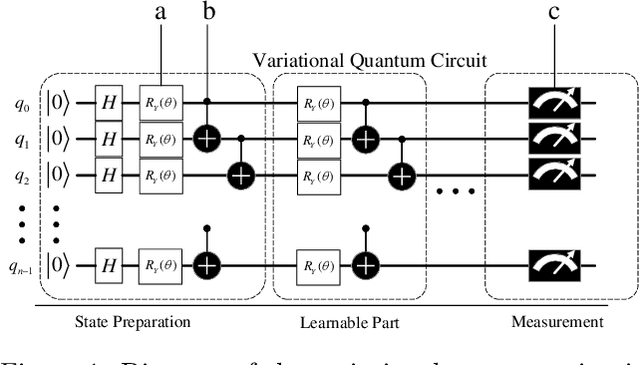
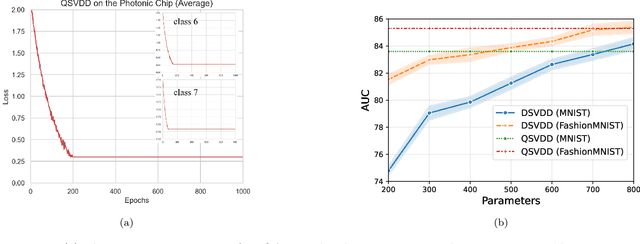
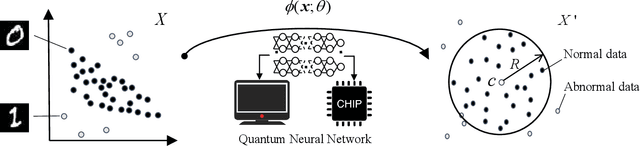
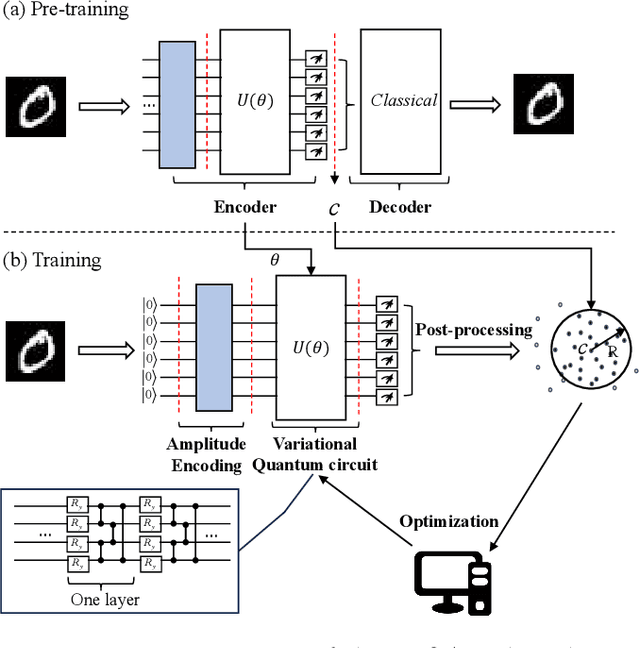
Quantum machine learning has gained attention for its potential to address computational challenges. However, whether those algorithms can effectively solve practical problems and outperform their classical counterparts, especially on current quantum hardware, remains a critical question. In this work, we propose a novel quantum machine learning method, called Quantum Support Vector Data Description (QSVDD), for practical anomaly detection, which aims to achieve both parameter efficiency and superior accuracy compared to classical models. Emulation results indicate that QSVDD demonstrates favourable recognition capabilities compared to classical baselines, achieving an average accuracy of over 90% on benchmarks with significantly fewer trainable parameters. Theoretical analysis confirms that QSVDD has a comparable expressivity to classical counterparts while requiring only a fraction of the parameters. Furthermore, we demonstrate the first implementation of a quantum machine learning method for anomaly detection on a superconducting quantum processor. Specifically, we achieve an accuracy of over 80% with only 16 parameters on the device, providing initial evidence of QSVDD's practical viability in the noisy intermediate-scale quantum era and highlighting its significant reduction in parameter requirements.