 Add to Chrome
 Add to Firefox
 Add to Edge
Clinically Interpretable Sepsis Early Warning via LLM-Guided Simulation of Temporal Physiological Dynamics
Apr 22, 2026
Timely and interpretable early warning of sepsis remains a major clinical challenge due to the complex temporal dynamics of physiological deterioration. Traditional data-driven models often provide accurate yet opaque predictions, limiting physicians' confidence and clinical applicability. To address this limitation, we propose a Large Language Model (LLM)-guided temporal simulation framework that explicitly models physiological trajectories prior to disease onset for clinically interpretable prediction. The framework consists of a spatiotemporal feature extraction module that captures dynamic dependencies among multivariate vital signs, a Medical Prompt-as-Prefix module that embeds clinical reasoning cues into LLMs, and an agent-based post-processing component that constrains predictions within physiologically plausible ranges. By first simulating the evolution of key physiological indicators and then classifying sepsis onset, our model offers transparent prediction mechanisms that align with clinical judgment. Evaluated on the MIMIC-IV and eICU databases, the proposed method achieves superior AUC scores (0.861-0.903) across 24-4-hour pre-onset prediction tasks, outperforming conventional deep learning and rule-based approaches. More importantly, it provides interpretable trajectories and risk trends that can assist clinicians in early intervention and personalized decision-making in intensive care environments.

Towards LLM-Empowered Knowledge Tracing via LLM-Student Hierarchical Behavior Alignment in Hyperbolic Space
Feb 26, 2026Knowledge Tracing (KT) diagnoses students' concept mastery through continuous learning state monitoring in education.Existing methods primarily focus on studying behavioral sequences based on ID or textual information.While existing methods rely on ID-based sequences or shallow textual features, they often fail to capture (1) the hierarchical evolution of cognitive states and (2) individualized problem difficulty perception due to limited semantic modeling. Therefore, this paper proposes a Large Language Model Hyperbolic Aligned Knowledge Tracing(L-HAKT). First, the teacher agent deeply parses question semantics and explicitly constructs hierarchical dependencies of knowledge points; the student agent simulates learning behaviors to generate synthetic data. Then, contrastive learning is performed between synthetic and real data in hyperbolic space to reduce distribution differences in key features such as question difficulty and forgetting patterns. Finally, by optimizing hyperbolic curvature, we explicitly model the tree-like hierarchical structure of knowledge points, precisely characterizing differences in learning curve morphology for knowledge points at different levels. Extensive experiments on four real-world educational datasets validate the effectiveness of our Large Language Model Hyperbolic Aligned Knowledge Tracing (L-HAKT) framework.
Implicit Federated In-context Learning For Task-Specific LLM Fine-Tuning
Nov 10, 2025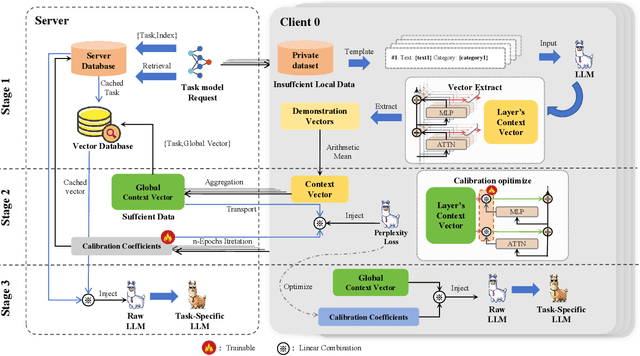

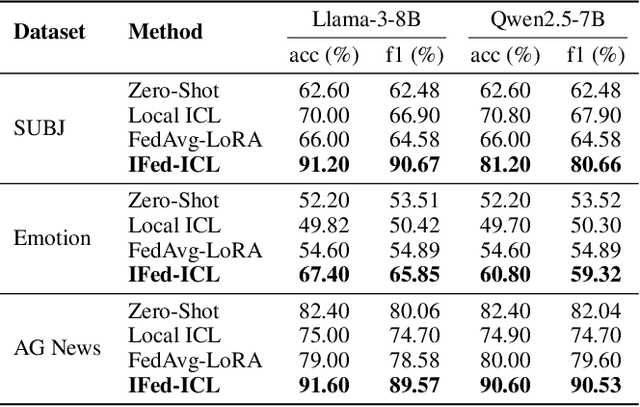
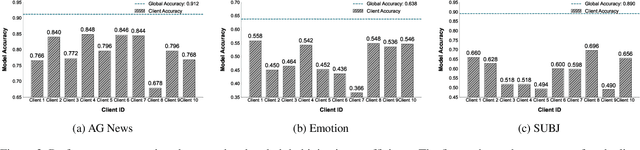
As large language models continue to develop and expand, the extensive public data they rely on faces the risk of depletion. Consequently, leveraging private data within organizations to enhance the performance of large models has emerged as a key challenge. The federated learning paradigm, combined with model fine-tuning techniques, effectively reduces the number of trainable parameters. However,the necessity to process high-dimensional feature spaces results in substantial overall computational overhead. To address this issue, we propose the Implicit Federated In-Context Learning (IFed-ICL) framework. IFed-ICL draws inspiration from federated learning to establish a novel distributed collaborative paradigm, by converting client local context examples into implicit vector representations, it enables distributed collaborative computation during the inference phase and injects model residual streams to enhance model performance. Experiments demonstrate that our proposed method achieves outstanding performance across multiple text classification tasks. Compared to traditional methods, IFed-ICL avoids the extensive parameter updates required by conventional fine-tuning methods while reducing data transmission and local computation at the client level in federated learning. This enables efficient distributed context learning using local private-domain data, significantly improving model performance on specific tasks.