 Add to Chrome
 Add to Firefox
 Add to Edge
IMPose: Interactive Multi-person Pose Estimation with Dynamic Correction Propagation
Jun 03, 2026
High-quality dynamic human pose annotation equips AI with precise motion kinematics to enable human behavior mastery, yet remains labor-intensive and time-consuming. Current annotation tools either lack temporal correction propagation or fail in multi-person scenarios, necessitating excessive manual intervention. In this paper, we introduce IMPose, an interactive tool for multi-person dynamic pose annotation. It features a dual-level tracking mechanism that propagates one-frame multi-person pose corrections from annotators across entire videos. The keypoint-level ensures corrections temporal propagation via sequential modeling, while the instance-level employs keypoint-aware embedding with relative positional encoding to maintain multi-person cross-frame consistency. To further improve robustness, IMPose maintains historical pose and instance cues in a trajectory bank, which enhances long-range temporal association and stabilizes annotation in challenging cases such as occlusion and motion blur. By converting sparse human corrections into dense and coherent pose trajectories, our framework significantly reduces repeated manual refinement across frames. Extensive experiments show that IMPose consistently achieves a strong accuracy efficiency trade off under different interaction budgets, demonstrating particular advantages in low click annotation settings. IMPose achieves high precision annotation with high efficiency, requiring only 27 clicks per 1,050 frame video on 3DPW and 3 clicks per tracklet per 84-frame on PoseTrack21. We further expand PoseTrack21 with 188K pose instances (3.55M keypoints) at a minimal cost of 10 annotators in 10 hours. The annotation tool, codes, and extended dataset will be open-sourced.

Clinically Interpretable Sepsis Early Warning via LLM-Guided Simulation of Temporal Physiological Dynamics
Apr 22, 2026Timely and interpretable early warning of sepsis remains a major clinical challenge due to the complex temporal dynamics of physiological deterioration. Traditional data-driven models often provide accurate yet opaque predictions, limiting physicians' confidence and clinical applicability. To address this limitation, we propose a Large Language Model (LLM)-guided temporal simulation framework that explicitly models physiological trajectories prior to disease onset for clinically interpretable prediction. The framework consists of a spatiotemporal feature extraction module that captures dynamic dependencies among multivariate vital signs, a Medical Prompt-as-Prefix module that embeds clinical reasoning cues into LLMs, and an agent-based post-processing component that constrains predictions within physiologically plausible ranges. By first simulating the evolution of key physiological indicators and then classifying sepsis onset, our model offers transparent prediction mechanisms that align with clinical judgment. Evaluated on the MIMIC-IV and eICU databases, the proposed method achieves superior AUC scores (0.861-0.903) across 24-4-hour pre-onset prediction tasks, outperforming conventional deep learning and rule-based approaches. More importantly, it provides interpretable trajectories and risk trends that can assist clinicians in early intervention and personalized decision-making in intensive care environments.
A Study on Decoupled Probabilistic Linear Discriminant Analysis
Nov 24, 2021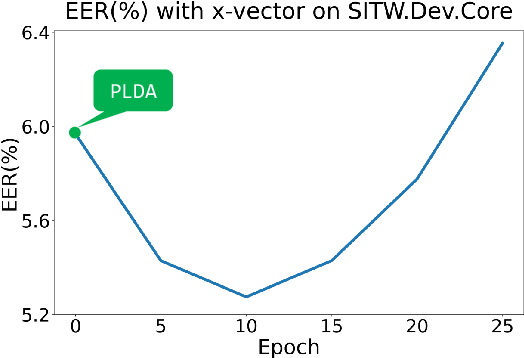
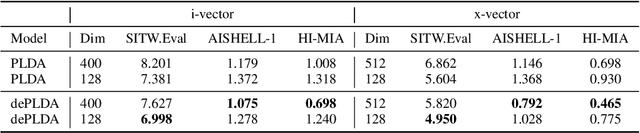
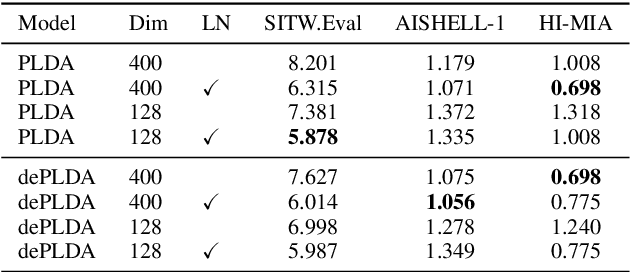
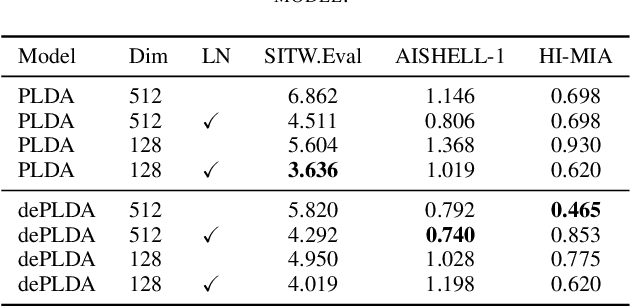
Probabilistic linear discriminant analysis (PLDA) has broad application in open-set verification tasks, such as speaker verification. A key concern for PLDA is that the model is too simple (linear Gaussian) to deal with complicated data; however, the simplicity by itself is a major advantage of PLDA, as it leads to desirable generalization. An interesting research therefore is how to improve modeling capacity of PLDA while retaining the simplicity. This paper presents a decoupling approach, which involves a global model that is simple and generalizable, and a local model that is complex and expressive. While the global model holds a bird view on the entire data, the local model represents the details of individual classes. We conduct a preliminary study towards this direction and investigate a simple decoupling model including both the global and local models. The new model, which we call decoupled PLDA, is tested on a speaker verification task. Experimental results show that it consistently outperforms the vanilla PLDA when the model is based on raw speaker vectors. However, when the speaker vectors are processed by length normalization, the advantage of decoupled PLDA will be largely lost, suggesting future research on non-linear local models.