 Add to Chrome
 Add to Firefox
 Add to Edge
Faster IndexTTS-2: Accelerating and Streaming Autoregressive Zero-Shot Text-to-Speech Synthesis on GPUs
Jul 23, 2026
Autoregressive text-to-speech models achieve strong naturalness but suffer from slow inference due to sequential token generation, limiting their deployment in production applications that require low latency. IndexTTS-2 is a state-of-the-art autoregressive TTS model consisting of a GPT, a flow-matching Diffusion Transformer, and a vocoder. Despite its high synthesis quality, its inference speed barely reaches real-time without streaming or batching support. We present Faster IndexTTS-2, which accelerates all neural network components of IndexTTS-2 for production deployment on GPUs using NVIDIA TensorRT and TensorRT-LLM. Faster IndexTTS-2 also enables streaming synthesis for latency-sensitive interactive applications, and batched inference across all components to maximize GPU utilization. Experiments on the Seed-TTS benchmark for both English and Chinese demonstrate up to 5.0$\times$ speedup on the autoregressive GPT and 3.6$\times$ end-to-end, with minimal degradation in word error rate, speaker similarity, and naturalness. Our methodology provides a practical reference for efficiently accelerating similar autoregressive speech models on GPUs.

Streaming T5-based Text-to-Speech Synthesis with Limited Lookahead
Jun 20, 2026Streaming text-to-speech synthesis in cascaded LLM-TTS systems still faces latency challenges as most TTS models require full context before initiating generation. We present S5-TTS, a streaming variant of T5-TTS that enables low-latency, word-by-word incremental speech synthesis through encoder-decoder language modeling and monotonic alignment learning. S5-TTS begins generating speech immediately after receiving the first few words, substantially reducing end-to-end response latency. To maintain quality under limited lookahead, we introduce a lookahead-causal masking mechanism with Conv-based auxiliary attention that preserves intelligibility and speaker similarity, and employ interleaved multi-source distillation to further restore naturalness. Experiments show that S5-TTS achieves comparable quality to full-context T5-TTS, supports zero-shot synthesis with high speaker similarity, and significantly reduces end-to-end latency for practical conversational AI systems.
GPU-Parallel Multi-Task Reinforcement Learning with Demonstration Guided Policy Optimization
Jun 02, 2026Large scale GPU-parallel reinforcement learning has changed what can be trained in robot simulation, yet most systems still optimize one specialist policy per task. We propose a construction methodology for turning structured manipulation task families into GPU-parallel multi-task RL benchmarks, and instantiate it as MT-Libero using LIBERO assets and task predicates in Isaac Lab. The resulting benchmark supports simultaneous reinforcement learning over heterogeneous task suites with parallel rendering, physics randomization, and state-input or visual-input policies. To make such training practical under sparse success signals and limited prior data, we further propose DGPO, an on-policy demonstration guided method that combines importance weighted PPO with adaptive behavior cloning on matched demonstration actions. DGPO enables a tunable preference toward demonstrated task distributions, outperforming both prior-free RL and existing demonstration-based methods while preserving the stability and online improvement benefits of on-policy PPO.
Tabero: Learning Gentle Manipulation with Closed-Loop Force Feedback from Vision, Touch, and Language
May 27, 2026Tactile sensing is essential for robots to achieve human-like gentle manipulation. However, existing Vision-Language-Action (VLA) models struggle to exploit tactile feedback for gentle manipulation due to scarce aligned vision-tactile-language data and the lack of effective closed-loop force feedback mechanisms. To address these challenges, we introduce Tabero, a benchmark and model suite for gentle, language-conditioned robotic manipulation that demands fine-grained contact force perception. First, the Tabero benchmark addresses the scarcity of tactile data by presenting a data-efficient pipeline that repurposes open-source robot manipulation trajectories to generate diverse vision-tactile-language tasks, and establishes a multidimensional evaluation protocol that measures task success alongside physical interaction quality. Second, we propose Tabero-VTLA, an architecture with a decoupled force-position command interface; the resulting force-position commands are executed by a fixed hybrid controller to enable real-time, force-aware manipulation. Evaluated on Tabero, our model maintains high task success while reducing average grip force by over 70\% under gentle instructions, demonstrating its ability to modulate interaction forces based on multimodal experience. Our code is publicly available at https://github.com/NathanWu7/Tabero.
LiDAR-EVS: Enhance Extrapolated View Synthesis for 3D Gaussian Splatting with Pseudo-LiDAR Supervision
Mar 16, 20263D Gaussian Splatting (3DGS) has emerged as a powerful technique for real-time LiDAR and camera synthesis in autonomous driving simulation. However, simulating LiDAR with 3DGS remains challenging for extrapolated views beyond the training trajectory, as existing methods are typically trained on single-traversal sensor scans, suffer from severe overfitting and poor generalization to novel ego-vehicle paths. To enable reliable simulation of LiDAR along unseen driving trajectories without external multi-pass data, we present LiDAR-EVS, a lightweight framework for robust extrapolated-view LiDAR simulation in autonomous driving. Designed to be plug-and-play, LiDAR-EVS readily extends to diverse LiDAR sensors and neural rendering baselines with minimal modification. Our framework comprises two key components: (1) pseudo extrapolated-view point cloud supervision with multi-frame LiDAR fusion, view transformation, occlusion curling, and intensity adjustment; (2) spatially-constrained dropout regularization that promotes robustness to diverse trajectory variations encountered in real-world driving. Extensive experiments demonstrate that LiDAR-EVS achieves SOTA performance on extrapolated-view LiDAR synthesis across three datasets, making it a promising tool for data-driven simulation, closed-loop evaluation, and synthetic data generation in autonomous driving systems.
FP8-RL: A Practical and Stable Low-Precision Stack for LLM Reinforcement Learning
Jan 26, 2026Reinforcement learning (RL) for large language models (LLMs) is increasingly bottlenecked by rollout (generation), where long output sequence lengths make attention and KV-cache memory dominate end-to-end step time. FP8 offers an attractive lever for accelerating RL by reducing compute cost and memory traffic during rollout, but applying FP8 in RL introduces unique engineering and algorithmic challenges: policy weights change every step (requiring repeated quantization and weight synchronization into the inference engine) and low-precision rollouts can deviate from the higher-precision policy assumed by the trainer, causing train-inference mismatch and potential instability. This report presents a practical FP8 rollout stack for LLM RL, implemented in the veRL ecosystem with support for common training backends (e.g., FSDP/Megatron-LM) and inference engines (e.g., vLLM/SGLang). We (i) enable FP8 W8A8 linear-layer rollout using blockwise FP8 quantization, (ii) extend FP8 to KV-cache to remove long-context memory bottlenecks via per-step QKV scale recalibration, and (iii) mitigate mismatch using importance-sampling-based rollout correction (token-level TIS/MIS variants). Across dense and MoE models, these techniques deliver up to 44% rollout throughput gains while preserving learning behavior comparable to BF16 baselines.
AIConfigurator: Lightning-Fast Configuration Optimization for Multi-Framework LLM Serving
Jan 09, 2026Optimizing Large Language Model (LLM) inference in production systems is increasingly difficult due to dynamic workloads, stringent latency/throughput targets, and a rapidly expanding configuration space. This complexity spans not only distributed parallelism strategies (tensor/pipeline/expert) but also intricate framework-specific runtime parameters such as those concerning the enablement of CUDA graphs, available KV-cache memory fractions, and maximum token capacity, which drastically impact performance. The diversity of modern inference frameworks (e.g., TRT-LLM, vLLM, SGLang), each employing distinct kernels and execution policies, makes manual tuning both framework-specific and computationally prohibitive. We present AIConfigurator, a unified performance-modeling system that enables rapid, framework-agnostic inference configuration search without requiring GPU-based profiling. AIConfigurator combines (1) a methodology that decomposes inference into analytically modelable primitives - GEMM, attention, communication, and memory operations while capturing framework-specific scheduling dynamics; (2) a calibrated kernel-level performance database for these primitives across a wide range of hardware platforms and popular open-weights models (GPT-OSS, Qwen, DeepSeek, LLama, Mistral); and (3) an abstraction layer that automatically resolves optimal launch parameters for the target backend, seamlessly integrating into production-grade orchestration systems. Evaluation on production LLM serving workloads demonstrates that AIConfigurator identifies superior serving configurations that improve performance by up to 40% for dense models (e.g., Qwen3-32B) and 50% for MoE architectures (e.g., DeepSeek-V3), while completing searches within 30 seconds on average. Enabling the rapid exploration of vast design spaces - from cluster topology down to engine specific flags.
Semi-supervised Learning for Code-Switching ASR with Large Language Model Filter
Jul 05, 2024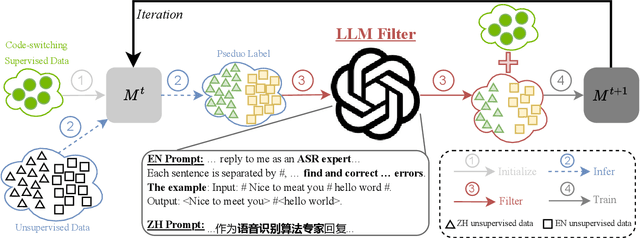
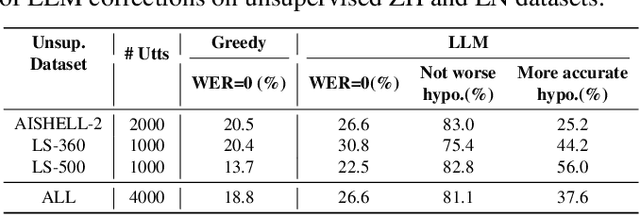
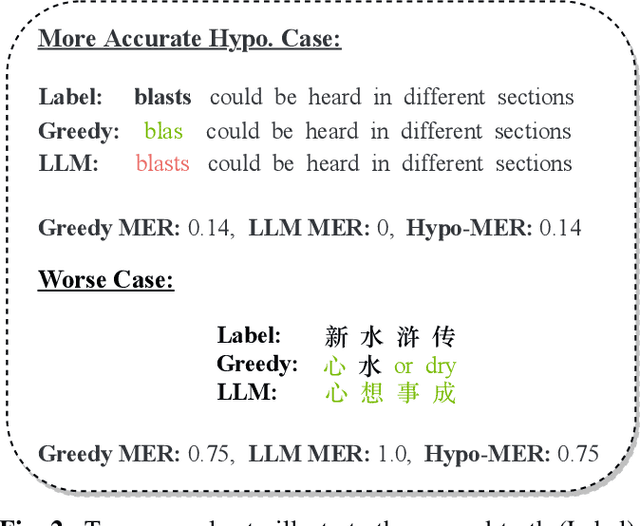
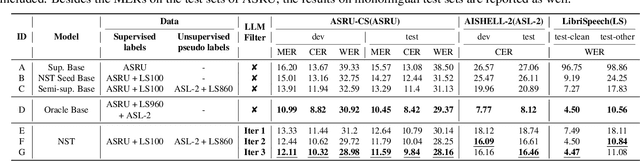
Code-switching (CS) phenomenon occurs when words or phrases from different languages are alternated in a single sentence. Due to data scarcity, building an effective CS Automatic Speech Recognition (ASR) system remains challenging. In this paper, we propose to enhance CS-ASR systems by utilizing rich unsupervised monolingual speech data within a semi-supervised learning framework, particularly when access to CS data is limited. To achieve this, we establish a general paradigm for applying noisy student training (NST) to the CS-ASR task. Specifically, we introduce the LLM-Filter, which leverages well-designed prompt templates to activate the correction capability of large language models (LLMs) for monolingual data selection and pseudo-labels refinement during NST. Our experiments on the supervised ASRU-CS and unsupervised AISHELL-2 and LibriSpeech datasets show that our method not only achieves significant improvements over supervised and semi-supervised learning baselines for the CS task, but also attains better performance compared with the fully-supervised oracle upper-bound on the CS English part. Additionally, we further investigate the influence of accent on AESRC dataset and demonstrate that our method can get achieve additional benefits when the monolingual data contains relevant linguistic characteristic.
Romanization Encoding For Multilingual ASR
Jul 05, 2024


We introduce romanization encoding for script-heavy languages to optimize multilingual and code-switching Automatic Speech Recognition (ASR) systems. By adopting romanization encoding alongside a balanced concatenated tokenizer within a FastConformer-RNNT framework equipped with a Roman2Char module, we significantly reduce vocabulary and output dimensions, enabling larger training batches and reduced memory consumption. Our method decouples acoustic modeling and language modeling, enhancing the flexibility and adaptability of the system. In our study, applying this method to Mandarin-English ASR resulted in a remarkable 63.51% vocabulary reduction and notable performance gains of 13.72% and 15.03% on SEAME code-switching benchmarks. Ablation studies on Mandarin-Korean and Mandarin-Japanese highlight our method's strong capability to address the complexities of other script-heavy languages, paving the way for more versatile and effective multilingual ASR systems.
Incremental FastPitch: Chunk-based High Quality Text to Speech
Jan 03, 2024Parallel text-to-speech models have been widely applied for real-time speech synthesis, and they offer more controllability and a much faster synthesis process compared with conventional auto-regressive models. Although parallel models have benefits in many aspects, they become naturally unfit for incremental synthesis due to their fully parallel architecture such as transformer. In this work, we propose Incremental FastPitch, a novel FastPitch variant capable of incrementally producing high-quality Mel chunks by improving the architecture with chunk-based FFT blocks, training with receptive-field constrained chunk attention masks, and inference with fixed size past model states. Experimental results show that our proposal can produce speech quality comparable to the parallel FastPitch, with a significant lower latency that allows even lower response time for real-time speech applications.