 Add to Chrome
 Add to Firefox
 Add to Edge
Tabero: Learning Gentle Manipulation with Closed-Loop Force Feedback from Vision, Touch, and Language
May 27, 2026
Tactile sensing is essential for robots to achieve human-like gentle manipulation. However, existing Vision-Language-Action (VLA) models struggle to exploit tactile feedback for gentle manipulation due to scarce aligned vision-tactile-language data and the lack of effective closed-loop force feedback mechanisms. To address these challenges, we introduce Tabero, a benchmark and model suite for gentle, language-conditioned robotic manipulation that demands fine-grained contact force perception. First, the Tabero benchmark addresses the scarcity of tactile data by presenting a data-efficient pipeline that repurposes open-source robot manipulation trajectories to generate diverse vision-tactile-language tasks, and establishes a multidimensional evaluation protocol that measures task success alongside physical interaction quality. Second, we propose Tabero-VTLA, an architecture with a decoupled force-position command interface; the resulting force-position commands are executed by a fixed hybrid controller to enable real-time, force-aware manipulation. Evaluated on Tabero, our model maintains high task success while reducing average grip force by over 70\% under gentle instructions, demonstrating its ability to modulate interaction forces based on multimodal experience. Our code is publicly available at https://github.com/NathanWu7/Tabero.

Quantifying Cyber-Vulnerability in Power Electronics Systems via an Impedance-Based Attack Reachable Domain
May 14, 2026Power electronics systems are increasingly exposed to cyber threats due to their integration with digital controllers and communication networks. However, an attacker-oriented metric is still lacking to quantify the extent to which a node can be pushed toward instability within a privilege-constrained action space. This letter proposes an impedance-based Attack Reachable Domain (ARD) framework that maps feasible adversarial actions to critical-eigenvalue migration through impedance reshaping. Based on the ARD, an Attack Penetration Index is defined to quantify node-level cyber-vulnerability by jointly characterizing the penetration of the nominal stability margin and the accessibility of successful destabilizing attacks within a privilege-constrained action space. To make the proposed assessment computable when inverter models are unavailable, a practical gray-box workflow is further established by integrating existing impedance identification and differentiable surrogate tools. Case studies on a 4-bus system and a modified IEEE 39-bus system show that coordinated cross-layer manipulations are markedly more damaging than isolated single-layer attacks, and that the proposed metric reveals vulnerability patterns that cannot be inferred from grid-strength indicators.
OpenAI GPT-5 System Card
Dec 19, 2025This is the system card published alongside the OpenAI GPT-5 launch, August 2025. GPT-5 is a unified system with a smart and fast model that answers most questions, a deeper reasoning model for harder problems, and a real-time router that quickly decides which model to use based on conversation type, complexity, tool needs, and explicit intent (for example, if you say 'think hard about this' in the prompt). The router is continuously trained on real signals, including when users switch models, preference rates for responses, and measured correctness, improving over time. Once usage limits are reached, a mini version of each model handles remaining queries. This system card focuses primarily on gpt-5-thinking and gpt-5-main, while evaluations for other models are available in the appendix. The GPT-5 system not only outperforms previous models on benchmarks and answers questions more quickly, but -- more importantly -- is more useful for real-world queries. We've made significant advances in reducing hallucinations, improving instruction following, and minimizing sycophancy, and have leveled up GPT-5's performance in three of ChatGPT's most common uses: writing, coding, and health. All of the GPT-5 models additionally feature safe-completions, our latest approach to safety training to prevent disallowed content. Similarly to ChatGPT agent, we have decided to treat gpt-5-thinking as High capability in the Biological and Chemical domain under our Preparedness Framework, activating the associated safeguards. While we do not have definitive evidence that this model could meaningfully help a novice to create severe biological harm -- our defined threshold for High capability -- we have chosen to take a precautionary approach.
EEG-Driven 3D Object Reconstruction with Color Consistency and Diffusion Prior
Oct 29, 2024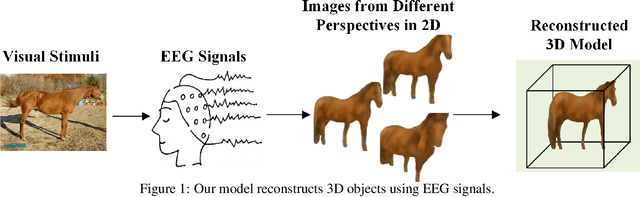
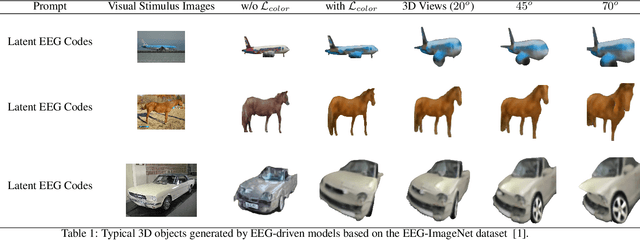
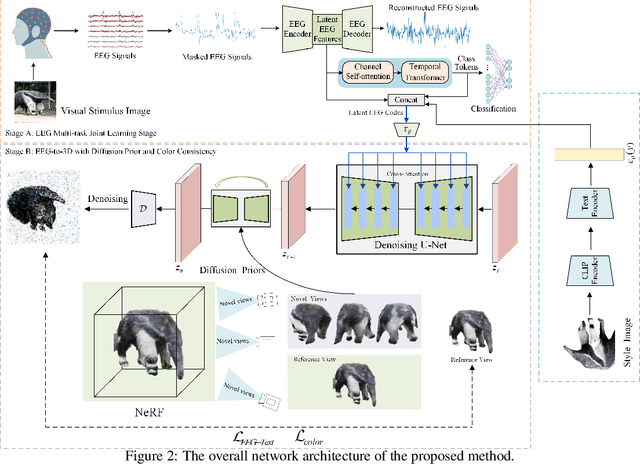
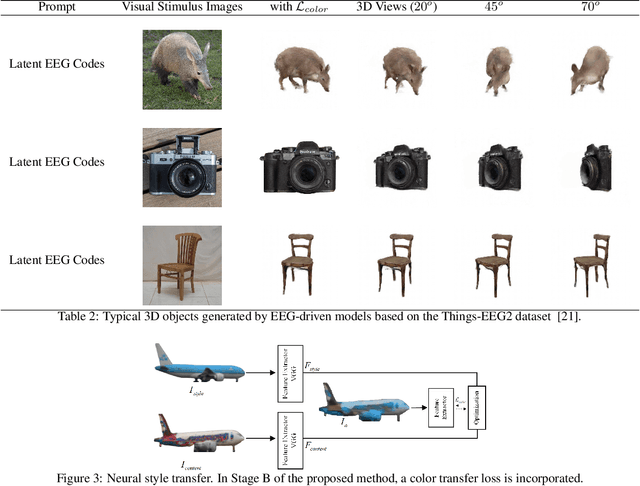
EEG-based visual perception reconstruction has become a current research hotspot. Neuroscientific studies have shown that humans can perceive various types of visual information, such as color, shape, and texture, when observing objects. However, existing technical methods often face issues such as inconsistencies in texture, shape, and color between the visual stimulus images and the reconstructed images. In this paper, we propose a method for reconstructing 3D objects with color consistency based on EEG signals. The method adopts a two-stage strategy: in the first stage, we train an implicit neural EEG encoder with the capability of perceiving 3D objects, enabling it to capture regional semantic features; in the second stage, based on the latent EEG codes obtained in the first stage, we integrate a diffusion model, neural style loss, and NeRF to implicitly decode the 3D objects. Finally, through experimental validation, we demonstrate that our method can reconstruct 3D objects with color consistency using EEG.