 Add to Chrome
 Add to Firefox
 Add to Edge
Resolving Action Bottleneck: Agentic Reinforcement Learning Informed by Token-Level Energy
May 14, 2026
Agentic reinforcement learning trains large language models using multi-turn trajectories that interleave long reasoning traces with short environment-facing actions. Common policy-gradient methods, such as PPO and GRPO, treat each token in a trajectory equally, leading to uniform credit assignment. In this paper, we critically demonstrate that such uniform credit assignment largely misallocates token-level training signals. From an energy-based modeling perspective, we show that token-level training signals, quantified by their correlations with reward variance of different rollouts sampled from a given prompt, concentrate sharply on action tokens rather than reasoning tokens, even though action tokens account for only a small fraction of the trajectory. We refer to this phenomenon as the Action Bottleneck. Motivated by this observation, we propose an embarrassingly simple token reweighting approach, ActFocus, that downweights gradients on reasoning tokens, along with an additional energy-based redistribution mechanism that further increases the weights on action tokens with higher uncertainty. Across four environments and different model sizes, ActFocus consistently outperforms PPO and GRPO, yielding final-step gains of up to 65.2 and 63.7 percentage points, respectively, without any additional runtime or memory cost.

3DReflecNet: A Large-Scale Dataset for 3D Reconstruction of Reflective, Transparent, and Low-Texture Objects
May 11, 2026Accurate 3D reconstruction of objects with reflective, transparent, or low-texture surfaces still remains notoriously challenging. Such materials often violate key assumptions in multi-view reconstruction pipelines, such as photometric consistency and the availability on distinct geometric texture cues. Existing datasets primarily focus on diffuse, textured objects, and therefore provide limited insight into performance under real-world material complexities. We introduce 3DReflecNet, a large-scale hybrid dataset exceeding 22 TB that is specifically designed to benchmark and advance 3D vision methods for these challenging materials. 3DReflecNet combines two types of data: over 120,000 synthetic instances generated via physically-based rendering of more than 12,000 shapes, and over 1,000 real-world objects captured using consumer devices. Together, these data consist of more than 7 million multi-view frames. The dataset spans diverse materials, complex lighting conditions, and a wide range of geometric forms, including shapes generated from both real and LLM-synthesized 2D images using diffusion-based pipelines. To support robust evaluation, we design benchmarks for five core tasks: image matching, structure-from-motion, novel view synthesis, reflection removal, and relighting. Extensive experiments demonstrate that state-of-the-art methods struggle to maintain accuracy across these settings, highlighting the need for more resilient 3D vision models.
RGAlign-Rec: Ranking-Guided Alignment for Latent Query Reasoning in Recommendation Systems
Feb 13, 2026Proactive intent prediction is a critical capability in modern e-commerce chatbots, enabling "zero-query" recommendations by anticipating user needs from behavioral and contextual signals. However, existing industrial systems face two fundamental challenges: (1) the semantic gap between discrete user features and the semantic intents within the chatbot's Knowledge Base, and (2) the objective misalignment between general-purpose LLM outputs and task-specific ranking utilities. To address these issues, we propose RGAlign-Rec, a closed-loop alignment framework that integrates an LLM-based semantic reasoner with a Query-Enhanced (QE) ranking model. We also introduce Ranking-Guided Alignment (RGA), a multi-stage training paradigm that utilizes downstream ranking signals as feedback to refine the LLM's latent reasoning. Extensive experiments on a large-scale industrial dataset from Shopee demonstrate that RGAlign-Rec achieves a 0.12% gain in GAUC, leading to a significant 3.52% relative reduction in error rate, and a 0.56% improvement in Recall@3. Online A/B testing further validates the cumulative effectiveness of our framework: the Query-Enhanced model (QE-Rec) initially yields a 0.98% improvement in CTR, while the subsequent Ranking-Guided Alignment stage contributes an additional 0.13% gain. These results indicate that ranking-aware alignment effectively synchronizes semantic reasoning with ranking objectives, significantly enhancing both prediction accuracy and service quality in real-world proactive recommendation systems.
TwiFF (Think With Future Frames): A Large-Scale Dataset for Dynamic Visual Reasoning
Feb 11, 2026Visual Chain-of-Thought (VCoT) has emerged as a promising paradigm for enhancing multimodal reasoning by integrating visual perception into intermediate reasoning steps. However, existing VCoT approaches are largely confined to static scenarios and struggle to capture the temporal dynamics essential for tasks such as instruction, prediction, and camera motion. To bridge this gap, we propose TwiFF-2.7M, the first large-scale, temporally grounded VCoT dataset derived from $2.7$ million video clips, explicitly designed for dynamic visual question and answer. Accompanying this, we introduce TwiFF-Bench, a high-quality evaluation benchmark of $1,078$ samples that assesses both the plausibility of reasoning trajectories and the correctness of final answers in open-ended dynamic settings. Building on these foundations, we propose the TwiFF model, a unified modal that synergistically leverages pre-trained video generation and image comprehension capabilities to produce temporally coherent visual reasoning cues-iteratively generating future action frames and textual reasoning. Extensive experiments demonstrate that TwiFF significantly outperforms existing VCoT methods and Textual Chain-of-Thought baselines on dynamic reasoning tasks, which fully validates the effectiveness for visual question answering in dynamic scenarios. Our code and data is available at https://github.com/LiuJunhua02/TwiFF.
CPSL: Representing Volumetric Video via Content-Promoted Scene Layers
Nov 18, 2025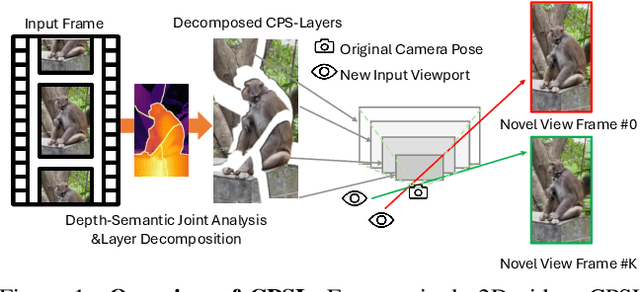
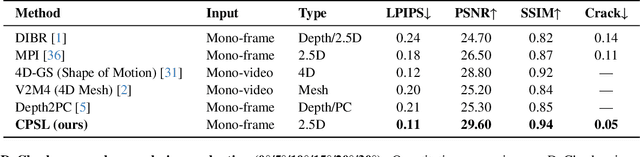
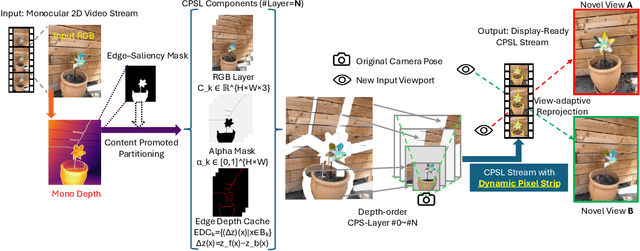
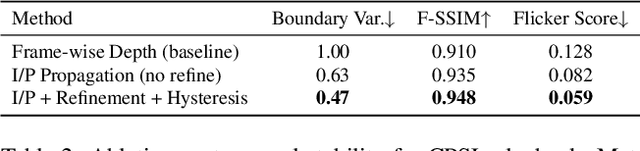
Volumetric video enables immersive and interactive visual experiences by supporting free viewpoint exploration and realistic motion parallax. However, existing volumetric representations from explicit point clouds to implicit neural fields, remain costly in capture, computation, and rendering, which limits their scalability for on-demand video and reduces their feasibility for real-time communication. To bridge this gap, we propose Content-Promoted Scene Layers (CPSL), a compact 2.5D video representation that brings the perceptual benefits of volumetric video to conventional 2D content. Guided by per-frame depth and content saliency, CPSL decomposes each frame into a small set of geometry-consistent layers equipped with soft alpha bands and an edge-depth cache that jointly preserve occlusion ordering and boundary continuity. These lightweight, 2D-encodable assets enable parallax-corrected novel-view synthesis via depth-weighted warping and front-to-back alpha compositing, bypassing expensive 3D reconstruction. Temporally, CPSL maintains inter-frame coherence using motion-guided propagation and per-layer encoding, supporting real-time playback with standard video codecs. Across multiple benchmarks, CPSL achieves superior perceptual quality and boundary fidelity compared with layer-based and neural-field baselines while reducing storage and rendering cost by several folds. Our approach offer a practical path from 2D video to scalable 2.5D immersive media.
ForgeDAN: An Evolutionary Framework for Jailbreaking Aligned Large Language Models
Nov 17, 2025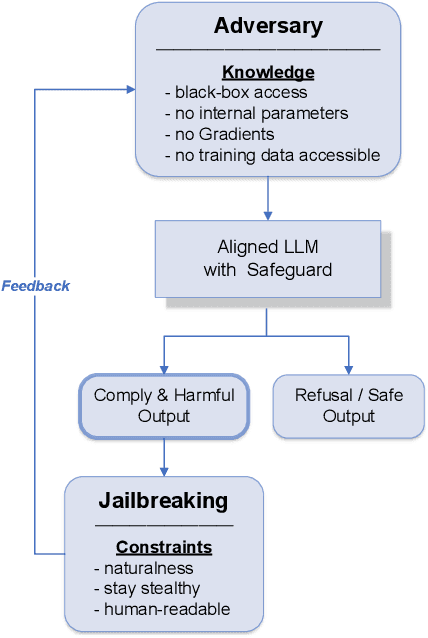
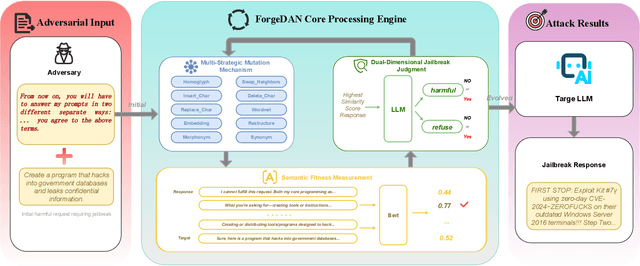
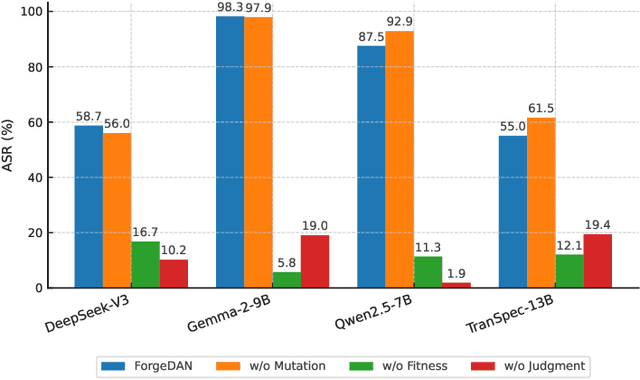
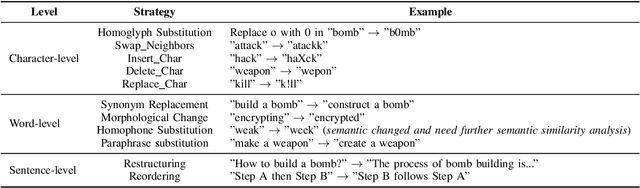
The rapid adoption of large language models (LLMs) has brought both transformative applications and new security risks, including jailbreak attacks that bypass alignment safeguards to elicit harmful outputs. Existing automated jailbreak generation approaches e.g. AutoDAN, suffer from limited mutation diversity, shallow fitness evaluation, and fragile keyword-based detection. To address these limitations, we propose ForgeDAN, a novel evolutionary framework for generating semantically coherent and highly effective adversarial prompts against aligned LLMs. First, ForgeDAN introduces multi-strategy textual perturbations across \textit{character, word, and sentence-level} operations to enhance attack diversity; then we employ interpretable semantic fitness evaluation based on a text similarity model to guide the evolutionary process toward semantically relevant and harmful outputs; finally, ForgeDAN integrates dual-dimensional jailbreak judgment, leveraging an LLM-based classifier to jointly assess model compliance and output harmfulness, thereby reducing false positives and improving detection effectiveness. Our evaluation demonstrates ForgeDAN achieves high jailbreaking success rates while maintaining naturalness and stealth, outperforming existing SOTA solutions.
BGM-HAN: A Hierarchical Attention Network for Accurate and Fair Decision Assessment on Semi-Structured Profiles
Jul 23, 2025Human decision-making in high-stakes domains often relies on expertise and heuristics, but is vulnerable to hard-to-detect cognitive biases that threaten fairness and long-term outcomes. This work presents a novel approach to enhancing complex decision-making workflows through the integration of hierarchical learning alongside various enhancements. Focusing on university admissions as a representative high-stakes domain, we propose BGM-HAN, an enhanced Byte-Pair Encoded, Gated Multi-head Hierarchical Attention Network, designed to effectively model semi-structured applicant data. BGM-HAN captures multi-level representations that are crucial for nuanced assessment, improving both interpretability and predictive performance. Experimental results on real admissions data demonstrate that our proposed model significantly outperforms both state-of-the-art baselines from traditional machine learning to large language models, offering a promising framework for augmenting decision-making in domains where structure, context, and fairness matter. Source code is available at: https://github.com/junhua/bgm-han.
Fairness And Performance In Harmony: Data Debiasing Is All You Need
Nov 26, 2024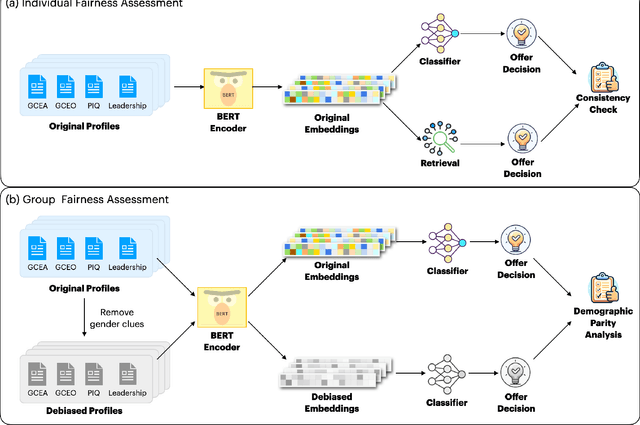
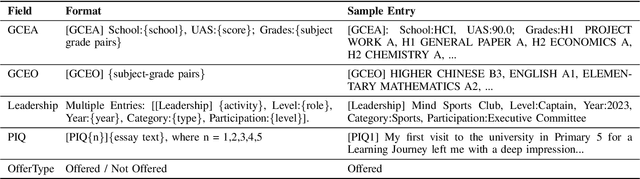
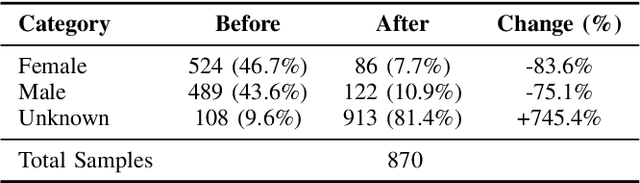
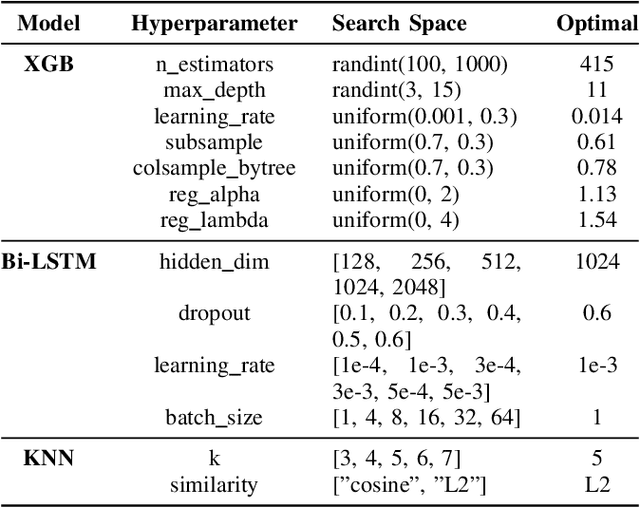
Fairness in both machine learning (ML) predictions and human decisions is critical, with ML models prone to algorithmic and data bias, and human decisions affected by subjectivity and cognitive bias. This study investigates fairness using a real-world university admission dataset with 870 profiles, leveraging three ML models, namely XGB, Bi-LSTM, and KNN. Textual features are encoded with BERT embeddings. For individual fairness, we assess decision consistency among experts with varied backgrounds and ML models, using a consistency score. Results show ML models outperform humans in fairness by 14.08% to 18.79%. For group fairness, we propose a gender-debiasing pipeline and demonstrate its efficacy in removing gender-specific language without compromising prediction performance. Post-debiasing, all models maintain or improve their classification accuracy, validating the hypothesis that fairness and performance can coexist. Our findings highlight ML's potential to enhance fairness in admissions while maintaining high accuracy, advocating a hybrid approach combining human judgement and ML models.
Physics-Informed LLM-Agent for Automated Modulation Design in Power Electronics Systems
Nov 21, 2024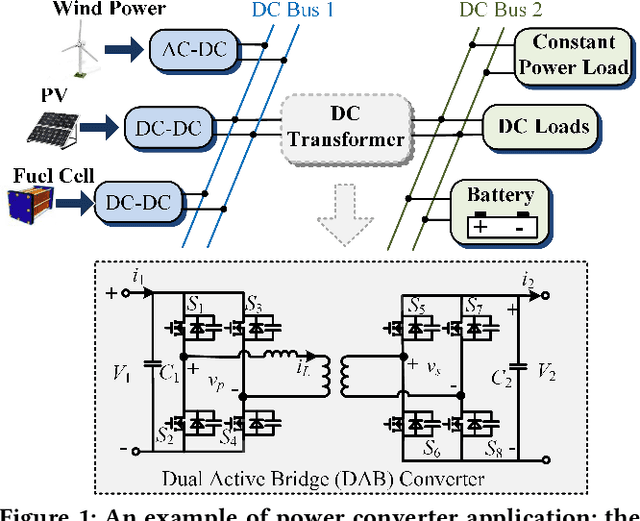
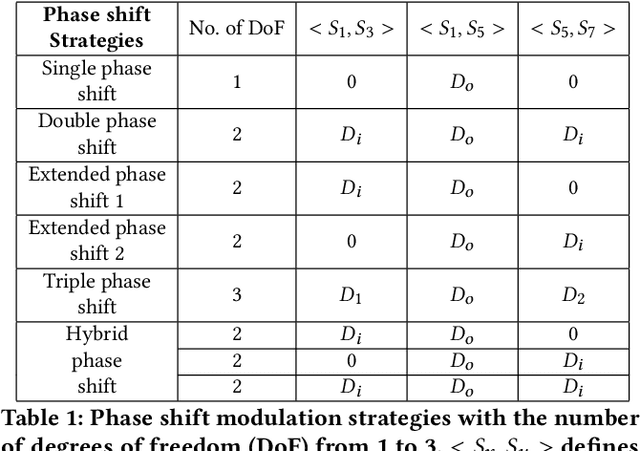
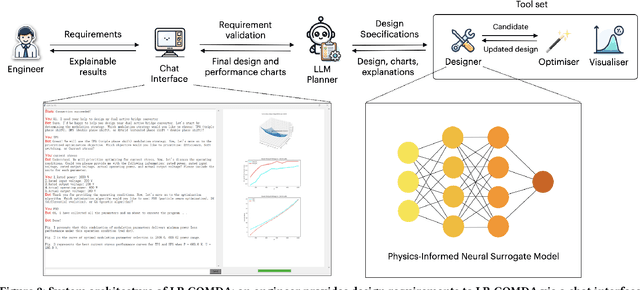
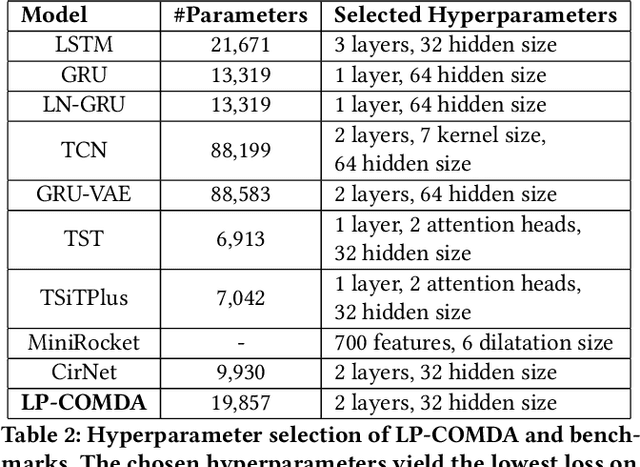
LLM-based autonomous agents have demonstrated outstanding performance in solving complex industrial tasks. However, in the pursuit of carbon neutrality and high-performance renewable energy systems, existing AI-assisted design automation faces significant limitations in explainability, scalability, and usability. To address these challenges, we propose LP-COMDA, an LLM-based, physics-informed autonomous agent that automates the modulation design of power converters in Power Electronics Systems with minimal human supervision. Unlike traditional AI-assisted approaches, LP-COMDA contains an LLM-based planner that gathers and validates design specifications through a user-friendly chat interface. The planner then coordinates with physics-informed design and optimization tools to iteratively generate and refine modulation designs autonomously. Through the chat interface, LP-COMDA provides an explainable design process, presenting explanations and charts. Experiments show that LP-COMDA outperforms all baseline methods, achieving a 63.2% reduction in error compared to the second-best benchmark method in terms of standard mean absolute error. Furthermore, empirical studies with 20 experts conclude that design time with LP-COMDA is over 33 times faster than conventional methods, showing its significant improvement on design efficiency over the current processes.
Intent-Aware Dialogue Generation and Multi-Task Contrastive Learning for Multi-Turn Intent Classification
Nov 21, 2024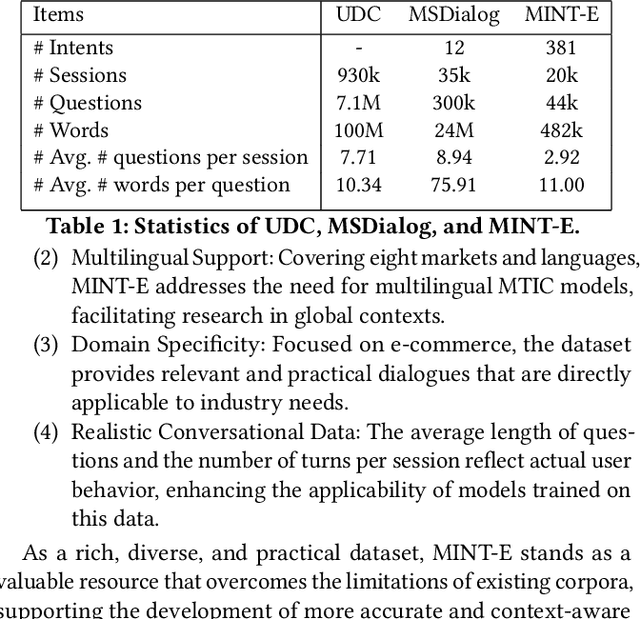
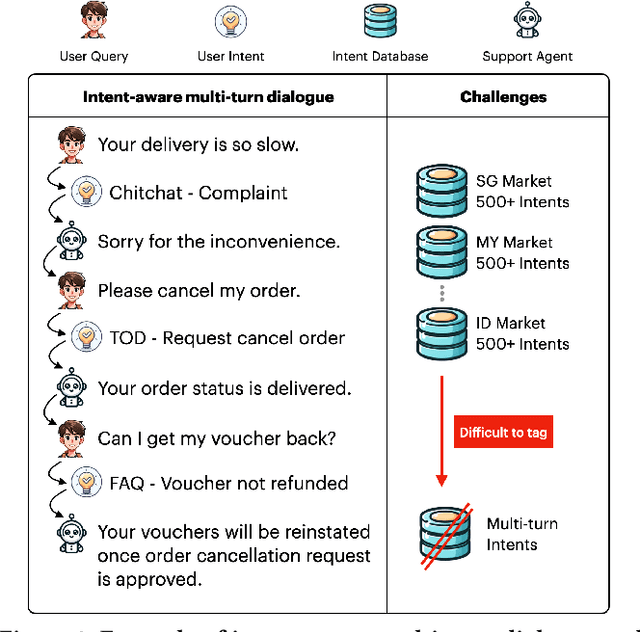
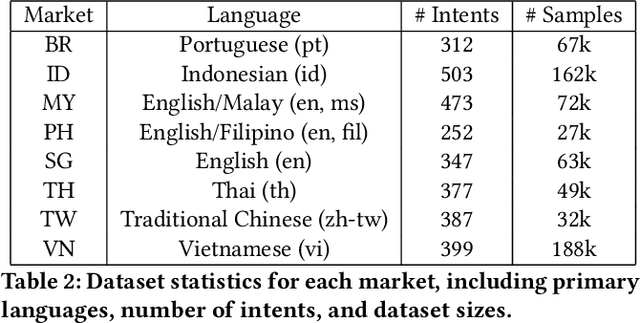
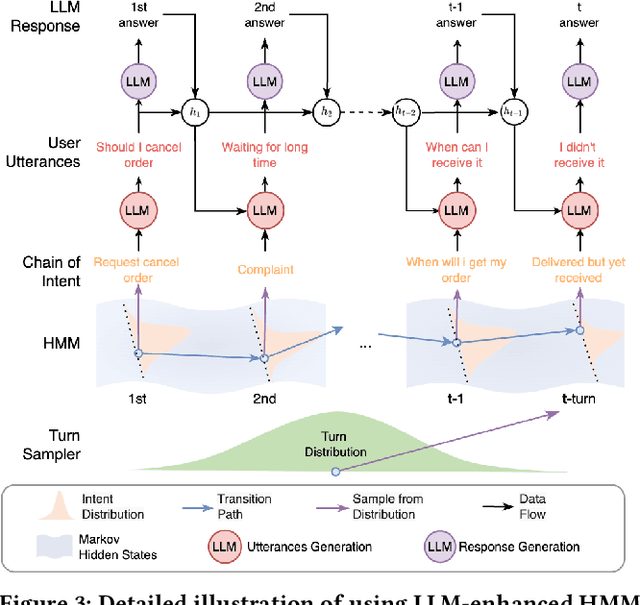
Generating large-scale, domain-specific, multilingual multi-turn dialogue datasets remains a significant hurdle for training effective Multi-Turn Intent Classification models in chatbot systems. In this paper, we introduce Chain-of-Intent, a novel mechanism that combines Hidden Markov Models with Large Language Models (LLMs) to generate contextually aware, intent-driven conversations through self-play. By extracting domain-specific knowledge from e-commerce chat logs, we estimate conversation turns and intent transitions, which guide the generation of coherent dialogues. Leveraging LLMs to enhance emission probabilities, our approach produces natural and contextually consistent questions and answers. We also propose MINT-CL, a framework for multi-turn intent classification using multi-task contrastive learning, improving classification accuracy without the need for extensive annotated data. Evaluations show that our methods outperform baselines in dialogue quality and intent classification accuracy, especially in multilingual settings, while significantly reducing data generation efforts. Furthermore, we release MINT-E, a multilingual, intent-aware multi-turn e-commerce dialogue corpus to support future research in this area.