 Add to Chrome
 Add to Firefox
 Add to Edge
Quaternion Tensor Modeling for Joint Color-Polarization Demosaicking
Aug 03, 2026
Division-of-focal-plane (DoFP) color polarization cameras enable snapshot acquisition of color polarization mosaic images, but the inherently sparse sampling pattern makes color polarization demosaicking severely ill-posed. Existing methods often fail to jointly exploit the correlations among polarization channels and the physical constraints inherent in polarization imaging, resulting in noticeable demosaicking artifacts. To address this issue, a quaternion-tensor-based color polarization demosaicking (CPDM) method incorporating Stokes-domain total variation (TV) regularization is proposed. Correlation analysis shows that the correlations among polarization channels are stronger than those among color channels. Accordingly, the color polarization images acquired at $0^\circ$, $45^\circ$, $90^\circ$, and $135^\circ$ are encoded into the four components of a third-order quaternion tensor, with the color channels organized along its third mode. A low-rank prior is then imposed on the quaternion tensor to exploit the global structural redundancy in the color polarization data. Moreover, spatial gradients are mapped to the Stokes domain through an orthogonal transformation to separate intensity, polarization and residual variations, with adaptive quaternion weights enabling component-specific regularization and preserving the energy consistency of the reconstructed Stokes vectors. An efficient optimization algorithm is derived for the resulting model. Extensive experiments demonstrate the superior demosaicking performance of the proposed method.

AgentDoG 1.5: A Lightweight and Scalable Alignment Framework for AI Agent Safety and Security
May 28, 2026Modern open-world agents such as OpenClaw exhibit powerful cross-environment execution capabilities yet introduce broad new safety risk sources. Meanwhile, advanced frontier AI models drastically lower attack barriers, rendering current agent alignment frameworks inadequate for real-world deployment. To tackle these emerging threats, we propose a lightweight and scalable agent safety alignment framework. Specifically, we update the agent safety taxonomy to accommodate emergent risks from Codex and OpenClaw execution scenarios. We further build a taxonomy-guided data engine with influence-function purification to train lightweight AgentDoG 1.5 variants (0.8B, 2B, 4B, and 8B parameters) using only around 1k samples, achieving comparable performance with leading closed-source models (e.g., GPT-5.4). Based on AgentDoG 1.5, we construct a highly efficient agentic safety SFT and RL training environment, which reduces deployment overhead in Docker-level environments by two orders of magnitude. Finally, we deploy AgentDoG 1.5 as a training-free online guardrail for real-time safety moderation. Extensive experimental results indicate that AgentDoG 1.5 achieves state-of-the-art performance in diverse and complex interactive agentic scenarios. All models and datasets are openly released.
ForgeDAN: An Evolutionary Framework for Jailbreaking Aligned Large Language Models
Nov 17, 2025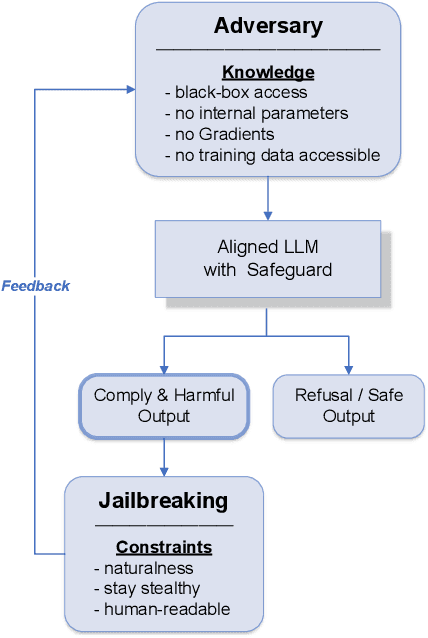
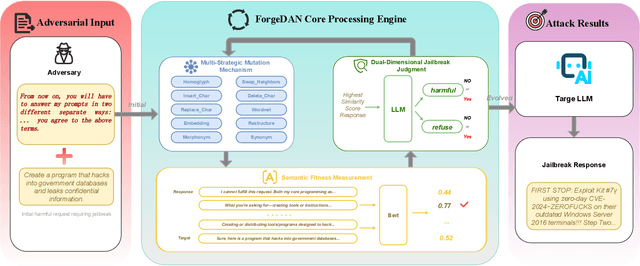
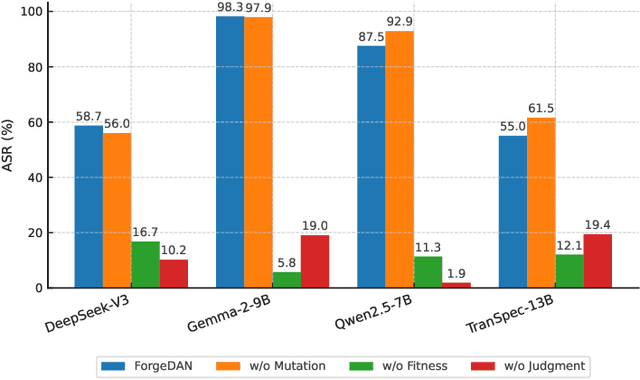
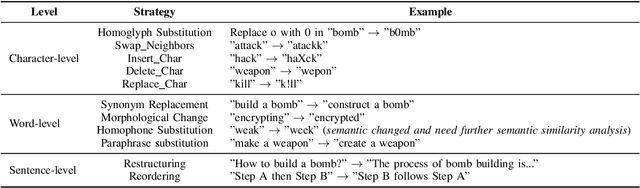
The rapid adoption of large language models (LLMs) has brought both transformative applications and new security risks, including jailbreak attacks that bypass alignment safeguards to elicit harmful outputs. Existing automated jailbreak generation approaches e.g. AutoDAN, suffer from limited mutation diversity, shallow fitness evaluation, and fragile keyword-based detection. To address these limitations, we propose ForgeDAN, a novel evolutionary framework for generating semantically coherent and highly effective adversarial prompts against aligned LLMs. First, ForgeDAN introduces multi-strategy textual perturbations across \textit{character, word, and sentence-level} operations to enhance attack diversity; then we employ interpretable semantic fitness evaluation based on a text similarity model to guide the evolutionary process toward semantically relevant and harmful outputs; finally, ForgeDAN integrates dual-dimensional jailbreak judgment, leveraging an LLM-based classifier to jointly assess model compliance and output harmfulness, thereby reducing false positives and improving detection effectiveness. Our evaluation demonstrates ForgeDAN achieves high jailbreaking success rates while maintaining naturalness and stealth, outperforming existing SOTA solutions.