 Add to Chrome
 Add to Firefox
 Add to Edge
3DReflecNet: A Large-Scale Dataset for 3D Reconstruction of Reflective, Transparent, and Low-Texture Objects
May 11, 2026
Accurate 3D reconstruction of objects with reflective, transparent, or low-texture surfaces still remains notoriously challenging. Such materials often violate key assumptions in multi-view reconstruction pipelines, such as photometric consistency and the availability on distinct geometric texture cues. Existing datasets primarily focus on diffuse, textured objects, and therefore provide limited insight into performance under real-world material complexities. We introduce 3DReflecNet, a large-scale hybrid dataset exceeding 22 TB that is specifically designed to benchmark and advance 3D vision methods for these challenging materials. 3DReflecNet combines two types of data: over 120,000 synthetic instances generated via physically-based rendering of more than 12,000 shapes, and over 1,000 real-world objects captured using consumer devices. Together, these data consist of more than 7 million multi-view frames. The dataset spans diverse materials, complex lighting conditions, and a wide range of geometric forms, including shapes generated from both real and LLM-synthesized 2D images using diffusion-based pipelines. To support robust evaluation, we design benchmarks for five core tasks: image matching, structure-from-motion, novel view synthesis, reflection removal, and relighting. Extensive experiments demonstrate that state-of-the-art methods struggle to maintain accuracy across these settings, highlighting the need for more resilient 3D vision models.

MISID: A Multimodal Multi-turn Dataset for Complex Intent Recognition in Strategic Deception Games
Apr 14, 2026Understanding human intent in complex multi-turn interactions remains a fundamental challenge in human-computer interaction and behavioral analysis. While existing intent recognition datasets focus mainly on single utterances or simple dialogues, real-world scenarios often involve sophisticated strategic interactions where participants must maintain complex deceptive narratives over extended periods. To address this gap, we introduce MISID, a comprehensive multimodal, multi-turn, and multi-participant benchmark for intent recognition. Sourced from high-stakes social strategy games, MISID features a fine-grained, two-tier multi-dimensional annotation scheme tailored for long-context discourse analysis and evidence-based causal tracking. Our systematic evaluation of state-of-the-art Multimodal Large Language Models (MLLMs) on MISID reveals critical deficiencies in complex scenarios, including text-prior visual hallucination, impaired cross-modal synergy, and limited capacity in chaining causal cues. Consequently, we propose FRACTAM as a baseline framework. Using a ``Decouple-Anchor-Reason'' paradigm, FRACTAM reduces text bias by extracting pure unimodal factual representations, employs two-stage retrieval for long-range factual anchoring, and constructs explicit cross-modal evidence chains. Extensive experiments demonstrate that FRACTAM enhances mainstream models' performance in complex strategic tasks, improving hidden intent detection and inference while maintaining robust perceptual accuracy. Our dataset is available at https://naislab.cn/datasets/MISID.
DeformStream: Deformation-based Adaptive Volumetric Video Streaming
Sep 25, 2024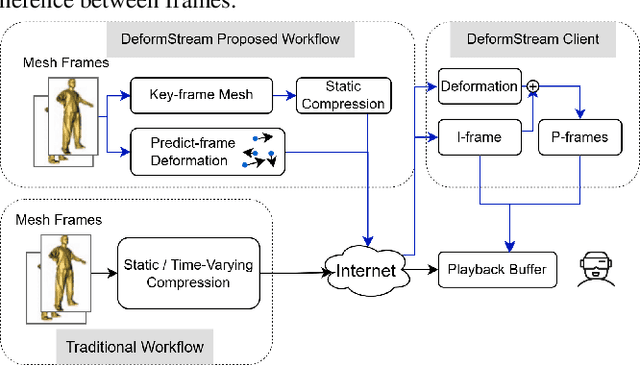

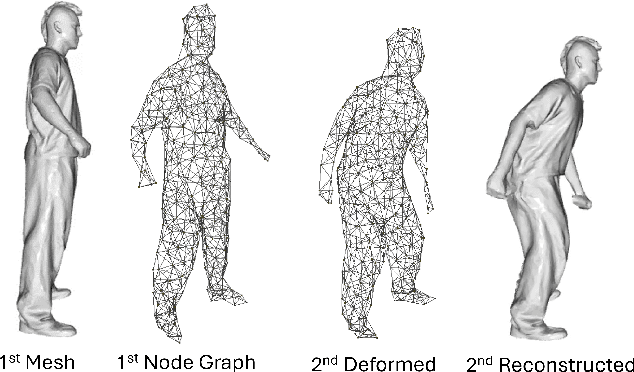
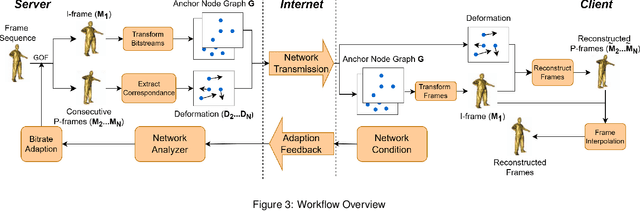
Volumetric video streaming offers immersive 3D experiences but faces significant challenges due to high bandwidth requirements and latency issues in transmitting detailed content in real time. Traditional methods like point cloud streaming compromise visual quality when zoomed in, and neural rendering techniques are too computationally intensive for real-time use. Though mesh-based streaming stands out by preserving surface detail and connectivity, offering a more refined representation for 3D content, traditional mesh streaming methods typically transmit data on a per-frame basis, failing to take full advantage of temporal redundancies across frames. This results in inefficient bandwidth usage and poor adaptability to fluctuating network conditions. We introduce Deformation-based Adaptive Volumetric Video Streaming, a novel framework that enhances volumetric video streaming performance by leveraging the inherent deformability of mesh-based representations. DeformStream uses embedded deformation to reconstruct subsequent frames from inter-frame motion, significantly reducing bandwidth usage while ensuring visual coherence between frames. To address frame reconstruction overhead and network adaptability, we formulate a new QoE model that accounts for client-side deformation latency and design a dynamic programming algorithm to optimize the trade-off between visual quality and bandwidth consumption under varying network conditions. Our evaluation demonstrates that Deformation-based Adaptive Volumetric Video Streaming outperforms existing mesh-based streaming systems in both bandwidth efficiency and visual quality, offering a robust solution for real-time volumetric video applications.
ILCAS: Imitation Learning-Based Configuration-Adaptive Streaming for Live Video Analytics with Cross-Camera Collaboration
Aug 19, 2023The high-accuracy and resource-intensive deep neural networks (DNNs) have been widely adopted by live video analytics (VA), where camera videos are streamed over the network to resource-rich edge/cloud servers for DNN inference. Common video encoding configurations (e.g., resolution and frame rate) have been identified with significant impacts on striking the balance between bandwidth consumption and inference accuracy and therefore their adaption scheme has been a focus of optimization. However, previous profiling-based solutions suffer from high profiling cost, while existing deep reinforcement learning (DRL) based solutions may achieve poor performance due to the usage of fixed reward function for training the agent, which fails to craft the application goals in various scenarios. In this paper, we propose ILCAS, the first imitation learning (IL) based configuration-adaptive VA streaming system. Unlike DRL-based solutions, ILCAS trains the agent with demonstrations collected from the expert which is designed as an offline optimal policy that solves the configuration adaption problem through dynamic programming. To tackle the challenge of video content dynamics, ILCAS derives motion feature maps based on motion vectors which allow ILCAS to visually ``perceive'' video content changes. Moreover, ILCAS incorporates a cross-camera collaboration scheme to exploit the spatio-temporal correlations of cameras for more proper configuration selection. Extensive experiments confirm the superiority of ILCAS compared with state-of-the-art solutions, with 2-20.9% improvement of mean accuracy and 19.9-85.3% reduction of chunk upload lag.