 Add to Chrome
 Add to Firefox
 Add to Edge
VeriSpace: Spatially Grounded Action Verification for Vision-Language-Action Models
Jun 09, 2026
Vision-language-action (VLA) models have shown strong promise for robotic manipulation, but their reliability at test time remains limited by one-shot action prediction, where even small action errors can cause grasp failure, collision, or incorrect task progression. A natural alternative is to equip VLA systems with test-time verification, allowing multiple candidate actions to be proposed and evaluated before execution. However, reliable action verification is challenging because it requires not only distinguishing subtle geometric differences between candidate actions, but also assessing whether an action makes meaningful progress toward the task goal. We present VeriSpace, a 3D-aware action verifier for test-time action selection in VLA systems. VeriSpace evaluates candidate actions through two key components: Dual-Path 3D-Injected Scene Encoding, which constructs a scene representation that jointly preserves visual semantics and explicit 3D geometry, and Spatially-Grounded Action Reasoning, which evaluates each action by reasoning over task-relevant spatial relations, geometric validity, and expected goal progress. Together, these components enable more reliable discrimination between subtle yet outcome-critical action candidates while remaining fully compatible with existing VLA policies. Experiments on public benchmarks and real-world robotic manipulation tasks show that VeriSpace consistently improves decision reliability over both underlying VLA policies and prior verification-based methods, yielding substantial gains in both in-distribution and out-of-distribution settings.

Learning Dynamic Stability Landscapes in Synchronization Networks
May 22, 2026The robustness of synchronization is typically characterized by scalar, per-node stability indices whose dependence on topology is studied via network science or graph neural networks (GNNs). We propose a novel upstream task, learning stability landscapes, which provide deeper insights into synchronization behavior and from which many such scalar indices can be derived. Crucially, we pioneer a graph-to-image prediction paradigm: learning image-like landscapes as per-node targets directly from graph topology, a formulation we are not aware of having been established elsewhere in the literature. To support this task, we release two datasets of 10,000 graphs each at 20 and 100 nodes with per-node landscape labels, based on a conceptual oscillator model, capturing power grid synchronization behavior. A GNN encodes topology and a CNN decoder renders per-node images, learned end-to-end with good in-distribution accuracy, generalizing across graph sizes and to realistic power grid topologies. This demonstrates that stability landscapes, while beyond the reach of conventional network science, are learnable from topology and open new avenues for moving beyond scalar stability indices in biology, neuroscience, and power grids.
Resolving Action Bottleneck: Agentic Reinforcement Learning Informed by Token-Level Energy
May 14, 2026Agentic reinforcement learning trains large language models using multi-turn trajectories that interleave long reasoning traces with short environment-facing actions. Common policy-gradient methods, such as PPO and GRPO, treat each token in a trajectory equally, leading to uniform credit assignment. In this paper, we critically demonstrate that such uniform credit assignment largely misallocates token-level training signals. From an energy-based modeling perspective, we show that token-level training signals, quantified by their correlations with reward variance of different rollouts sampled from a given prompt, concentrate sharply on action tokens rather than reasoning tokens, even though action tokens account for only a small fraction of the trajectory. We refer to this phenomenon as the Action Bottleneck. Motivated by this observation, we propose an embarrassingly simple token reweighting approach, ActFocus, that downweights gradients on reasoning tokens, along with an additional energy-based redistribution mechanism that further increases the weights on action tokens with higher uncertainty. Across four environments and different model sizes, ActFocus consistently outperforms PPO and GRPO, yielding final-step gains of up to 65.2 and 63.7 percentage points, respectively, without any additional runtime or memory cost.
Xiaomi MiMo-VL-Miloco Technical Report
Dec 22, 2025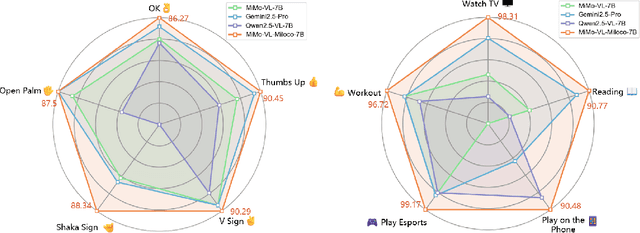
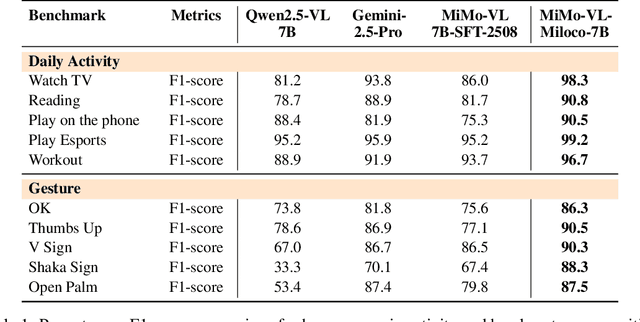
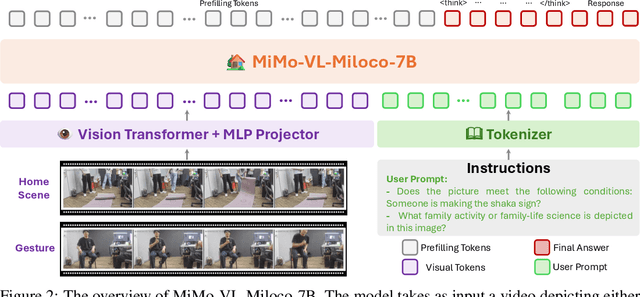
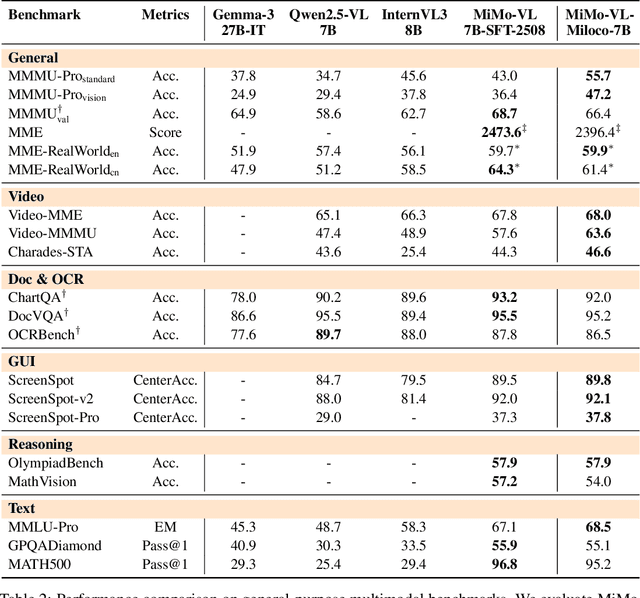
We open-source MiMo-VL-Miloco-7B and its quantized variant MiMo-VL-Miloco-7B-GGUF, a pair of home-centric vision-language models that achieve strong performance on both home-scenario understanding and general multimodal reasoning. Built on the MiMo-VL-7B backbone, MiMo-VL-Miloco-7B is specialized for smart-home environments, attaining leading F1 scores on gesture recognition and common home-scenario understanding, while also delivering consistent gains across video benchmarks such as Video-MME, Video-MMMU, and Charades-STA, as well as language understanding benchmarks including MMMU-Pro and MMLU-Pro. In our experiments, MiMo-VL-Miloco-7B outperforms strong closed-source and open-source baselines on home-scenario understanding and several multimodal reasoning benchmarks. To balance specialization and generality, we design a two-stage training pipeline that combines supervised fine-tuning with reinforcement learning based on Group Relative Policy Optimization, leveraging efficient multi-domain data. We further incorporate chain-of-thought supervision and token-budget-aware reasoning, enabling the model to learn knowledge in a data-efficient manner while also performing reasoning efficiently. Our analysis shows that targeted home-scenario training not only enhances activity and gesture understanding, but also improves text-only reasoning with only modest trade-offs on document-centric tasks. Model checkpoints, quantized GGUF weights, and our home-scenario evaluation toolkit are publicly available at https://github.com/XiaoMi/xiaomi-mimo-vl-miloco to support research and deployment in real-world smart-home applications.
MiniVLN: Efficient Vision-and-Language Navigation by Progressive Knowledge Distillation
Sep 27, 2024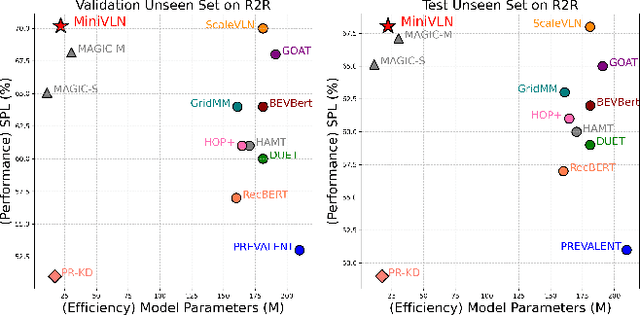
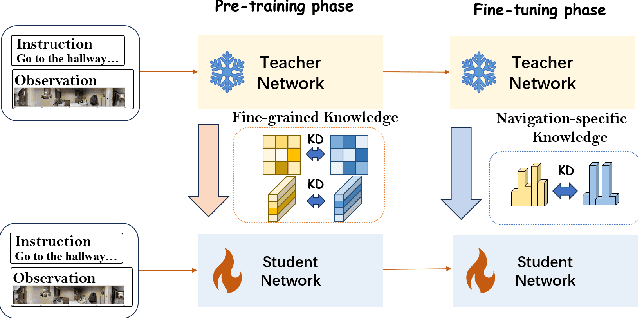
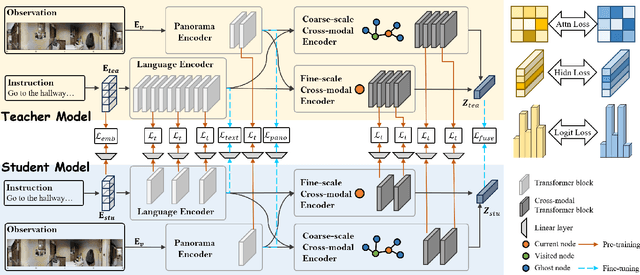
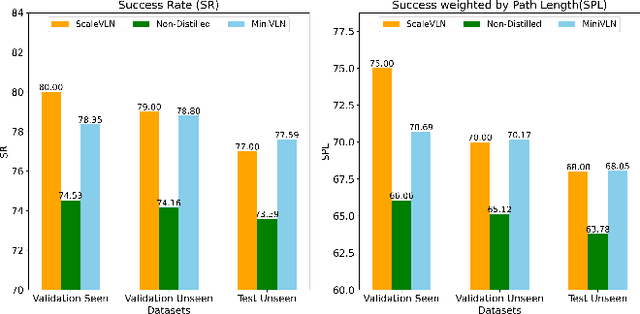
In recent years, Embodied Artificial Intelligence (Embodied AI) has advanced rapidly, yet the increasing size of models conflicts with the limited computational capabilities of Embodied AI platforms. To address this challenge, we aim to achieve both high model performance and practical deployability. Specifically, we focus on Vision-and-Language Navigation (VLN), a core task in Embodied AI. This paper introduces a two-stage knowledge distillation framework, producing a student model, MiniVLN, and showcasing the significant potential of distillation techniques in developing lightweight models. The proposed method aims to capture fine-grained knowledge during the pretraining phase and navigation-specific knowledge during the fine-tuning phase. Our findings indicate that the two-stage distillation approach is more effective in narrowing the performance gap between the teacher model and the student model compared to single-stage distillation. On the public R2R and REVERIE benchmarks, MiniVLN achieves performance on par with the teacher model while having only about 12% of the teacher model's parameter count.