 Add to Chrome
 Add to Firefox
 Add to Edge
Counterfactual Anatomy-guided Spatial-Temporal Decoding for Annotation-Free Hallucination Mitigation in Medical VLMs
Aug 18, 2026
Medical vision-language models (Med-VLMs) have demonstrated strong performance on medical visual question answering, yet they remain prone to hallucination, generating clinically unsupported statements that are insufficiently grounded in image evidence. Mitigation methods applied during decoding offer a practical solution, but they typically lack anatomical awareness or rely heavily on ground truth annotations, which limits their applicability. We propose Counterfactual Anatomy-guided Spatial-Temporal decoding (CAST), a framework that operates entirely during inference and requires no manual annotations for anatomically grounded hallucination mitigation. CAST automatically discovers anatomical regions relevant to the given query through broad medical segmentation. It then selects a compact, causally informative area using counterfactual intervention based on the drop in answer likelihood under occlusion. Guided by this chosen region, CAST performs a unified contrastive decoding process, combining classifier-free guidance to correct spatial attention with stepwise temporal contrast to regulate generation dynamics. Experiments on the SLAKE and MIMIC-CXR datasets across three Med-VLMs demonstrate that CAST consistently outperforms strong baselines and surpasses decoding strategies reliant on ground truth. Our results indicate that compact, automatically selected regions provide highly effective contrastive guidance without expert annotations, offering a practical and generalizable solution for improving spatial grounding and reducing hallucinations. Code is available at https://github.com/csyifan/CAST.

LOHA: Direct Graph Spectral Contrastive Learning Between Low-pass and High-pass Views
Jan 06, 2025
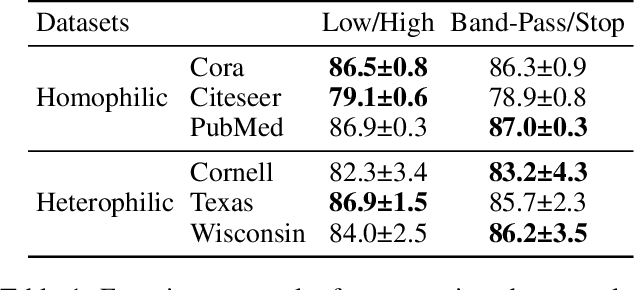

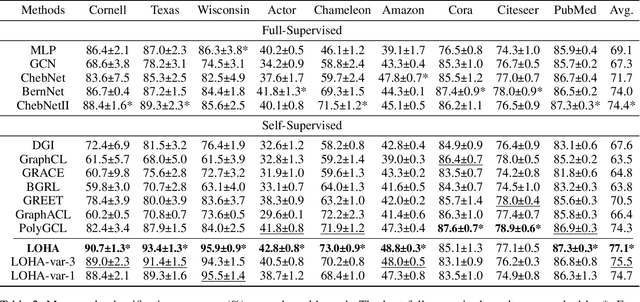
Spectral Graph Neural Networks effectively handle graphs with different homophily levels, with low-pass filter mining feature smoothness and high-pass filter capturing differences. When these distinct filters could naturally form two opposite views for self-supervised learning, the commonalities between the counterparts for the same node remain unexplored, leading to suboptimal performance. In this paper, a simple yet effective self-supervised contrastive framework, LOHA, is proposed to address this gap. LOHA optimally leverages low-pass and high-pass views by embracing "harmony in diversity". Rather than solely maximizing the difference between these distinct views, which may lead to feature separation, LOHA harmonizes the diversity by treating the propagation of graph signals from both views as a composite feature. Specifically, a novel high-dimensional feature named spectral signal trend is proposed to serve as the basis for the composite feature, which remains relatively unaffected by changing filters and focuses solely on original feature differences. LOHA achieves an average performance improvement of 2.8% over runner-up models on 9 real-world datasets with varying homophily levels. Notably, LOHA even surpasses fully-supervised models on several datasets, which underscores the potential of LOHA in advancing the efficacy of spectral GNNs for diverse graph structures.