 Add to Chrome
 Add to Firefox
 Add to Edge
EvObj: Learning Evolving Object-centric Representations for 3D Instance Segmentation without Scene Supervision
May 13, 2026
We introduce EvObj for unsupervised 3D instance segmentation that bridges the geometric domain gap between synthetic pretraining data and real-world point clouds. Current methods suffer from structural discrepancies when transferring object priors from synthetic datasets (e.g., ShapeNet) to real scans (e.g., ScanNet), particularly due to morphological variations and occlusion artifacts. To address this, EvObj integrates two innovative modules: (1) An object discerning module that dynamically refines object candidates, enabling continuous adaptation of object priors to target domains; and (2) An object completion module that reconstructs partial geometries after discovering objects. We conduct extensive experiments on both real-world and synthetic datasets, demonstrating superior 3D object segmentation performance over all baselines while achieving state-of-the-art results.

PhysInOne: Visual Physics Learning and Reasoning in One Suite
Apr 10, 2026We present PhysInOne, a large-scale synthetic dataset addressing the critical scarcity of physically-grounded training data for AI systems. Unlike existing datasets limited to merely hundreds or thousands of examples, PhysInOne provides 2 million videos across 153,810 dynamic 3D scenes, covering 71 basic physical phenomena in mechanics, optics, fluid dynamics, and magnetism. Distinct from previous works, our scenes feature multiobject interactions against complex backgrounds, with comprehensive ground-truth annotations including 3D geometry, semantics, dynamic motion, physical properties, and text descriptions. We demonstrate PhysInOne's efficacy across four emerging applications: physics-aware video generation, long-/short-term future frame prediction, physical property estimation, and motion transfer. Experiments show that fine-tuning foundation models on PhysInOne significantly enhances physical plausibility, while also exposing critical gaps in modeling complex physical dynamics and estimating intrinsic properties. As the largest dataset of its kind, orders of magnitude beyond prior works, PhysInOne establishes a new benchmark for advancing physics-grounded world models in generation, simulation, and embodied AI.
Few-shot Online Anomaly Detection and Segmentation
Mar 27, 2024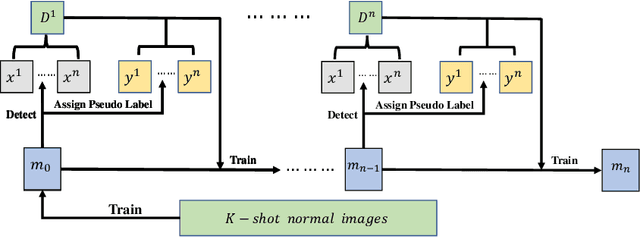
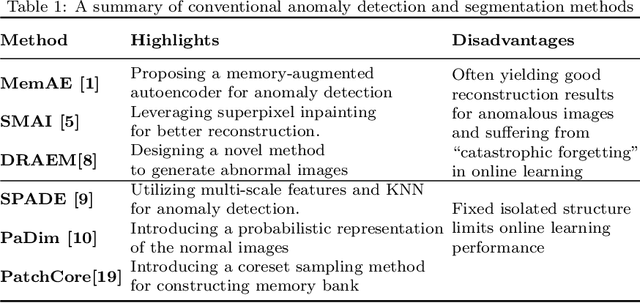
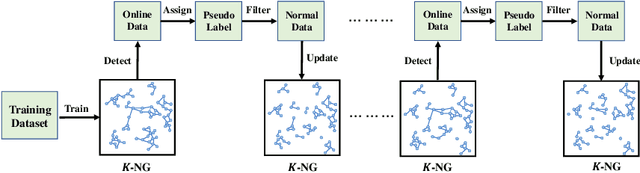
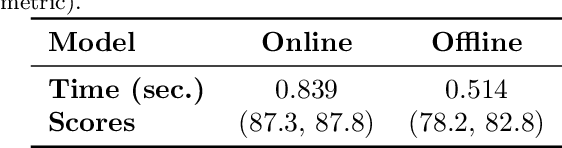
Detecting anomaly patterns from images is a crucial artificial intelligence technique in industrial applications. Recent research in this domain has emphasized the necessity of a large volume of training data, overlooking the practical scenario where, post-deployment of the model, unlabeled data containing both normal and abnormal samples can be utilized to enhance the model's performance. Consequently, this paper focuses on addressing the challenging yet practical few-shot online anomaly detection and segmentation (FOADS) task. Under the FOADS framework, models are trained on a few-shot normal dataset, followed by inspection and improvement of their capabilities by leveraging unlabeled streaming data containing both normal and abnormal samples simultaneously. To tackle this issue, we propose modeling the feature distribution of normal images using a Neural Gas network, which offers the flexibility to adapt the topology structure to identify outliers in the data flow. In order to achieve improved performance with limited training samples, we employ multi-scale feature embedding extracted from a CNN pre-trained on ImageNet to obtain a robust representation. Furthermore, we introduce an algorithm that can incrementally update parameters without the need to store previous samples. Comprehensive experimental results demonstrate that our method can achieve substantial performance under the FOADS setting, while ensuring that the time complexity remains within an acceptable range on MVTec AD and BTAD datasets.