 Add to Chrome
 Add to Firefox
 Add to Edge
MXAttention: Data-Free Optimal Scaling and Pre-Normalization Quantization for MXFP4 Attention
Jul 27, 2026
The quadratic cost of attention is a major bottleneck in diffusion-based video generation models. MXFP4 attention provides a promising path toward efficient inference, but direct MXFP4 quantization often degrades generation quality due to two numerical issues: the clipping-underflow trade-off from power-of-two scaling and the row-wise normalization error introduced in the softmax loop. We propose MXAttention, a data-free post-training quantization framework for MXFP4 attention. MXAttention introduces two components: Universal Optimal Scaling (UOS), which exploits the periodic structure of power-of-two microscaling to derive a distribution-independent optimal scaling boundary Qmax=7.25 without calibration or search, and Pre-Normalization Quantization (PNQ), which quantizes unnormalized softmax exponentials before row-wise summation to preserve normalization by construction. Experiments on Wan2.2 and HunyuanVideo show that MXAttention closes at least 95% of the VBench Imaging Quality gap between OCP MXFP4 and FP16, substantially improves frame-level similarity, and preserves FP16-level generation quality with less than 0.01 absolute degradation on all reported VBench metrics. MXAttention also achieves performance competitive with strong NVFP4-based baselines with negligible overhead when fused into the attention pipeline. The implementation is publicly available in MindIE-SD.

PeopleSearchBench: A Multi-Dimensional Benchmark for Evaluating AI-Powered People Search Platforms
Mar 29, 2026AI-powered people search platforms are increasingly used in recruiting, sales prospecting, and professional networking, yet no widely accepted benchmark exists for evaluating their performance. We introduce PeopleSearchBench, an open-source benchmark that compares four people search platforms on 119 real-world queries across four use cases: corporate recruiting, B2B sales prospecting, expert search with deterministic answers, and influencer/KOL discovery. A key contribution is Criteria-Grounded Verification, a factual relevance pipeline that extracts explicit, verifiable criteria from each query and uses live web search to determine whether returned people satisfy them. This produces binary relevance judgments grounded in factual verification rather than subjective holistic LLM-as-judge scores. We evaluate systems on three dimensions: Relevance Precision (padded nDCG@10), Effective Coverage (task completion and qualified result yield), and Information Utility (profile completeness and usefulness), averaged equally into an overall score. Lessie, a specialized AI people search agent, performs best overall, scoring 65.2, 18.5% higher than the second-ranked system, and is the only system to achieve 100% task completion across all 119 queries. We also report confidence intervals, human validation of the verification pipeline (Cohen's kappa = 0.84), ablations, and full documentation of queries, prompts, and normalization procedures. Code, query definitions, and aggregated results are available on GitHub.
Solving Parametric PDEs with Radial Basis Functions and Deep Neural Networks
Apr 12, 2024We propose the POD-DNN, a novel algorithm leveraging deep neural networks (DNNs) along with radial basis functions (RBFs) in the context of the proper orthogonal decomposition (POD) reduced basis method (RBM), aimed at approximating the parametric mapping of parametric partial differential equations on irregular domains. The POD-DNN algorithm capitalizes on the low-dimensional characteristics of the solution manifold for parametric equations, alongside the inherent offline-online computational strategy of RBM and DNNs. In numerical experiments, POD-DNN demonstrates significantly accelerated computation speeds during the online phase. Compared to other algorithms that utilize RBF without integrating DNNs, POD-DNN substantially improves the computational speed in the online inference process. Furthermore, under reasonable assumptions, we have rigorously derived upper bounds on the complexity of approximating parametric mappings with POD-DNN, thereby providing a theoretical analysis of the algorithm's empirical performance.
Solving PDEs on Spheres with Physics-Informed Convolutional Neural Networks
Aug 18, 2023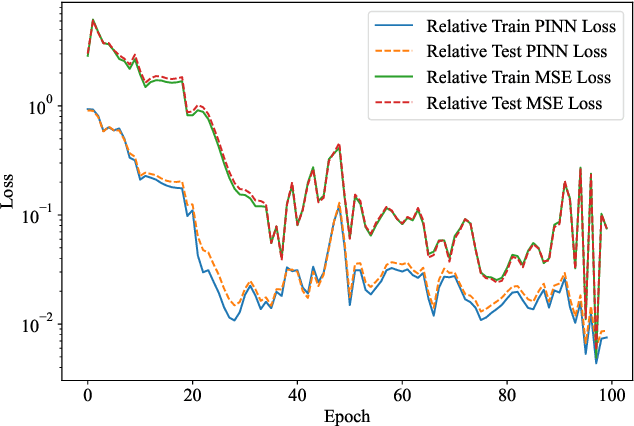
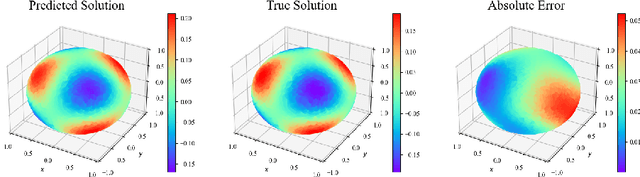
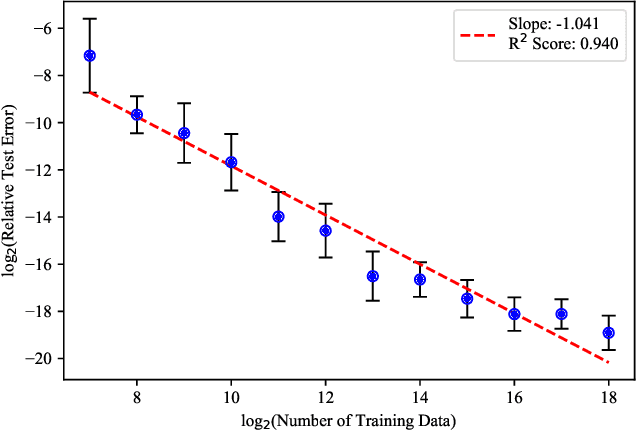
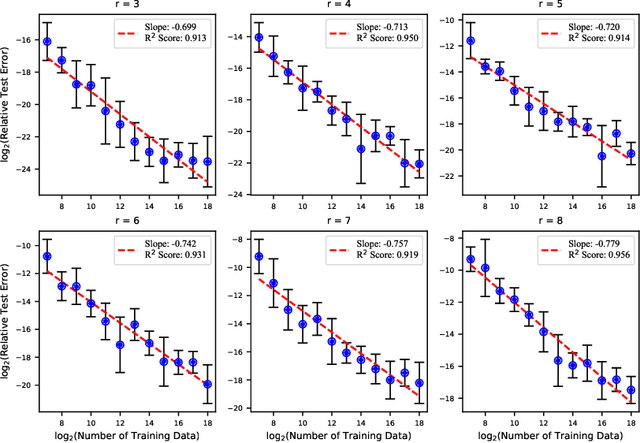
Physics-informed neural networks (PINNs) have been demonstrated to be efficient in solving partial differential equations (PDEs) from a variety of experimental perspectives. Some recent studies have also proposed PINN algorithms for PDEs on surfaces, including spheres. However, theoretical understanding of the numerical performance of PINNs, especially PINNs on surfaces or manifolds, is still lacking. In this paper, we establish rigorous analysis of the physics-informed convolutional neural network (PICNN) for solving PDEs on the sphere. By using and improving the latest approximation results of deep convolutional neural networks and spherical harmonic analysis, we prove an upper bound for the approximation error with respect to the Sobolev norm. Subsequently, we integrate this with innovative localization complexity analysis to establish fast convergence rates for PICNN. Our theoretical results are also confirmed and supplemented by our experiments. In light of these findings, we explore potential strategies for circumventing the curse of dimensionality that arises when solving high-dimensional PDEs.
Solving parametric partial differential equations with deep rectified quadratic unit neural networks
Mar 14, 2022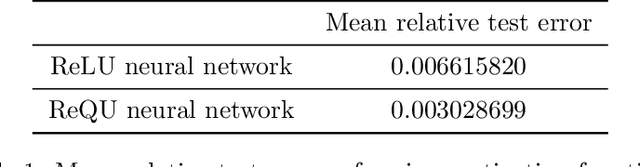
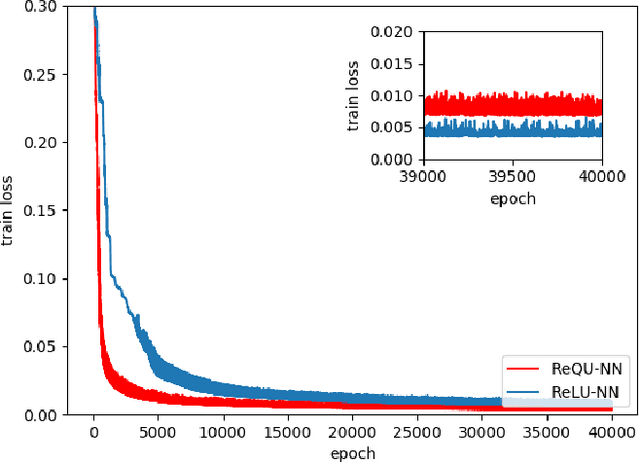
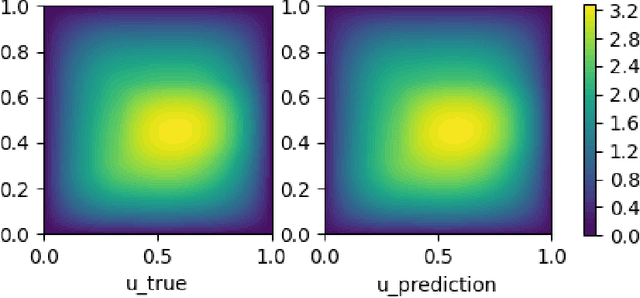
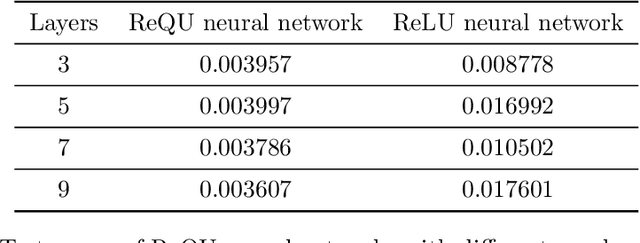
Implementing deep neural networks for learning the solution maps of parametric partial differential equations (PDEs) turns out to be more efficient than using many conventional numerical methods. However, limited theoretical analyses have been conducted on this approach. In this study, we investigate the expressive power of deep rectified quadratic unit (ReQU) neural networks for approximating the solution maps of parametric PDEs. The proposed approach is motivated by the recent important work of G. Kutyniok, P. Petersen, M. Raslan and R. Schneider (Gitta Kutyniok, Philipp Petersen, Mones Raslan, and Reinhold Schneider. A theoretical analysis of deep neural networks and parametric pdes. Constructive Approximation, pages 1-53, 2021), which uses deep rectified linear unit (ReLU) neural networks for solving parametric PDEs. In contrast to the previously established complexity-bound $\mathcal{O}\left(d^3\log_{2}^{q}(1/ \epsilon) \right)$ for ReLU neural networks, we derive an upper bound $\mathcal{O}\left(d^3\log_{2}^{q}\log_{2}(1/ \epsilon) \right)$ on the size of the deep ReQU neural network required to achieve accuracy $\epsilon>0$, where $d$ is the dimension of reduced basis representing the solutions. Our method takes full advantage of the inherent low-dimensionality of the solution manifolds and better approximation performance of deep ReQU neural networks. Numerical experiments are performed to verify our theoretical result.