 Add to Chrome
 Add to Firefox
 Add to Edge
Evaluating Accounting Reasoning Capabilities of Large Language Models
Jan 10, 2026
Large language models are transforming learning, cognition, and research across many fields. Effectively integrating them into professional domains, such as accounting, is a key challenge for enterprise digital transformation. To address this, we define vertical domain accounting reasoning and propose evaluation criteria derived from an analysis of the training data characteristics of representative GLM models. These criteria support systematic study of accounting reasoning and provide benchmarks for performance improvement. Using this framework, we evaluate GLM-6B, GLM-130B, GLM-4, and OpenAI GPT-4 on accounting reasoning tasks. Results show that prompt design significantly affects performance, with GPT-4 demonstrating the strongest capability. Despite these gains, current models remain insufficient for real-world enterprise accounting, indicating the need for further optimization to unlock their full practical value.

A New Framework for Explainable Rare Cell Identification in Single-Cell Transcriptomics Data
Jan 04, 2026The detection of rare cell types in single-cell transcriptomics data is crucial for elucidating disease pathogenesis and tissue development dynamics. However, a critical gap that persists in current methods is their inability to provide an explanation based on genes for each cell they have detected as rare. We identify three primary sources of this deficiency. First, the anomaly detectors often function as "black boxes", designed to detect anomalies but unable to explain why a cell is anomalous. Second, the standard analytical framework hinders interpretability by relying on dimensionality reduction techniques, such as Principal Component Analysis (PCA), which transform meaningful gene expression data into abstract, uninterpretable features. Finally, existing explanation algorithms cannot be readily applied to this domain, as single-cell data is characterized by high dimensionality, noise, and substantial sparsity. To overcome these limitations, we introduce a framework for explainable anomaly detection in single-cell transcriptomics data which not only identifies individual anomalies, but also provides a visual explanation based on genes that makes an instance anomalous. This framework has two key ingredients that are not existed in current methods applied in this domain. First, it eliminates the PCA step which is deemed to be an essential component in previous studies. Second, it employs the state-of-art anomaly detector and explainer as the efficient and effective means to find each rare cell and the relevant gene subspace in order to provide explanations for each rare cell as well as the typical normal cell associated with the rare cell's closest normal cells.
CAP-IQA: Context-Aware Prompt-Guided CT Image Quality Assessment
Jan 04, 2026Prompt-based methods, which encode medical priors through descriptive text, have been only minimally explored for CT Image Quality Assessment (IQA). While such prompts can embed prior knowledge about diagnostic quality, they often introduce bias by reflecting idealized definitions that may not hold under real-world degradations such as noise, motion artifacts, or scanner variability. To address this, we propose the Context-Aware Prompt-guided Image Quality Assessment (CAP-IQA) framework, which integrates text-level priors with instance-level context prompts and applies causal debiasing to separate idealized knowledge from factual, image-specific degradations. Our framework combines a CNN-based visual encoder with a domain-specific text encoder to assess diagnostic visibility, anatomical clarity, and noise perception in abdominal CT images. The model leverages radiology-style prompts and context-aware fusion to align semantic and perceptual representations. On the 2023 LDCTIQA challenge benchmark, CAP-IQA achieves an overall correlation score of 2.8590 (sum of PLCC, SROCC, and KROCC), surpassing the top-ranked leaderboard team (2.7427) by 4.24%. Moreover, our comprehensive ablation experiments confirm that prompt-guided fusion and the simplified encoder-only design jointly enhance feature alignment and interpretability. Furthermore, evaluation on an in-house dataset of 91,514 pediatric CT images demonstrates the true generalizability of CAP-IQA in assessing perceptual fidelity in a different patient population.
T2VAttack: Adversarial Attack on Text-to-Video Diffusion Models
Dec 30, 2025The rapid evolution of Text-to-Video (T2V) diffusion models has driven remarkable advancements in generating high-quality, temporally coherent videos from natural language descriptions. Despite these achievements, their vulnerability to adversarial attacks remains largely unexplored. In this paper, we introduce T2VAttack, a comprehensive study of adversarial attacks on T2V diffusion models from both semantic and temporal perspectives. Considering the inherently dynamic nature of video data, we propose two distinct attack objectives: a semantic objective to evaluate video-text alignment and a temporal objective to assess the temporal dynamics. To achieve an effective and efficient attack process, we propose two adversarial attack methods: (i) T2VAttack-S, which identifies semantically or temporally critical words in prompts and replaces them with synonyms via greedy search, and (ii) T2VAttack-I, which iteratively inserts optimized words with minimal perturbation to the prompt. By combining these objectives and strategies, we conduct a comprehensive evaluation on the adversarial robustness of several state-of-the-art T2V models, including ModelScope, CogVideoX, Open-Sora, and HunyuanVideo. Our experiments reveal that even minor prompt modifications, such as the substitution or insertion of a single word, can cause substantial degradation in semantic fidelity and temporal dynamics, highlighting critical vulnerabilities in current T2V diffusion models.
Training Report of TeleChat3-MoE
Dec 30, 2025TeleChat3-MoE is the latest series of TeleChat large language models, featuring a Mixture-of-Experts (MoE) architecture with parameter counts ranging from 105 billion to over one trillion,trained end-to-end on Ascend NPU cluster. This technical report mainly presents the underlying training infrastructure that enables reliable and efficient scaling to frontier model sizes. We detail systematic methodologies for operator-level and end-to-end numerical accuracy verification, ensuring consistency across hardware platforms and distributed parallelism strategies. Furthermore, we introduce a suite of performance optimizations, including interleaved pipeline scheduling, attention-aware data scheduling for long-sequence training,hierarchical and overlapped communication for expert parallelism, and DVM-based operator fusion. A systematic parallelization framework, leveraging analytical estimation and integer linear programming, is also proposed to optimize multi-dimensional parallelism configurations. Additionally, we present methodological approaches to cluster-level optimizations, addressing host- and device-bound bottlenecks during large-scale training tasks. These infrastructure advancements yield significant throughput improvements and near-linear scaling on clusters comprising thousands of devices, providing a robust foundation for large-scale language model development on hardware ecosystems.
Exploring the Vertical-Domain Reasoning Capabilities of Large Language Models
Dec 27, 2025Large Language Models (LLMs) are reshaping learning paradigms, cognitive processes, and research methodologies across a wide range of domains. Integrating LLMs with professional fields and redefining the relationship between LLMs and domain-specific applications has become a critical challenge for promoting enterprise digital transformation and broader social development. To effectively integrate LLMs into the accounting domain, it is essential to understand their domain-specific reasoning capabilities. This study introduces the concept of vertical-domain accounting reasoning and establishes evaluation criteria by analyzing the training data characteristics of representative GLM-series models. These criteria provide a foundation for subsequent research on reasoning paradigms and offer benchmarks for improving accounting reasoning performance. Based on this framework, we evaluate several representative models, including GLM-6B, GLM-130B, GLM-4, and OpenAI GPT-4, on a set of accounting reasoning tasks. Experimental results show that different prompt engineering strategies lead to varying degrees of performance improvement across models, with GPT-4 achieving the strongest accounting reasoning capability. However, current LLMs still fall short of real-world application requirements. In particular, further optimization is needed for deployment in enterprise-level accounting scenarios to fully realize the potential value of LLMs in this domain.
Steering Vision-Language Pre-trained Models for Incremental Face Presentation Attack Detection
Dec 24, 2025Face Presentation Attack Detection (PAD) demands incremental learning (IL) to combat evolving spoofing tactics and domains. Privacy regulations, however, forbid retaining past data, necessitating rehearsal-free IL (RF-IL). Vision-Language Pre-trained (VLP) models, with their prompt-tunable cross-modal representations, enable efficient adaptation to new spoofing styles and domains. Capitalizing on this strength, we propose \textbf{SVLP-IL}, a VLP-based RF-IL framework that balances stability and plasticity via \textit{Multi-Aspect Prompting} (MAP) and \textit{Selective Elastic Weight Consolidation} (SEWC). MAP isolates domain dependencies, enhances distribution-shift sensitivity, and mitigates forgetting by jointly exploiting universal and domain-specific cues. SEWC selectively preserves critical weights from previous tasks, retaining essential knowledge while allowing flexibility for new adaptations. Comprehensive experiments across multiple PAD benchmarks show that SVLP-IL significantly reduces catastrophic forgetting and enhances performance on unseen domains. SVLP-IL offers a privacy-compliant, practical solution for robust lifelong PAD deployment in RF-IL settings.
Semantic Mismatch and Perceptual Degradation: A New Perspective on Image Editing Immunity
Dec 16, 2025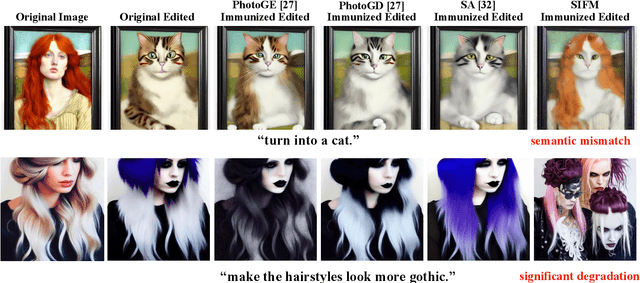
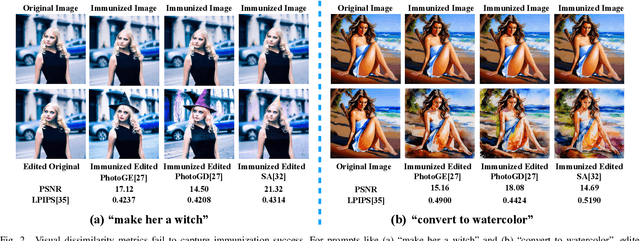
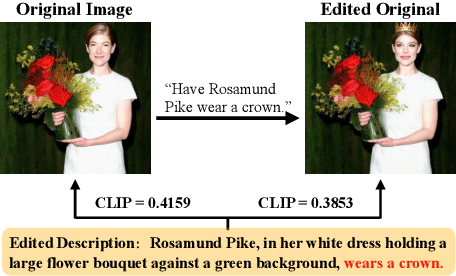
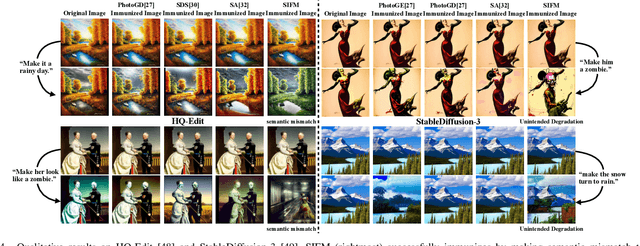
Text-guided image editing via diffusion models, while powerful, raises significant concerns about misuse, motivating efforts to immunize images against unauthorized edits using imperceptible perturbations. Prevailing metrics for evaluating immunization success typically rely on measuring the visual dissimilarity between the output generated from a protected image and a reference output generated from the unprotected original. This approach fundamentally overlooks the core requirement of image immunization, which is to disrupt semantic alignment with attacker intent, regardless of deviation from any specific output. We argue that immunization success should instead be defined by the edited output either semantically mismatching the prompt or suffering substantial perceptual degradations, both of which thwart malicious intent. To operationalize this principle, we propose Synergistic Intermediate Feature Manipulation (SIFM), a method that strategically perturbs intermediate diffusion features through dual synergistic objectives: (1) maximizing feature divergence from the original edit trajectory to disrupt semantic alignment with the expected edit, and (2) minimizing feature norms to induce perceptual degradations. Furthermore, we introduce the Immunization Success Rate (ISR), a novel metric designed to rigorously quantify true immunization efficacy for the first time. ISR quantifies the proportion of edits where immunization induces either semantic failure relative to the prompt or significant perceptual degradations, assessed via Multimodal Large Language Models (MLLMs). Extensive experiments show our SIFM achieves the state-of-the-art performance for safeguarding visual content against malicious diffusion-based manipulation.
Towards Transferable Defense Against Malicious Image Edits
Dec 16, 2025Recent approaches employing imperceptible perturbations in input images have demonstrated promising potential to counter malicious manipulations in diffusion-based image editing systems. However, existing methods suffer from limited transferability in cross-model evaluations. To address this, we propose Transferable Defense Against Malicious Image Edits (TDAE), a novel bimodal framework that enhances image immunity against malicious edits through coordinated image-text optimization. Specifically, at the visual defense level, we introduce FlatGrad Defense Mechanism (FDM), which incorporates gradient regularization into the adversarial objective. By explicitly steering the perturbations toward flat minima, FDM amplifies immune robustness against unseen editing models. For textual enhancement protection, we propose an adversarial optimization paradigm named Dynamic Prompt Defense (DPD), which periodically refines text embeddings to align the editing outcomes of immunized images with those of the original images, then updates the images under optimized embeddings. Through iterative adversarial updates to diverse embeddings, DPD enforces the generation of immunized images that seek a broader set of immunity-enhancing features, thereby achieving cross-model transferability. Extensive experimental results demonstrate that our TDAE achieves state-of-the-art performance in mitigating malicious edits under both intra- and cross-model evaluations.
Dual Attention Guided Defense Against Malicious Edits
Dec 16, 2025Recent progress in text-to-image diffusion models has transformed image editing via text prompts, yet this also introduces significant ethical challenges from potential misuse in creating deceptive or harmful content. While current defenses seek to mitigate this risk by embedding imperceptible perturbations, their effectiveness is limited against malicious tampering. To address this issue, we propose a Dual Attention-Guided Noise Perturbation (DANP) immunization method that adds imperceptible perturbations to disrupt the model's semantic understanding and generation process. DANP functions over multiple timesteps to manipulate both cross-attention maps and the noise prediction process, using a dynamic threshold to generate masks that identify text-relevant and irrelevant regions. It then reduces attention in relevant areas while increasing it in irrelevant ones, thereby misguides the edit towards incorrect regions and preserves the intended targets. Additionally, our method maximizes the discrepancy between the injected noise and the model's predicted noise to further interfere with the generation. By targeting both attention and noise prediction mechanisms, DANP exhibits impressive immunity against malicious edits, and extensive experiments confirm that our method achieves state-of-the-art performance.