 Add to Chrome
 Add to Firefox
 Add to Edge
InCTRLv2: Generalist Residual Models for Few-Shot Anomaly Detection and Segmentation
Apr 06, 2026
While recent anomaly detection (AD) methods have made substantial progress in recognizing abnormal patterns within specific domains, most of them are specialist models that are trained on large training samples from a specific target dataset, struggling to generalize to unseen datasets. To address this limitation, the paradigm of Generalist Anomaly Detection (GAD) has emerged in recent years, aiming to learn a single generalist model to detect anomalies across diverse domains without retraining. To this end, this work introduces InCTRLv2, a novel few-shot Generalist Anomaly Detection and Segmentation (GADS) framework that significantly extends our previously proposed GAD model, InCTRL. Building on the idea of learning in-context residuals with few-shot normal examples to detect anomalies as in InCTRL, InCTRLv2 introduces two new, complementary perspectives of anomaly perception under a dual-branch framework. This is accomplished by two novel modules upon InCTRL: i) Discriminative Anomaly Score Learning (DASL) with both normal and abnormal data in the main branch, which learns a semantic-guided abnormality and normality space that supports the classification of query samples from both the abnormality and normality perspectives; and ii) One-class Anomaly Score Learning (OASL) using only the normal data, which learns generalized normality patterns in a semantic space via an auxiliary branch, focusing on detecting anomalies through the lens of normality solely. Both branches are guided by rich visual-text semantic priors encoded by large-scale vision-language models. Together, they offer a dual semantic perspective for AD: one emphasizes normal-abnormal discriminations, while the other emphasizes normality-deviated semantics. Extensive experiments on ten AD datasets demonstrate that InCTRLv2 achieves SotA performance in both anomaly detection and segmentation tasks across various settings.

Robust Hallucination Detection in LLMs via Adaptive Token Selection
Apr 10, 2025Hallucinations in large language models (LLMs) pose significant safety concerns that impede their broader deployment. Recent research in hallucination detection has demonstrated that LLMs' internal representations contain truthfulness hints, which can be harnessed for detector training. However, the performance of these detectors is heavily dependent on the internal representations of predetermined tokens, fluctuating considerably when working on free-form generations with varying lengths and sparse distributions of hallucinated entities. To address this, we propose HaMI, a novel approach that enables robust detection of hallucinations through adaptive selection and learning of critical tokens that are most indicative of hallucinations. We achieve this robustness by an innovative formulation of the Hallucination detection task as Multiple Instance (HaMI) learning over token-level representations within a sequence, thereby facilitating a joint optimisation of token selection and hallucination detection on generation sequences of diverse forms. Comprehensive experimental results on four hallucination benchmarks show that HaMI significantly outperforms existing state-of-the-art approaches.
Mitigating Hallucinations in Large Language Models via Self-Refinement-Enhanced Knowledge Retrieval
May 10, 2024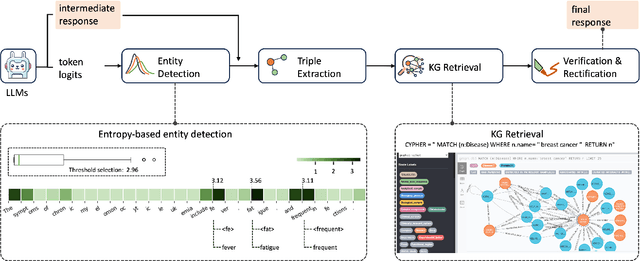
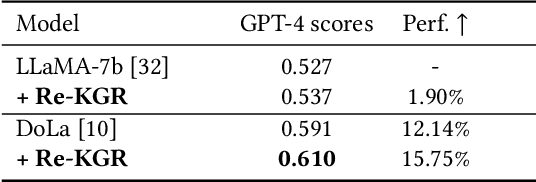

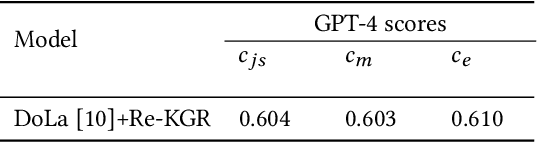
Large language models (LLMs) have demonstrated remarkable capabilities across various domains, although their susceptibility to hallucination poses significant challenges for their deployment in critical areas such as healthcare. To address this issue, retrieving relevant facts from knowledge graphs (KGs) is considered a promising method. Existing KG-augmented approaches tend to be resource-intensive, requiring multiple rounds of retrieval and verification for each factoid, which impedes their application in real-world scenarios. In this study, we propose Self-Refinement-Enhanced Knowledge Graph Retrieval (Re-KGR) to augment the factuality of LLMs' responses with less retrieval efforts in the medical field. Our approach leverages the attribution of next-token predictive probability distributions across different tokens, and various model layers to primarily identify tokens with a high potential for hallucination, reducing verification rounds by refining knowledge triples associated with these tokens. Moreover, we rectify inaccurate content using retrieved knowledge in the post-processing stage, which improves the truthfulness of generated responses. Experimental results on a medical dataset demonstrate that our approach can enhance the factual capability of LLMs across various foundational models as evidenced by the highest scores on truthfulness.
Joint Problems in Learning Multiple Dynamical Systems
Nov 03, 2023Clustering of time series is a well-studied problem, with applications ranging from quantitative, personalized models of metabolism obtained from metabolite concentrations to state discrimination in quantum information theory. We consider a variant, where given a set of trajectories and a number of parts, we jointly partition the set of trajectories and learn linear dynamical system (LDS) models for each part, so as to minimize the maximum error across all the models. We present globally convergent methods and EM heuristics, accompanied by promising computational results.
Effective Abnormal Activity Detection on Multivariate Time Series Healthcare Data
Sep 11, 2023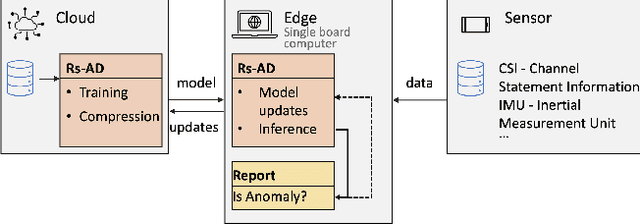
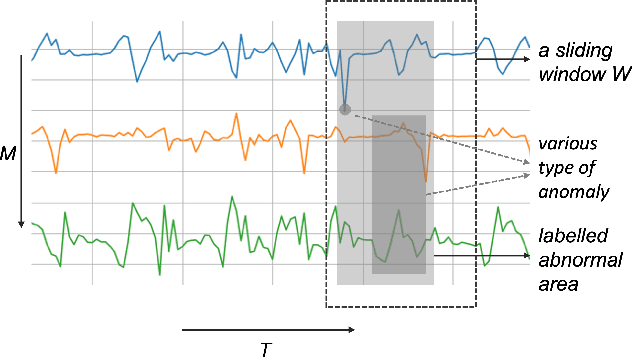
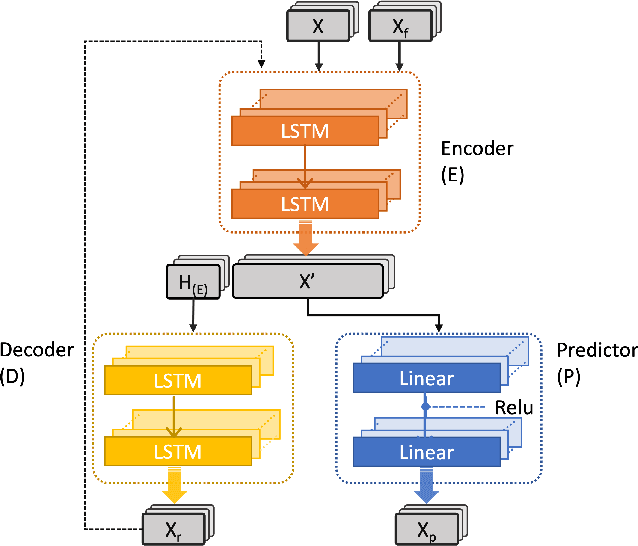
Multivariate time series (MTS) data collected from multiple sensors provide the potential for accurate abnormal activity detection in smart healthcare scenarios. However, anomalies exhibit diverse patterns and become unnoticeable in MTS data. Consequently, achieving accurate anomaly detection is challenging since we have to capture both temporal dependencies of time series and inter-relationships among variables. To address this problem, we propose a Residual-based Anomaly Detection approach, Rs-AD, for effective representation learning and abnormal activity detection. We evaluate our scheme on a real-world gait dataset and the experimental results demonstrate an F1 score of 0.839.