 Add to Chrome
 Add to Firefox
 Add to Edge
GP2F: Cross-Domain Graph Prompting with Adaptive Fusion of Pre-trained Graph Neural Networks
Feb 12, 2026
Graph Prompt Learning (GPL) has recently emerged as a promising paradigm for downstream adaptation of pre-trained graph models, mitigating the misalignment between pre-training objectives and downstream tasks. Recently, the focus of GPL has shifted from in-domain to cross-domain scenarios, which is closer to the real world applications, where the pre-training source and downstream target often differ substantially in data distribution. However, why GPLs remain effective under such domain shifts is still unexplored. Empirically, we observe that representative GPL methods are competitive with two simple baselines in cross-domain settings: full fine-tuning (FT) and linear probing (LP), motivating us to explore a deeper understanding of the prompting mechanism. We provide a theoretical analysis demonstrating that jointly leveraging these two complementary branches yields a smaller estimation error than using either branch alone, formally proving that cross-domain GPL benefits from the integration between pre-trained knowledge and task-specific adaptation. Based on this insight, we propose GP2F, a dual-branch GPL method that explicitly instantiates the two extremes: (1) a frozen branch that retains pre-trained knowledge, and (2) an adapted branch with lightweight adapters for task-specific adaptation. We then perform adaptive fusion under topology constraints via a contrastive loss and a topology-consistent loss. Extensive experiments on cross-domain few-shot node and graph classification demonstrate that our method outperforms existing methods.

Adaptive$^2$: Adaptive Domain Mining for Fine-grained Domain Adaptation Modeling
Dec 11, 2024

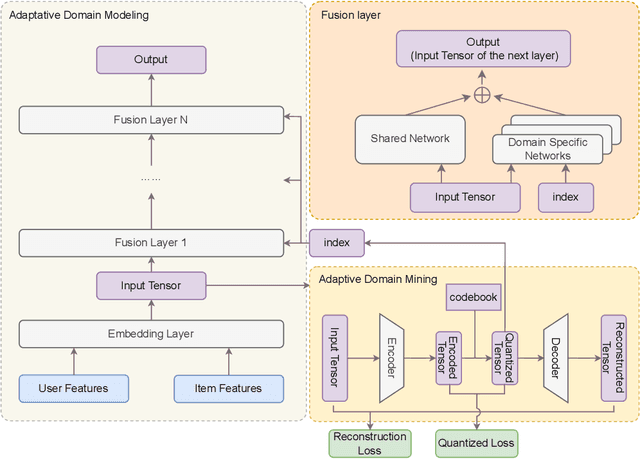

Advertising systems often face the multi-domain challenge, where data distributions vary significantly across scenarios. Existing domain adaptation methods primarily focus on building domain-adaptive neural networks but often rely on hand-crafted domain information, e.g., advertising placement, which may be sub-optimal. We think that fine-grained "domain" patterns exist that are difficult to hand-craft in online advertisement. Thus, we propose Adaptive$^2$, a novel framework that first learns domains adaptively using a domain mining module by self-supervision and then employs a shared&specific network to model shared and conflicting information. As a practice, we use VQ-VAE as the domain mining module and conduct extensive experiments on public benchmarks. Results show that traditional domain adaptation methods with hand-crafted domains perform no better than single-domain models under fair FLOPS conditions, highlighting the importance of domain definition. In contrast, Adaptive$^2$ outperforms existing approaches, emphasizing the effectiveness of our method and the significance of domain mining. We also deployed Adaptive$^2$ in the live streaming scenario of Kuaishou Advertising System, demonstrating its commercial value and potential for automatic domain identification. To the best of our knowledge, Adaptive$^2$ is the first approach to automatically learn both domain identification and adaptation in online advertising, opening new research directions for this area.
ADBM: Adversarial diffusion bridge model for reliable adversarial purification
Aug 01, 2024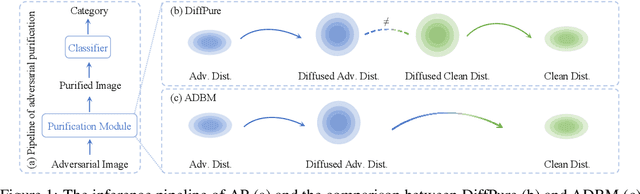
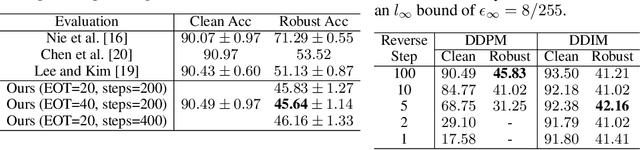
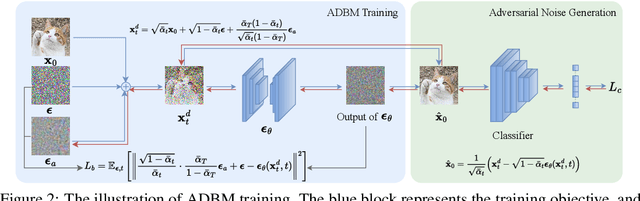
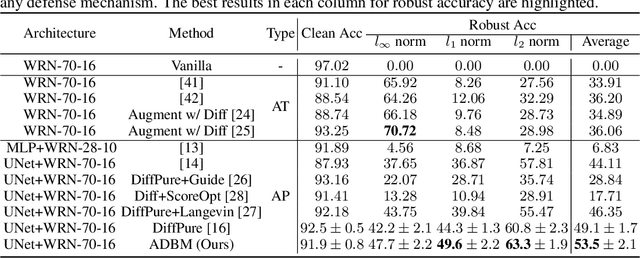
Recently Diffusion-based Purification (DiffPure) has been recognized as an effective defense method against adversarial examples. However, we find DiffPure which directly employs the original pre-trained diffusion models for adversarial purification, to be suboptimal. This is due to an inherent trade-off between noise purification performance and data recovery quality. Additionally, the reliability of existing evaluations for DiffPure is questionable, as they rely on weak adaptive attacks. In this work, we propose a novel Adversarial Diffusion Bridge Model, termed ADBM. ADBM directly constructs a reverse bridge from the diffused adversarial data back to its original clean examples, enhancing the purification capabilities of the original diffusion models. Through theoretical analysis and experimental validation across various scenarios, ADBM has proven to be a superior and robust defense mechanism, offering significant promise for practical applications.