 Add to Chrome
 Add to Firefox
 Add to Edge
Herculean: An Agentic Benchmark for Financial Intelligence
May 14, 2026
As AI agents improve, the central question is no longer whether they can solve isolated well-defined financial tasks, but whether they can reliably carry out financial professional work. Existing financial benchmarks offer only a partial view of this ability, as they primarily evaluate static competencies such as question answering, retrieval, summarization, and classification. We introduce Herculean, the first skilled benchmark for agentic financial intelligence spanning four representative workflows, including Trading, Hedging, Market Insights, and Auditing. Each workflow is instantiated as a standardized MCP-based skill environment with its own tools, interaction dynamics, constraints, and success criteria, enabling consistent end-to-end assessment of heterogeneous agent systems. Across frontier agents, we find agents perform relatively well on Trading and Market Insights, but struggle substantially on Hedging and Auditing, where long-horizon coordination, state consistency, and structured verification are critical. Overall, our results point to a key gap in current agents in turning financial reasoning into dependable workflow execution in high-stakes financial workflows.

From Sufficiency to Reflection: Reinforcement-Guided Thinking Quality in Retrieval-Augmented Reasoning for LLMs
Jul 30, 2025Reinforcement learning-based retrieval-augmented generation (RAG) methods enhance the reasoning abilities of large language models (LLMs). However, most rely only on final-answer rewards, overlooking intermediate reasoning quality. This paper analyzes existing RAG reasoning models and identifies three main failure patterns: (1) information insufficiency, meaning the model fails to retrieve adequate support; (2) faulty reasoning, where logical or content-level flaws appear despite sufficient information; and (3) answer-reasoning inconsistency, where a valid reasoning chain leads to a mismatched final answer. We propose TIRESRAG-R1, a novel framework using a think-retrieve-reflect process and a multi-dimensional reward system to improve reasoning and stability. TIRESRAG-R1 introduces: (1) a sufficiency reward to encourage thorough retrieval; (2) a reasoning quality reward to assess the rationality and accuracy of the reasoning chain; and (3) a reflection reward to detect and revise errors. It also employs a difficulty-aware reweighting strategy and training sample filtering to boost performance on complex tasks. Experiments on four multi-hop QA datasets show that TIRESRAG-R1 outperforms prior RAG methods and generalizes well to single-hop tasks. The code and data are available at: https://github.com/probe2/TIRESRAG-R1.
Evaluating and Improving Graph to Text Generation with Large Language Models
Jan 24, 2025Large language models (LLMs) have demonstrated immense potential across various tasks. However, research for exploring and improving the capabilities of LLMs in interpreting graph structures remains limited. To address this gap, we conduct a comprehensive evaluation of prompting current open-source LLMs on graph-to-text generation tasks. Although we explored the optimal prompting strategies and proposed a novel and effective diversity-difficulty-based few-shot sample selection method, we found that the improvements from tuning-free approaches were incremental, as LLMs struggle with planning on complex graphs, particularly those with a larger number of triplets. To further improve LLMs in planning with graph sequences and grounding in truth, we introduce a new graph-to-text dataset, PlanGTG, annotated with two sub-tasks: reordering and attribution. Through extensive automatic and human evaluations, we demonstrate significant improvements in the quality of generated text from both few-shot learning and fine-tuning perspectives using the PlanGTG dataset. Our study paves the way for new research directions in graph-to-text generation. PlanGTG datasets can be found in https://github.com/probe2/kg_text.
MiCEval: Unveiling Multimodal Chain of Thought's Quality via Image Description and Reasoning Steps
Oct 18, 2024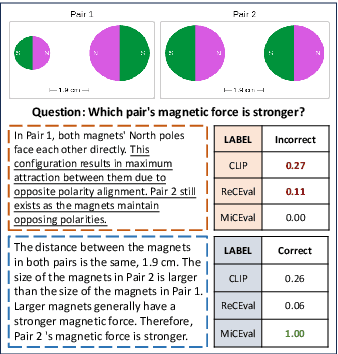


Multimodal Chain of Thought (MCoT) is a popular prompting strategy for improving the performance of multimodal large language models (MLLMs) across a range of complex reasoning tasks. Despite its popularity, there is a notable absence of automated methods for evaluating the quality of reasoning steps in MCoT. To address this gap, we propose Multimodal Chain-of-Thought Evaluation (MiCEval), a framework designed to assess the correctness of reasoning chains by evaluating the quality of both the description and each reasoning step. The evaluation of the description component focuses on the accuracy of the image descriptions, while the reasoning step evaluates the quality of each step as it is conditionally generated based on the preceding steps. MiCEval is built upon a fine-grained dataset with annotations that rate each step according to correctness, relevance, and informativeness. Extensive experiments on four state-of-the-art MLLMs show that step-wise evaluations using MiCEval align more closely with human judgments compared to existing methods based on cosine similarity or fine-tuning approaches. MiCEval datasets and code can be found in https://github.com/alenai97/MiCEval.