 Add to Chrome
 Add to Firefox
 Add to Edge
SwarmX: Agentic Scheduling for Low-Latency Agentic Systems
Jun 19, 2026
Agentic AI applications compose multiple model calls and tool executions, creating new scheduling challenges for GPU-CPU clusters. Their inference time and model-call structure often depend on prompt semantics, making conventional scheduling approaches ineffective for low-latency serving. This paper presents SwarmX, a system that implements agentic scheduling for low-latency agentic applications. SwarmX uses scheduling-specific neural predictors to capture prompt, device, runtime, and target-model features; exposes distributional predictions to routers and scalers for tail-aware decisions; and provides mechanisms for predictor training and online adaptation. These predictors and mechanisms are integrated into a scheduler-agent framework that provides a common substrate for integration with existing scheduling and model-serving infrastructure. We evaluate SwarmX using production deployment (nearly one thousand GPUs and one million CPU cores) and controlled experiments on a 128-GPU testbed. Across multi-agent code generation, deep research, and multimodal agentic workflows, SwarmX reduces tail latency by up to 61.5% compared to state-of-the-art schedulers and sustains up to 2x the throughput of production schedulers under the same SLO.

Ling and Ring 2.6 Technical Report: Efficient and Instant Agentic Intelligence at Trillion-Parameter Scale
Jun 13, 2026Efficient and scalable agentic intelligence requires models that can deliver both low-latency responses and strong reasoning capabilities while remaining practical to train, serve, and deploy. In this report, we present Ling-2.6 and Ring-2.6, a family of models designed to address this challenge at scale. Ling-2.6 is optimized for instant response generation and high capability per output token, whereas Ring-2.6 is tailored for deeper reasoning and more advanced agentic workflows. Instead of training from scratch, we upgrade the Ling-2.0 base model through architectural migration pre-training and large-scale post-training. This upgrade is guided by a unified co-design of model architecture, optimization objectives, serving systems, and agent training environments, enabling improvements in both model capability and deployment efficiency. At the architectural level, we introduce a hybrid linear attention design that integrates Lightning Attention with MLA, improving the efficiency of long-context training and decoding. To further enhance token efficiency, we optimize capability per output token through Evolutionary Chain-of-Thought, Linguistic Unit Policy Optimization, bidirectional preference alignment, and shortest-correct-response distillation. For agentic capabilities, we propose KPop, a reinforcement learning framework designed to support stable training of Ring-2.6-1T on large-scale environment-grounded data. KPop improves training efficiency through asynchronous scheduling across coding, search, tool use, and workflow execution, enabling scalable learning from complex agent-environment interactions. Together, Ling-2.6 and Ring-2.6 provide a practical pathway toward efficient, scalable, and open agentic systems. We open-source all checkpoints in the 2.6 family to support further research and development in practical agentic intelligence.
LEGS: Laplacian-Enhanced Gaussian Splatting with a Nonlinear Weighted Loss
Jun 06, 20263D Gaussian Splatting (3DGS) has become an efficient explicit representation for radiance field reconstruction and real-time novel view synthesis. However, its standard photometric loss treats flat and structure-rich regions similarly, which may limit the recovery of sharp contours and fine details. Edge-Guided Gaussian Splatting (EGGS) improves structure awareness through edge-guided weighting, but mainly relies on first-order gradient responses and linear weighting. In this paper, we propose LEGS, a Laplacian-Enhanced Gaussian Splatting method with a nonlinearly weighted loss. LEGS replaces first-order gradient guidance with second-order Laplacian structural guidance and maps the normalized Laplacian response into pixel-wise weights through nonlinear response-to-weight functions. The proposed loss improves structure-aware Gaussian optimization while keeping the original 3DGS rendering pipeline unchanged. Experiments on the full Tanks\&Temples and Mip-NeRF360 datasets show that LEGS improves peak signal-to-noise ratio (PSNR) by up to 1.68 dB over 3DGS and up to 0.52 dB over EGGS. Incorporating the proposed second-order nonlinear weighting strategy into FastGS and FasterGS further improves PSNR by up to 1.69 dB, demonstrating its effectiveness as a general loss-level extension for Gaussian Splatting pipelines with potential applications in AR/VR, immersive visualization, and real-time 3D content generation.
A data-driven approach to inferring travel trajectory during peak hours in urban rail transit systems
Dec 10, 2025Refined trajectory inference of urban rail transit is of great significance to the operation organization. In this paper, we develop a fully data-driven approach to inferring individual travel trajectories in urban rail transit systems. It utilizes data from the Automatic Fare Collection (AFC) and Automatic Vehicle Location (AVL) systems to infer key trajectory elements, such as selected train, access/egress time, and transfer time. The approach includes establishing train alternative sets based on spatio-temporal constraints, data-driven adaptive trajectory inference, and trave l trajectory construction. To realize data-driven adaptive trajectory inference, a data-driven parameter estimation method based on KL divergence combined with EM algorithm (KLEM) was proposed. This method eliminates the reliance on external or survey data for parameter fitting, enhancing the robustness and applicability of the model. Furthermore, to overcome the limitations of using synthetic data to validate the result, this paper employs real individual travel trajectory data for verification. The results show that the approach developed in this paper can achieve high-precision passenger trajectory inference, with an accuracy rate of over 90% in urban rail transit travel trajectory inference during peak hours.
RAGBoost: Efficient Retrieval-Augmented Generation with Accuracy-Preserving Context Reuse
Nov 05, 2025Retrieval-augmented generation (RAG) enhances large language models (LLMs) with retrieved context but often suffers from downgraded prefill performance as modern applications demand longer and more complex inputs. Existing caching techniques either preserve accuracy with low cache reuse or improve reuse at the cost of degraded reasoning quality. We present RAGBoost, an efficient RAG system that achieves high cache reuse without sacrificing accuracy through accuracy-preserving context reuse. RAGBoost detects overlapping retrieved items across concurrent sessions and multi-turn interactions, using efficient context indexing, ordering, and de-duplication to maximize reuse, while lightweight contextual hints maintain reasoning fidelity. It integrates seamlessly with existing LLM inference engines and improves their prefill performance by 1.5-3X over state-of-the-art methods, while preserving or even enhancing reasoning accuracy across diverse RAG and agentic AI workloads. Our code is released at: https://github.com/Edinburgh-AgenticAI/RAGBoost.
D2SL: Decouple Defogging and Semantic Learning for Foggy Domain-Adaptive Segmentation
Apr 07, 2024We investigated domain adaptive semantic segmentation in foggy weather scenarios, which aims to enhance the utilization of unlabeled foggy data and improve the model's adaptability to foggy conditions. Current methods rely on clear images as references, jointly learning defogging and segmentation for foggy images. Despite making some progress, there are still two main drawbacks: (1) the coupling of segmentation and defogging feature representations, resulting in a decrease in semantic representation capability, and (2) the failure to leverage real fog priors in unlabeled foggy data, leading to insufficient model generalization ability. To address these issues, we propose a novel training framework, Decouple Defogging and Semantic learning, called D2SL, aiming to alleviate the adverse impact of defogging tasks on the final segmentation task. In this framework, we introduce a domain-consistent transfer strategy to establish a connection between defogging and segmentation tasks. Furthermore, we design a real fog transfer strategy to improve defogging effects by fully leveraging the fog priors from real foggy images. Our approach enhances the semantic representations required for segmentation during the defogging learning process and maximizes the representation capability of fog invariance by effectively utilizing real fog data. Comprehensive experiments validate the effectiveness of the proposed method.
Valid Information Guidance Network for Compressed Video Quality Enhancement
Feb 28, 2023

In recent years deep learning methods have shown great superiority in compressed video quality enhancement tasks. Existing methods generally take the raw video as the ground truth and extract practical information from consecutive frames containing various artifacts. However, they do not fully exploit the valid information of compressed and raw videos to guide the quality enhancement for compressed videos. In this paper, we propose a unique Valid Information Guidance scheme (VIG) to enhance the quality of compressed videos by mining valid information from both compressed videos and raw videos. Specifically, we propose an efficient framework, Compressed Redundancy Filtering (CRF) network, to balance speed and enhancement. After removing the redundancy by filtering the information, CRF can use the valid information of the compressed video to reconstruct the texture. Furthermore, we propose a progressive Truth Guidance Distillation (TGD) strategy, which does not need to design additional teacher models and distillation loss functions. By only using the ground truth as input to guide the model to aggregate the correct spatio-temporal correspondence across the raw frames, TGD can significantly improve the enhancement effect without increasing the extra training cost. Extensive experiments show that our method achieves the state-of-the-art performance of compressed video quality enhancement in terms of accuracy and efficiency.
NFL: Robust Learned Index via Distribution Transformation
May 24, 2022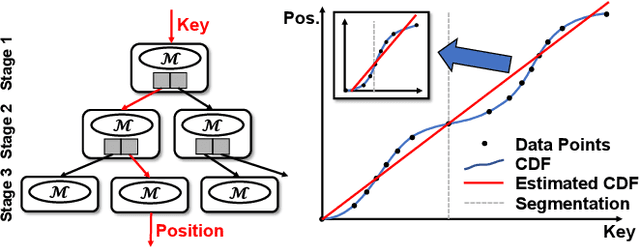
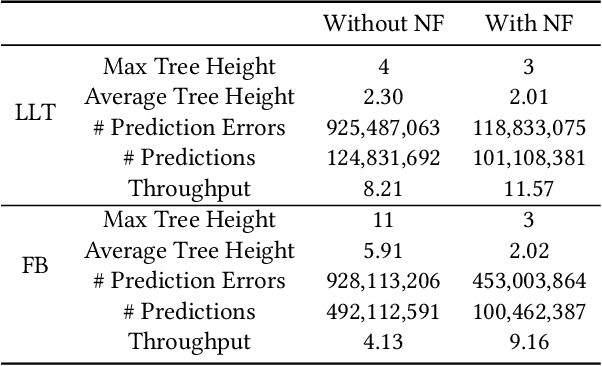
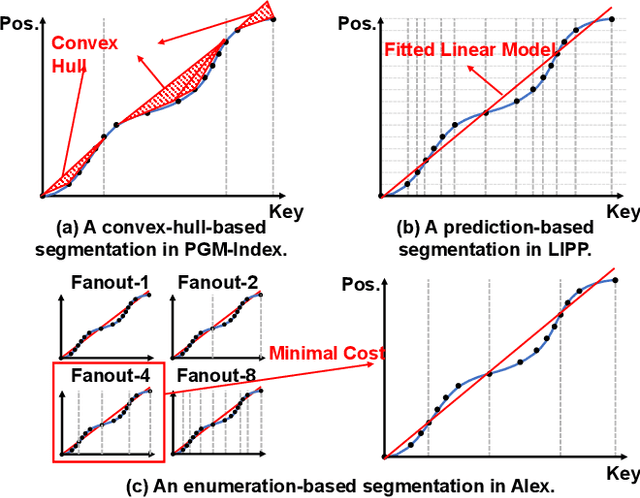
Recent works on learned index open a new direction for the indexing field. The key insight of the learned index is to approximate the mapping between keys and positions with piece-wise linear functions. Such methods require partitioning key space for a better approximation. Although lots of heuristics are proposed to improve the approximation quality, the bottleneck is that the segmentation overheads could hinder the overall performance. This paper tackles the approximation problem by applying a \textit{distribution transformation} to the keys before constructing the learned index. A two-stage Normalizing-Flow-based Learned index framework (NFL) is proposed, which first transforms the original complex key distribution into a near-uniform distribution, then builds a learned index leveraging the transformed keys. For effective distribution transformation, we propose a Numerical Normalizing Flow (Numerical NF). Based on the characteristics of the transformed keys, we propose a robust After-Flow Learned Index (AFLI). To validate the performance, comprehensive evaluations are conducted on both synthetic and real-world workloads, which shows that the proposed NFL produces the highest throughput and the lowest tail latency compared to the state-of-the-art learned indexes.