 Add to Chrome
 Add to Firefox
 Add to Edge
Reinforced In-Context Black-Box Optimization
Feb 27, 2024
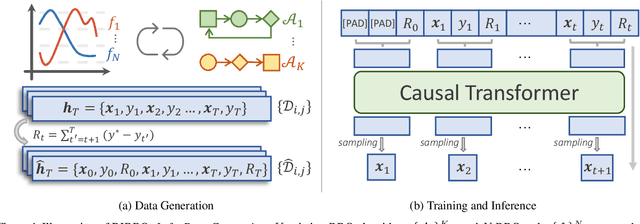
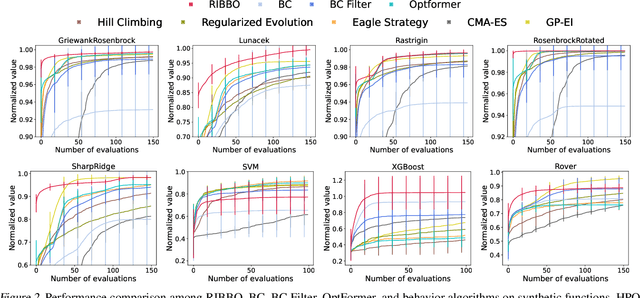
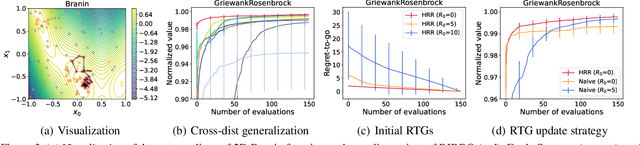
Black-Box Optimization (BBO) has found successful applications in many fields of science and engineering. Recently, there has been a growing interest in meta-learning particular components of BBO algorithms to speed up optimization and get rid of tedious hand-crafted heuristics. As an extension, learning the entire algorithm from data requires the least labor from experts and can provide the most flexibility. In this paper, we propose RIBBO, a method to reinforce-learn a BBO algorithm from offline data in an end-to-end fashion. RIBBO employs expressive sequence models to learn the optimization histories produced by multiple behavior algorithms and tasks, leveraging the in-context learning ability of large models to extract task information and make decisions accordingly. Central to our method is to augment the optimization histories with regret-to-go tokens, which are designed to represent the performance of an algorithm based on cumulative regret of the histories. The integration of regret-to-go tokens enables RIBBO to automatically generate sequences of query points that satisfy the user-desired regret, which is verified by its universally good empirical performance on diverse problems, including BBOB functions, hyper-parameter optimization and robot control problems.

Enhancing Robotic Manipulation with AI Feedback from Multimodal Large Language Models
Feb 22, 2024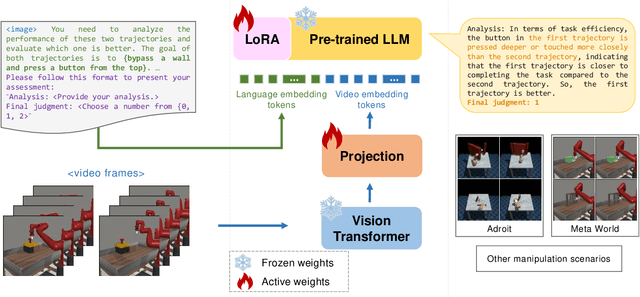
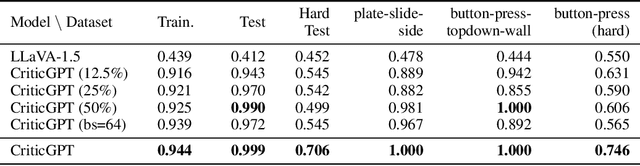
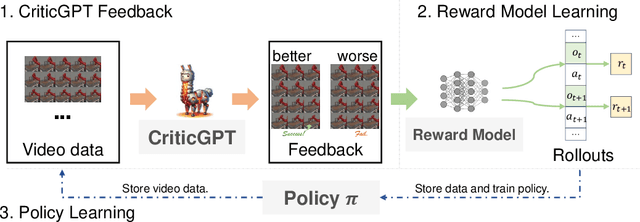
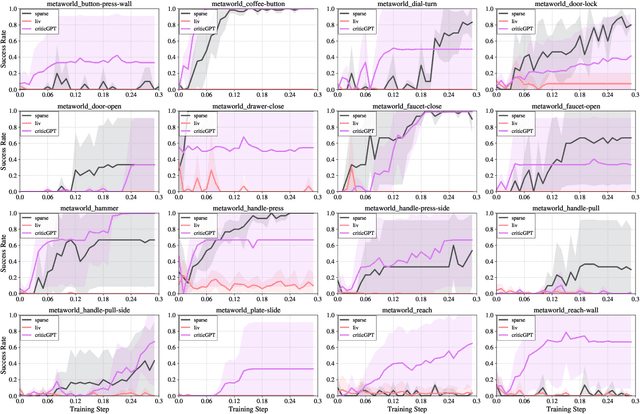
Recently, there has been considerable attention towards leveraging large language models (LLMs) to enhance decision-making processes. However, aligning the natural language text instructions generated by LLMs with the vectorized operations required for execution presents a significant challenge, often necessitating task-specific details. To circumvent the need for such task-specific granularity, inspired by preference-based policy learning approaches, we investigate the utilization of multimodal LLMs to provide automated preference feedback solely from image inputs to guide decision-making. In this study, we train a multimodal LLM, termed CriticGPT, capable of understanding trajectory videos in robot manipulation tasks, serving as a critic to offer analysis and preference feedback. Subsequently, we validate the effectiveness of preference labels generated by CriticGPT from a reward modeling perspective. Experimental evaluation of the algorithm's preference accuracy demonstrates its effective generalization ability to new tasks. Furthermore, performance on Meta-World tasks reveals that CriticGPT's reward model efficiently guides policy learning, surpassing rewards based on state-of-the-art pre-trained representation models.
MENTOR: Guiding Hierarchical Reinforcement Learning with Human Feedback and Dynamic Distance Constraint
Feb 22, 2024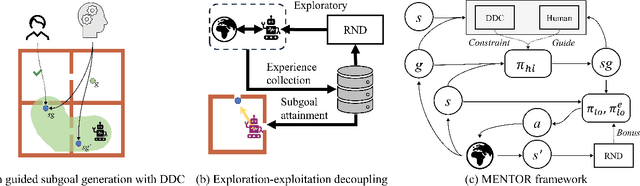
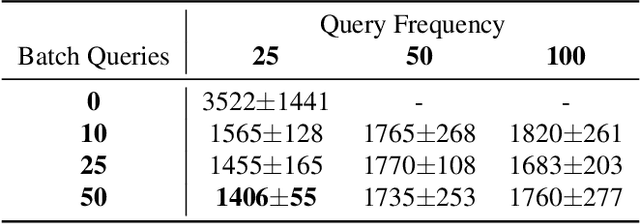

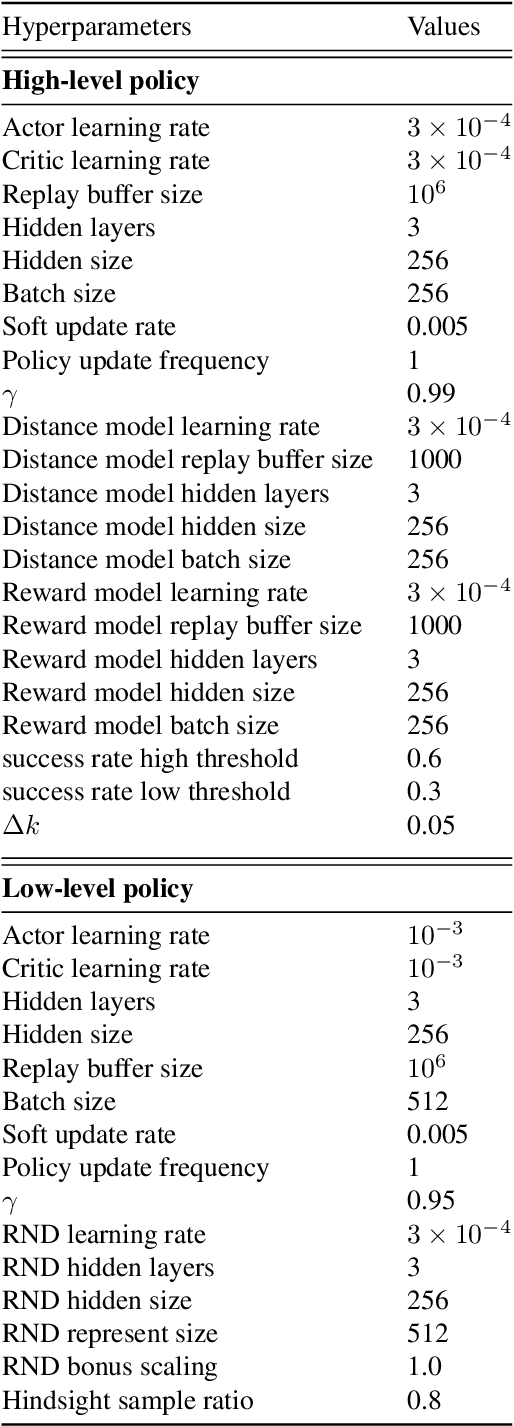
Hierarchical reinforcement learning (HRL) provides a promising solution for complex tasks with sparse rewards of intelligent agents, which uses a hierarchical framework that divides tasks into subgoals and completes them sequentially. However, current methods struggle to find suitable subgoals for ensuring a stable learning process. Without additional guidance, it is impractical to rely solely on exploration or heuristics methods to determine subgoals in a large goal space. To address the issue, We propose a general hierarchical reinforcement learning framework incorporating human feedback and dynamic distance constraints (MENTOR). MENTOR acts as a "mentor", incorporating human feedback into high-level policy learning, to find better subgoals. As for low-level policy, MENTOR designs a dual policy for exploration-exploitation decoupling respectively to stabilize the training. Furthermore, although humans can simply break down tasks into subgoals to guide the right learning direction, subgoals that are too difficult or too easy can still hinder downstream learning efficiency. We propose the Dynamic Distance Constraint (DDC) mechanism dynamically adjusting the space of optional subgoals. Thus MENTOR can generate subgoals matching the low-level policy learning process from easy to hard. Extensive experiments demonstrate that MENTOR uses a small amount of human feedback to achieve significant improvement in complex tasks with sparse rewards.
Uni-RLHF: Universal Platform and Benchmark Suite for Reinforcement Learning with Diverse Human Feedback
Feb 04, 2024Reinforcement Learning with Human Feedback (RLHF) has received significant attention for performing tasks without the need for costly manual reward design by aligning human preferences. It is crucial to consider diverse human feedback types and various learning methods in different environments. However, quantifying progress in RLHF with diverse feedback is challenging due to the lack of standardized annotation platforms and widely used unified benchmarks. To bridge this gap, we introduce Uni-RLHF, a comprehensive system implementation tailored for RLHF. It aims to provide a complete workflow from real human feedback, fostering progress in the development of practical problems. Uni-RLHF contains three packages: 1) a universal multi-feedback annotation platform, 2) large-scale crowdsourced feedback datasets, and 3) modular offline RLHF baseline implementations. Uni-RLHF develops a user-friendly annotation interface tailored to various feedback types, compatible with a wide range of mainstream RL environments. We then establish a systematic pipeline of crowdsourced annotations, resulting in large-scale annotated datasets comprising more than 15 million steps across 30+ popular tasks. Through extensive experiments, the results in the collected datasets demonstrate competitive performance compared to those from well-designed manual rewards. We evaluate various design choices and offer insights into their strengths and potential areas of improvement. We wish to build valuable open-source platforms, datasets, and baselines to facilitate the development of more robust and reliable RLHF solutions based on realistic human feedback. The website is available at https://uni-rlhf.github.io/.
DiffuserLite: Towards Real-time Diffusion Planning
Feb 02, 2024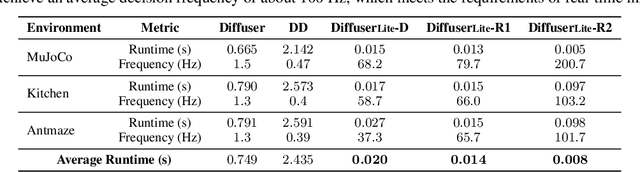
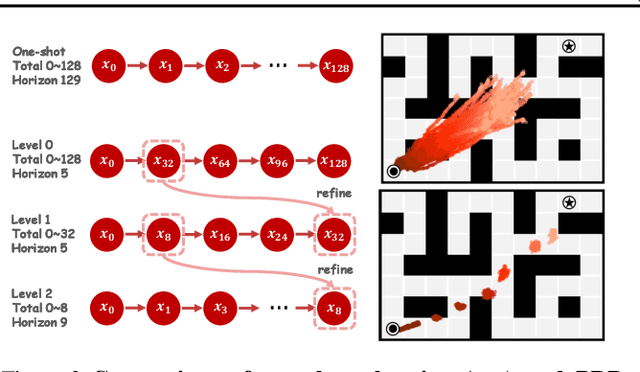
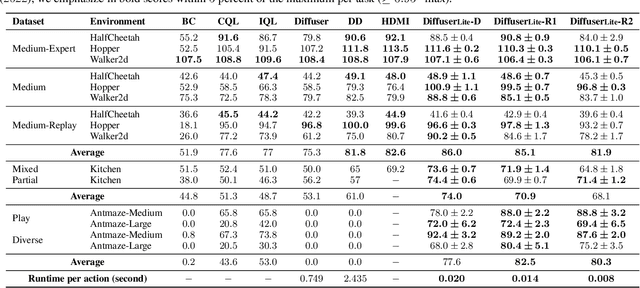
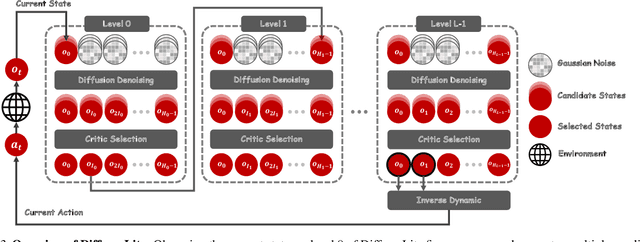
Diffusion planning has been recognized as an effective decision-making paradigm in various domains. The capability of conditionally generating high-quality long-horizon trajectories makes it a promising research direction. However, existing diffusion planning methods suffer from low decision-making frequencies due to the expensive iterative sampling cost. To address this issue, we introduce DiffuserLite, a super fast and lightweight diffusion planning framework. DiffuserLite employs a planning refinement process (PRP) to generate coarse-to-fine-grained trajectories, significantly reducing the modeling of redundant information and leading to notable increases in decision-making frequency. Our experimental results demonstrate that DiffuserLite achieves a decision-making frequency of $122$Hz ($112.7$x faster than previous mainstream frameworks) and reaches state-of-the-art performance on D4RL benchmarks. In addition, our neat DiffuserLite framework can serve as a flexible plugin to enhance decision frequency in other diffusion planning algorithms, providing a structural design reference for future works. More details and visualizations are available at https://diffuserlite.github.io/.
Bridging Evolutionary Algorithms and Reinforcement Learning: A Comprehensive Survey
Jan 22, 2024Evolutionary Reinforcement Learning (ERL), which integrates Evolutionary Algorithms (EAs) and Reinforcement Learning (RL) for optimization, has demonstrated remarkable performance advancements. By fusing the strengths of both approaches, ERL has emerged as a promising research direction. This survey offers a comprehensive overview of the diverse research branches in ERL. Specifically, we systematically summarize recent advancements in relevant algorithms and identify three primary research directions: EA-assisted optimization of RL, RL-assisted optimization of EA, and synergistic optimization of EA and RL. Following that, we conduct an in-depth analysis of each research direction, organizing multiple research branches. We elucidate the problems that each branch aims to tackle and how the integration of EA and RL addresses these challenges. In conclusion, we discuss potential challenges and prospective future research directions across various research directions.
Machine Learning Insides OptVerse AI Solver: Design Principles and Applications
Jan 17, 2024

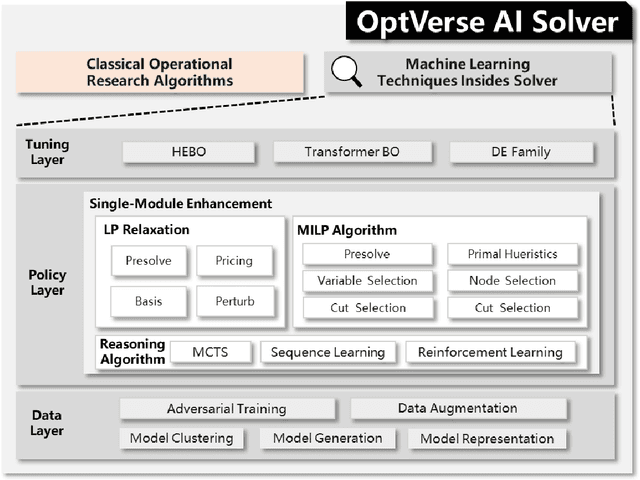
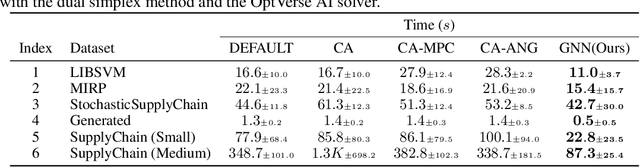
In an era of digital ubiquity, efficient resource management and decision-making are paramount across numerous industries. To this end, we present a comprehensive study on the integration of machine learning (ML) techniques into Huawei Cloud's OptVerse AI Solver, which aims to mitigate the scarcity of real-world mathematical programming instances, and to surpass the capabilities of traditional optimization techniques. We showcase our methods for generating complex SAT and MILP instances utilizing generative models that mirror multifaceted structures of real-world problem. Furthermore, we introduce a training framework leveraging augmentation policies to maintain solvers' utility in dynamic environments. Besides the data generation and augmentation, our proposed approaches also include novel ML-driven policies for personalized solver strategies, with an emphasis on applications like graph convolutional networks for initial basis selection and reinforcement learning for advanced presolving and cut selection. Additionally, we detail the incorporation of state-of-the-art parameter tuning algorithms which markedly elevate solver performance. Compared with traditional solvers such as Cplex and SCIP, our ML-augmented OptVerse AI Solver demonstrates superior speed and precision across both established benchmarks and real-world scenarios, reinforcing the practical imperative and effectiveness of machine learning techniques in mathematical programming solvers.
Pangu-Agent: A Fine-Tunable Generalist Agent with Structured Reasoning
Dec 22, 2023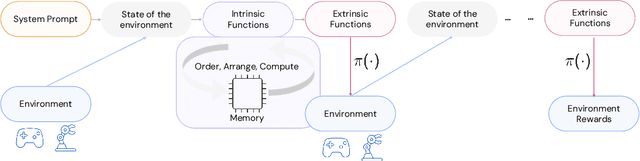



A key method for creating Artificial Intelligence (AI) agents is Reinforcement Learning (RL). However, constructing a standalone RL policy that maps perception to action directly encounters severe problems, chief among them being its lack of generality across multiple tasks and the need for a large amount of training data. The leading cause is that it cannot effectively integrate prior information into the perception-action cycle when devising the policy. Large language models (LLMs) emerged as a fundamental way to incorporate cross-domain knowledge into AI agents but lack crucial learning and adaptation toward specific decision problems. This paper presents a general framework model for integrating and learning structured reasoning into AI agents' policies. Our methodology is motivated by the modularity found in the human brain. The framework utilises the construction of intrinsic and extrinsic functions to add previous understandings of reasoning structures. It also provides the adaptive ability to learn models inside every module or function, consistent with the modular structure of cognitive processes. We describe the framework in-depth and compare it with other AI pipelines and existing frameworks. The paper explores practical applications, covering experiments that show the effectiveness of our method. Our results indicate that AI agents perform and adapt far better when organised reasoning and prior knowledge are embedded. This opens the door to more resilient and general AI agent systems.
OVD-Explorer: Optimism Should Not Be the Sole Pursuit of Exploration in Noisy Environments
Dec 20, 2023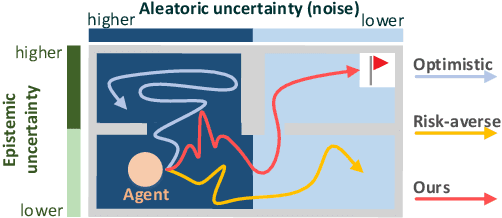
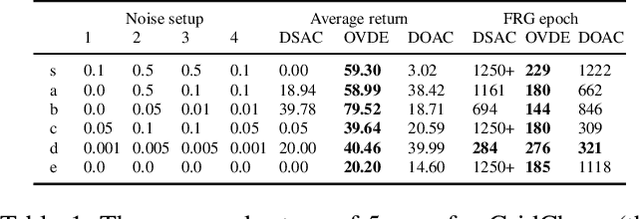
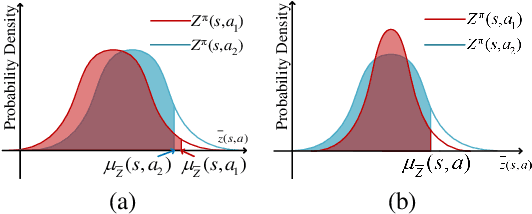
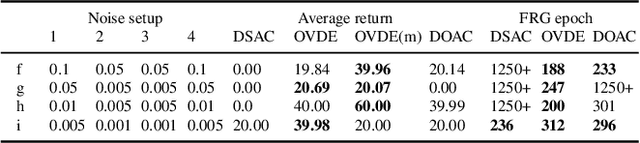
In reinforcement learning, the optimism in the face of uncertainty (OFU) is a mainstream principle for directing exploration towards less explored areas, characterized by higher uncertainty. However, in the presence of environmental stochasticity (noise), purely optimistic exploration may lead to excessive probing of high-noise areas, consequently impeding exploration efficiency. Hence, in exploring noisy environments, while optimism-driven exploration serves as a foundation, prudent attention to alleviating unnecessary over-exploration in high-noise areas becomes beneficial. In this work, we propose Optimistic Value Distribution Explorer (OVD-Explorer) to achieve a noise-aware optimistic exploration for continuous control. OVD-Explorer proposes a new measurement of the policy's exploration ability considering noise in optimistic perspectives, and leverages gradient ascent to drive exploration. Practically, OVD-Explorer can be easily integrated with continuous control RL algorithms. Extensive evaluations on the MuJoCo and GridChaos tasks demonstrate the superiority of OVD-Explorer in achieving noise-aware optimistic exploration.
Rethinking Decision Transformer via Hierarchical Reinforcement Learning
Nov 01, 2023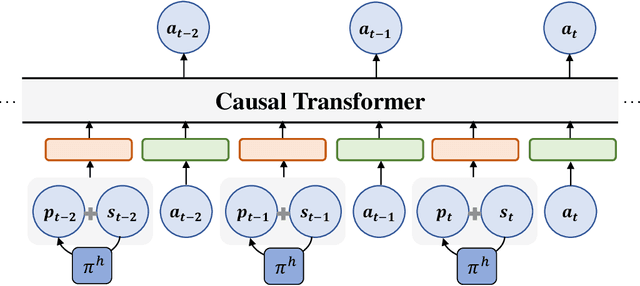
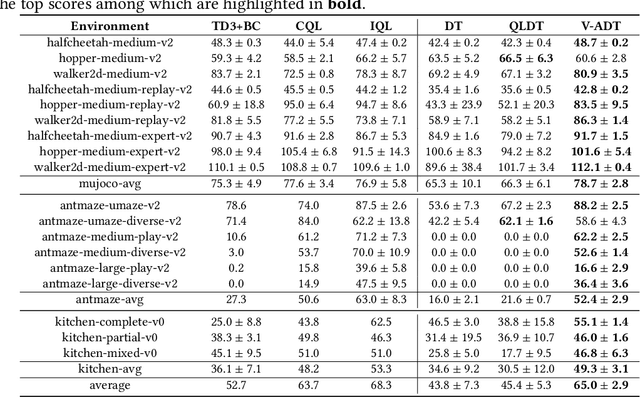


Decision Transformer (DT) is an innovative algorithm leveraging recent advances of the transformer architecture in reinforcement learning (RL). However, a notable limitation of DT is its reliance on recalling trajectories from datasets, losing the capability to seamlessly stitch sub-optimal trajectories together. In this work we introduce a general sequence modeling framework for studying sequential decision making through the lens of Hierarchical RL. At the time of making decisions, a high-level policy first proposes an ideal prompt for the current state, a low-level policy subsequently generates an action conditioned on the given prompt. We show DT emerges as a special case of this framework with certain choices of high-level and low-level policies, and discuss the potential failure of these choices. Inspired by these observations, we study how to jointly optimize the high-level and low-level policies to enable the stitching ability, which further leads to the development of new offline RL algorithms. Our empirical results clearly show that the proposed algorithms significantly surpass DT on several control and navigation benchmarks. We hope our contributions can inspire the integration of transformer architectures within the field of RL.