 Add to Chrome
 Add to Firefox
 Add to Edge
SafeDivertor: Faithful Divertor Heat Flux Reconstruction from Macroscopic Plasma State Signals via Time-Frequency Prior Exploitation
Aug 06, 2026
Divertor heat-flux analysis is essential for understanding plasma-wall interactions and protecting plasma-facing components in magnetic-confinement fusion devices, while conventional infrared-based inversion is usually performed after discharge and requires heat-conduction modeling with device-specific material properties, divertor geometry, and boundary conditions. Rather than accelerating this conventional infrared-based inversion paradigm, we introduce a new online-oriented signal-based reconstruction paradigm that directly reconstructs time-resolved radial heat-flux profiles from multi-source macroscopic plasma-state signals available during discharge. To enable systematic study of this task, we construct \textbf{DivMPS2HF}, a multi-source discharge dataset that provides the data foundation and benchmark for signal-based divertor heat-flux reconstruction. We further propose \textbf{SafeDivertor}, a task-driven framework designed to address the key challenges of signal-based heat-flux reconstruction. It employs physical prior-aware initialization to provide radial-distribution guidance for target channels, input perturbation to reduce over-reliance on specific heterogeneous signals, spectral-aware reconstruction optimization to exploit time-frequency priors and preserve transient dynamics, and progressive training to stabilize the optimization of these complementary objectives. Experiments on DivMPS2HF demonstrate that SafeDivertor achieves the best overall performance among the evaluated time-series baselines across all five metrics, establishing a new performance benchmark for signal-based divertor heat-flux reconstruction. The source code will be released on https://github.com/Event-AHU/OpenFusion

Physics-Informed Neural Networks for Complex Eigenfrequency Identification and Mode Structure Reconstruction of the Ground-State ITG Branch
Aug 03, 2026Physics-informed neural networks (PINNs) combine sparse observations with physical equations, providing an important approach for modeling complex plasma processes and inferring unknown physical quantities. The steep-gradient pedestal of high-confinement-mode tokamaks is closely linked to plasma confinement and edge transport. Analyzing ion-temperature-gradient (ITG) drift waves in this region requires jointly identifying complex eigenfrequencies and reconstructing two-dimensional complex-valued mode fields. Localized high-frequency oscillations, strong real-imaginary coupling, and nonlinear coupling between the mode field and eigenfrequency challenge PINN representation and joint optimization. To address these challenges, we propose a physics-informed neural framework combining Fourier feature encoding, complex-valued feature propagation, and three-stage training. Under sparse observations and physical constraints, it jointly solves for the complex eigenfrequency and mode field of a representative ground-state ITG branch. Experiments show that the framework accurately recovers the target complex eigenfrequency and two-dimensional complex-valued mode field and outperforms representative PINN baselines. It also provides a basis for analyzing higher-order and multiple-branch drift-wave modes.
Visible-Light Imaging Diagnosis of Neutral Particle Emission Tomography in the Tokamak Divertor: An Efficient Transformer-based Surrogate Model
Jul 19, 2026Nuclear fusion has made significant progress in recent years and is expected to become one of the most important pathways to addressing global energy challenges. This paper focuses on observing plasma using visible-light cameras, analyzing its spatio-temporal motion cues, and predicting the two-dimensional spatial distribution of light intensity, aiming to provide a foundational basis for future scientific experiments using deep neural networks. Specifically, we propose Delta-InvFormer, a novel backbone network centered on a differential Transformer. The key insight is that by taking consecutive video frames as input, we can better capture the dynamics of the plasma. Moreover, spatial and temporal differential self-attention effectively mitigates interference from noisy signals, ensuring high-quality feature extraction. These features are then fused into a compact and informative representation, which is fed into a decoder network to predict the distribution. Based on real experimental data collected from the Experimental Advanced Superconducting Tokamak (EAST) large-scale scientific facility, our results demonstrate that the proposed model not only significantly accelerates traditional methods for distribution prediction but also achieves competitive reconstruction accuracy. The source code of this paper will be released on https://github.com/Event-AHU/OpenFusion
RefAerial: A Benchmark and Approach for Referring Detection in Aerial Images
Apr 22, 2026Referring detection refers to locate the target referred by natural languages, which has recently attracted growing research interests. However, existing datasets are limited to ground images with large object centered in relative small scenes. This paper introduces a large-scale challenging dataset for referring detection in aerial images, termed as RefAerial. It distinguishes from conventional ground referring detection datasets by 4 characteristics: (1) low but diverse object-to-scene ratios, (2) numerous targets and distractors, (3)complex and fine-grained referring descriptions, (4) diverse and broad scenes in the aerial view. We also develop a human-in-the-loop referring expansion and annotation engine (REA-Engine) for efficient semi-automated referring pair annotation. Besides, we observe that existing ground referring detection approaches exhibiting serious performance degradation on our aerial dataset since the intrinsic scale variety issue within or across aerial images. Therefore, we further propose a novel scale-comprehensive and sensitive (SCS) framework for referring detection in aerial images. It consists of a mixture-of-granularity (MoG) attention and a two-stage comprehensive-to-sensitive (CtS) decoding strategy. Specifically, the mixture-of-granularity attention is developed for scale-comprehensive target understanding. In addition, the two-stage comprehensive-to-sensitive decoding strategy is designed for coarse-to-fine referring target decoding. Eventually, the proposed SCS framework achieves remarkable performance on our aerial referring detection dataset and even promising performance boost on conventional ground referring detection datasets.
UniPINN: A Unified PINN Framework for Multi-task Learning of Diverse Navier-Stokes Equations
Mar 11, 2026Physics-Informed Neural Networks (PINNs) have shown promise in solving incompressible Navier-Stokes equations, yet existing approaches are predominantly designed for single-flow settings. When extended to multi-flow scenarios, these methods face three key challenges: (1) difficulty in simultaneously capturing both shared physical principles and flow-specific characteristics, (2) susceptibility to inter-task negative transfer that degrades prediction accuracy, and (3) unstable training dynamics caused by disparate loss magnitudes across heterogeneous flow regimes. To address these limitations, we propose UniPINN, a unified multi-flow PINN framework that integrates three complementary components: a shared-specialized architecture that disentangles universal physical laws from flow-specific features, a cross-flow attention mechanism that selectively reinforces relevant patterns while suppressing task-irrelevant interference, and a dynamic weight allocation strategy that adaptively balances loss contributions to stabilize multi-objective optimization. Extensive experiments on three canonical flows demonstrate that UniPINN effectively unifies multi-flow learning, achieving superior prediction accuracy and balanced performance across heterogeneous regimes while successfully mitigating negative transfer. The source code of this paper will be released on https://github.com/Event-AHU/OpenFusion
Structure and Progress Aware Diffusion for Medical Image Segmentation
Mar 09, 2026Medical image segmentation is crucial for computer-aided diagnosis, which necessitates understanding both coarse morphological and semantic structures, as well as carving fine boundaries. The morphological and semantic structures in medical images are beneficial and stable clues for target understanding. While the fine boundaries of medical targets (like tumors and lesions) are usually ambiguous and noisy since lesion overlap, annotation uncertainty, and so on, making it not reliable to serve as early supervision. However, existing methods simultaneously learn coarse structures and fine boundaries throughout the training process. In this paper, we propose a structure and progress-aware diffusion (SPAD) for medical image segmentation, which consists of a semantic-concentrated diffusion (ScD) and a boundary-centralized diffusion (BcD) modulated by a progress-aware scheduler (PaS). Specifically, the semantic-concentrated diffusion introduces anchor-preserved target perturbation, which perturbs pixels within a medical target but preserves unaltered areas as semantic anchors, encouraging the model to infer noisy target areas from the surrounding semantic context. The boundary-centralized diffusion introduces progress-aware boundary noise, which blurs unreliable and ambiguous boundaries, thus compelling the model to focus on coarse but stable anatomical morphology and global semantics. Furthermore, the progress-aware scheduler gradually modulates noise intensity of the ScD and BcD forming a coarse-to-fine diffusion paradigm, which encourage focusing on coarse morphological and semantic structures during early target understanding stages and gradually shifting to fine target boundaries during later contour adjusting stages.
NESTOR: A Nested MOE-based Neural Operator for Large-Scale PDE Pre-Training
Feb 25, 2026Neural operators have emerged as an efficient paradigm for solving PDEs, overcoming the limitations of traditional numerical methods and significantly improving computational efficiency. However, due to the diversity and complexity of PDE systems, existing neural operators typically rely on a single network architecture, which limits their capacity to fully capture heterogeneous features and complex system dependencies. This constraint poses a bottleneck for large-scale PDE pre-training based on neural operators. To address these challenges, we propose a large-scale PDE pre-trained neural operator based on a nested Mixture-of-Experts (MoE) framework. In particular, the image-level MoE is designed to capture global dependencies, while the token-level Sub-MoE focuses on local dependencies. Our model can selectively activate the most suitable expert networks for a given input, thereby enhancing generalization and transferability. We conduct large-scale pre-training on twelve PDE datasets from diverse sources and successfully transfer the model to downstream tasks. Extensive experiments demonstrate the effectiveness of our approach.
Fully Automated SAM for Single-source Domain Generalization in Medical Image Segmentation
Jul 23, 2025Although SAM-based single-source domain generalization models for medical image segmentation can mitigate the impact of domain shift on the model in cross-domain scenarios, these models still face two major challenges. First, the segmentation of SAM is highly dependent on domain-specific expert-annotated prompts, which prevents SAM from achieving fully automated medical image segmentation and therefore limits its application in clinical settings. Second, providing poor prompts (such as bounding boxes that are too small or too large) to the SAM prompt encoder can mislead SAM into generating incorrect mask results. Therefore, we propose the FA-SAM, a single-source domain generalization framework for medical image segmentation that achieves fully automated SAM. FA-SAM introduces two key innovations: an Auto-prompted Generation Model (AGM) branch equipped with a Shallow Feature Uncertainty Modeling (SUFM) module, and an Image-Prompt Embedding Fusion (IPEF) module integrated into the SAM mask decoder. Specifically, AGM models the uncertainty distribution of shallow features through the SUFM module to generate bounding box prompts for the target domain, enabling fully automated segmentation with SAM. The IPEF module integrates multiscale information from SAM image embeddings and prompt embeddings to capture global and local details of the target object, enabling SAM to mitigate the impact of poor prompts. Extensive experiments on publicly available prostate and fundus vessel datasets validate the effectiveness of FA-SAM and highlight its potential to address the above challenges.
Correlative and Discriminative Label Grouping for Multi-Label Visual Prompt Tuning
Apr 14, 2025Modeling label correlations has always played a pivotal role in multi-label image classification (MLC), attracting significant attention from researchers. However, recent studies have overemphasized co-occurrence relationships among labels, which can lead to overfitting risk on this overemphasis, resulting in suboptimal models. To tackle this problem, we advocate for balancing correlative and discriminative relationships among labels to mitigate the risk of overfitting and enhance model performance. To this end, we propose the Multi-Label Visual Prompt Tuning framework, a novel and parameter-efficient method that groups classes into multiple class subsets according to label co-occurrence and mutual exclusivity relationships, and then models them respectively to balance the two relationships. In this work, since each group contains multiple classes, multiple prompt tokens are adopted within Vision Transformer (ViT) to capture the correlation or discriminative label relationship within each group, and effectively learn correlation or discriminative representations for class subsets. On the other hand, each group contains multiple group-aware visual representations that may correspond to multiple classes, and the mixture of experts (MoE) model can cleverly assign them from the group-aware to the label-aware, adaptively obtaining label-aware representation, which is more conducive to classification. Experiments on multiple benchmark datasets show that our proposed approach achieves competitive results and outperforms SOTA methods on multiple pre-trained models.
Bidirectional Uncertainty-Aware Region Learning for Semi-Supervised Medical Image Segmentation
Feb 11, 2025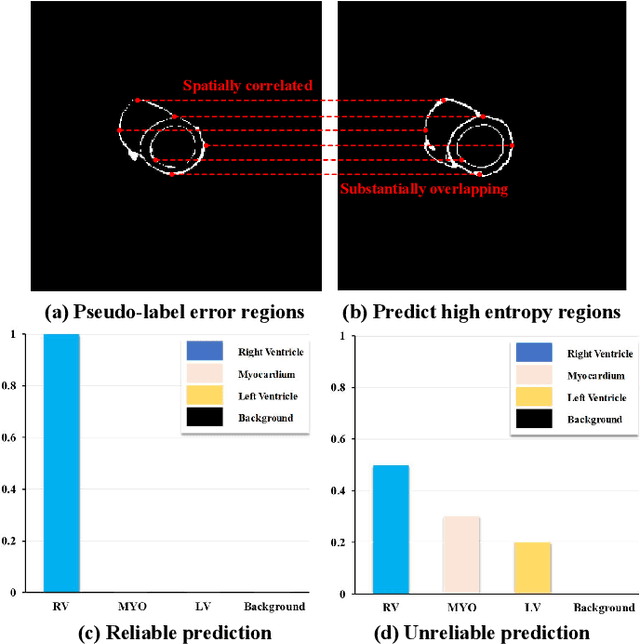
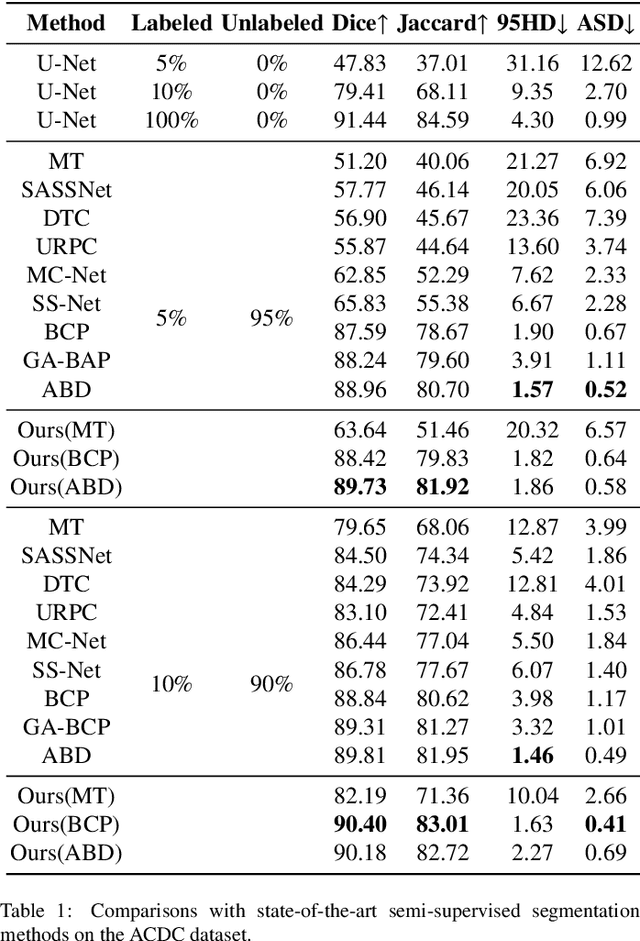
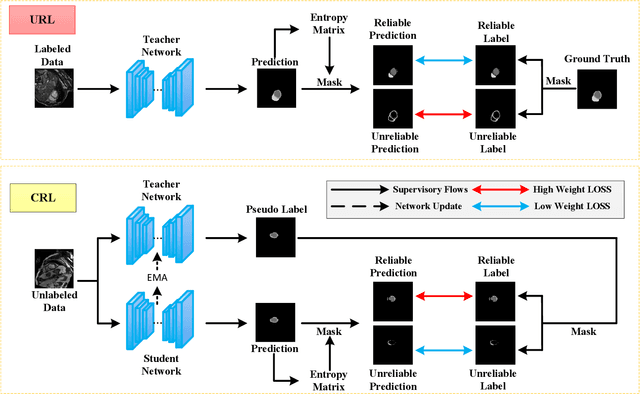
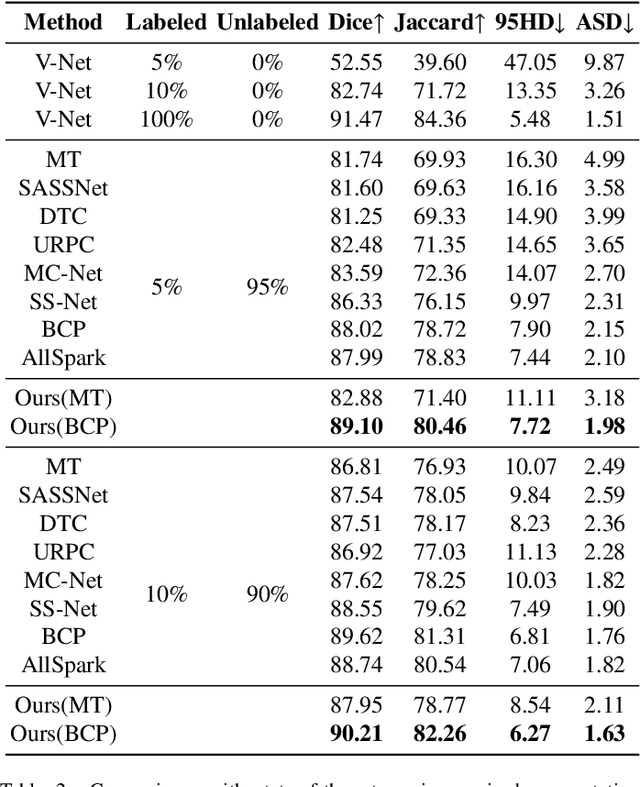
In semi-supervised medical image segmentation, the poor quality of unlabeled data and the uncertainty in the model's predictions lead to models that inevitably produce erroneous pseudo-labels. These errors accumulate throughout model training, thereby weakening the model's performance. We found that these erroneous pseudo-labels are typically concentrated in high-uncertainty regions. Traditional methods improve performance by directly discarding pseudo-labels in these regions, but this can also result in neglecting potentially valuable training data. To alleviate this problem, we propose a bidirectional uncertainty-aware region learning strategy. In training labeled data, we focus on high-uncertainty regions, using precise label information to guide the model's learning in potentially uncontrollable areas. Meanwhile, in the training of unlabeled data, we concentrate on low-uncertainty regions to reduce the interference of erroneous pseudo-labels on the model. Through this bidirectional learning strategy, the model's overall performance has significantly improved. Extensive experiments show that our proposed method achieves significant performance improvement on different medical image segmentation tasks.