 Add to Chrome
 Add to Firefox
 Add to Edge
Conformal Cascade: Distribution-Free Accuracy Guarantees for Multi-Tier LLM Inference
Jul 27, 2026
Large language model (LLM) cascades reduce inference cost by routing easy queries to a small model and deferring hard queries to a larger one. Production cascades govern this deferral through a confidence threshold, but LLM confidence scores are miscalibrated, the threshold must be tuned per model pair and per domain, and no setting yields a formal bound on cascade accuracy. We introduce \textbf{Conformal Cascade} (CC), a multi-tier inference framework that uses conformal prediction set size as the deferral rule: accept when the calibrated set collapses to a single answer, defer otherwise. The procedure delivers a distribution-free, finite-sample accuracy guarantee. By a per-tier union bound, the prediction set at the accepting tier covers the correct answer with probability at least $1 - Kα$ for any user-specified $α$; under a selection-preservation condition (consistent with, but not strictly implied by, our marginal coverage results), the bound tightens to $1 - α$. We further characterise expected cascade cost as an explicit function of $α$ and the calibration-set acceptance rate. Across 18 multiple-choice benchmarks spanning science, medicine, commonsense, and standardized exams, evaluated on two-tier cascades drawn from four open-weight model families, CC strictly improves over the strongest calibration-tuned heuristic cascade on the majority of family--benchmark pairs, with the largest gains on reasoning-heavy benchmarks where majority vote is unreliable; on easier benchmarks the cascade commits the vast majority of queries to the small model at no accuracy cost. Extension to open-ended generation requires an answer-clustering step that we leave for future work. The method requires no model training and only black-box API access.

Verbalized Particle Posterior: Bayesian Inference over Natural Language Hypotheses
Jul 25, 2026Verbalized Machine Learning (VML) parameterizes a model as a natural-language prompt that an LLM evaluates as f(x; theta). The framework is interpretable, but it commits to a single hypothesis with no measure of uncertainty, and that hypothesis varies substantially across optimization runs on the same data. We propose the Verbalized Particle Posterior (VPP), which treats verbalized learning as a Bayesian inference problem: maintain a population of natural-language hypotheses as particles, update them with Metropolis-Hastings (VPP-MH) or Sequential Monte Carlo (VPP-SMC), and predict by Bayesian model averaging. Both algorithms treat the LLM as a black box, requiring no access to logits or gradients. A distinctive consequence follows. In classical Bayesian learning, model selection sits outside the posterior; in VPP both model structure and parameters share a single language space, and the posterior ranges over both. We evaluate VPP on regression, classification, and rule-discovery benchmarks. It improves over a single VML run on every benchmark and matches or exceeds an oracle-best ensemble of independent VML runs on most, while eliminating the catastrophic single-run failures that VML occasionally produces. Because each particle is a human-readable hypothesis, the posterior is itself something a reader can inspect, seeing in plain text which explanations the data supported and which it ruled out.
ConsistencyGate: Preventing Memory Contamination in LLM Agents via Self-Consistency Admission Control
Jul 25, 2026LLM agents that operate over many turns accumulate facts in an external memory store and reuse them as premises for downstream reasoning. A hallucinated fact written at one step therefore persists as a false premise for every subsequent step, a failure mode we call memory contamination. Existing memory management addresses retrieval and capacity but not write-time correctness; this admission problem cannot be solved by utility- or recency-based criteria, and uncontrolled contamination compounds across long trajectories. We propose ConsistencyGate, a write-time admission gate that, before committing a candidate fact m extracted from context c, queries the LLM K times for a soft support score and admits m only when the average exceeds a threshold. The mechanism is model-agnostic, requires no fine-tuning, and reduces to a single forward pass in a log-probability variant for latency-sensitive deployments. To measure the effect on natural data, we construct two real-conversation benchmarks (LoCoMo-Contam and MSC-Contam) by planting controlled single-detail corruptions in long-term conversations from LoCoMo and MSC, and complement them with a structured synthetic corpus (MemContam) that isolates a near-oracle upper bound. Across four LLM backbones, ConsistencyGate reduces contamination on every benchmark relative to a write-everything baseline, with the cost concentrated on facts that are stated only implicitly in the source context. We release all three benchmarks together with the gate implementation.
PIER-Flow: Physics-Informed Efficient Rectified Flow for Real-Time Mobile Robot Navigation
Jul 11, 2026Autonomous navigation in dense and highly dynamic environments requires both physically feasible control and low-latency replanning. Optimization-based methods such as Model Predictive Control (MPC) explicitly handle robot kinematics and safety constraints, but repeated nonlinear optimization can limit real-time responsiveness. Deterministic behavior-cloning policies enable efficient inference but may fail to represent multimodal avoidance behaviors, whereas diffusion policies capture multimodality at the cost of time-consuming iterative denoising. We propose PIER-Flow (Physics-Informed Efficient Rectified Flow), a lightweight navigation policy for mobile robots. By distilling an MPC expert into a continuous-time Ordinary Differential Equation (ODE), PIER-Flow achieves single-step action generation through parallel latent sampling and lightweight feasibility selection. We introduce a physics-informed training objective to enforce kinematic consistency, paired with an asynchronous action chunking architecture for robust sim-to-real deployment. Extensive simulations demonstrate that PIER-Flow achieves a 98.85\% success rate and zero collisions, with an average inference of $\sim$1.29 ms, which accelerates planning by 37.2$\times$ compared to MPC and over 800$\times$ against standard diffusion models. Crucially, real-world deployment on a resource-constrained edge computer further achieves an approximately stable inference latency of $\sim$5.3 ms, avoiding the latency spikes and freezing events observed with planning baselines.
Unlocking the Latent Canvas: Eliciting and Benchmarking Symbolic Visual Expression in LLMs
Mar 15, 2026Current multimodal approaches predominantly treat visual generation as an external process, relying on pixel rendering or code execution, thereby overlooking the native visual representation capabilities latent within Large Language Models (LLMs). In this work, we unlock this potential through ASCII art, a compact, efficient, and text-native visual format. We introduce SVE-ASCII, a unified framework designed to elicit and benchmark Symbolic Visual Expression directly within the pure text space. To address the scarcity of systematic resources, we construct ASCIIArt-7K, a high-quality dataset synthesized via a novel "Seed-and-Evolve" pipeline that augments human-curated anchors through in-context stylistic editing. We further implement a unified instruction-tuning strategy that jointly optimizes for both Generation (Text-to-ASCII) and Understanding (ASCII-to-Text). Crucially, our experiments reveal a critical phenomenon regarding task duality: while it is established that perception aids generation, we provide compelling evidence that generative training significantly enhances visual comprehension. This confirms a mutually reinforcing cycle in symbolic visual processing, a relationship previously hypothesized but rarely empirically demonstrated in the visual domain. We release our dataset, the ASCIIArt-Bench benchmark, and the SVE-ASCII model, establishing a robust baseline for native text-based visual intelligence.
Regime-Adaptive Bayesian Optimization via Dirichlet Process Mixtures of Gaussian Processes
Jan 27, 2026Standard Bayesian Optimization (BO) assumes uniform smoothness across the search space an assumption violated in multi-regime problems such as molecular conformation search through distinct energy basins or drug discovery across heterogeneous molecular scaffolds. A single GP either oversmooths sharp transitions or hallucinates noise in smooth regions, yielding miscalibrated uncertainty. We propose RAMBO, a Dirichlet Process Mixture of Gaussian Processes that automatically discovers latent regimes during optimization, each modeled by an independent GP with locally-optimized hyperparameters. We derive collapsed Gibbs sampling that analytically marginalizes latent functions for efficient inference, and introduce adaptive concentration parameter scheduling for coarse-to-fine regime discovery. Our acquisition functions decompose uncertainty into intra-regime and inter-regime components. Experiments on synthetic benchmarks and real-world applications, including molecular conformer optimization, virtual screening for drug discovery, and fusion reactor design, demonstrate consistent improvements over state-of-the-art baselines on multi-regime objectives.
Dynamic Bayesian Optimization Framework for Instruction Tuning in Partial Differential Equation Discovery
Dec 31, 2025Large Language Models (LLMs) show promise for equation discovery, yet their outputs are highly sensitive to prompt phrasing, a phenomenon we term instruction brittleness. Static prompts cannot adapt to the evolving state of a multi-step generation process, causing models to plateau at suboptimal solutions. To address this, we propose NeuroSymBO, which reframes prompt engineering as a sequential decision problem. Our method maintains a discrete library of reasoning strategies and uses Bayesian Optimization to select the optimal instruction at each step based on numerical feedback. Experiments on PDE discovery benchmarks show that adaptive instruction selection significantly outperforms fixed prompts, achieving higher recovery rates with more parsimonious solutions.
Online Conformal Model Selection for Nonstationary Time Series
Jun 05, 2025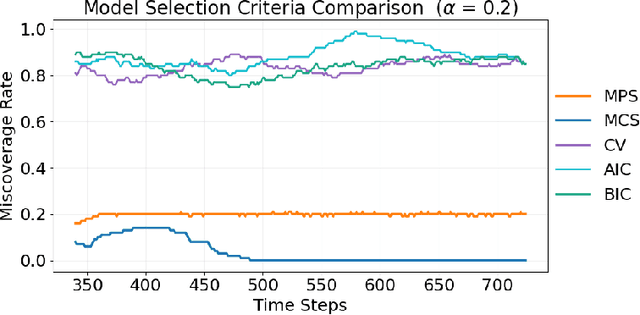
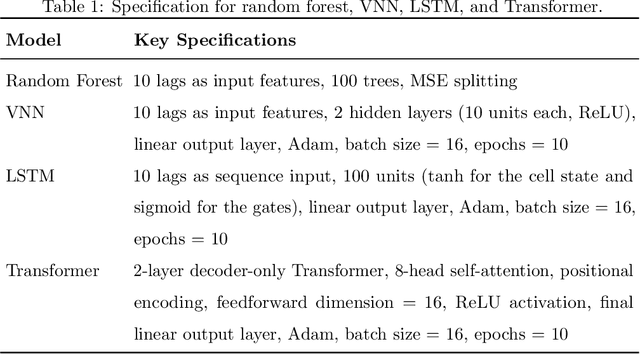
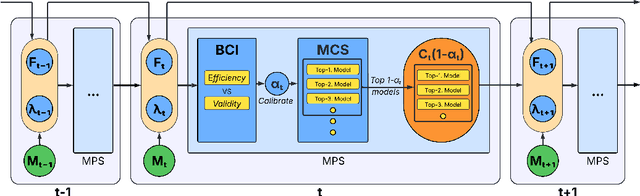
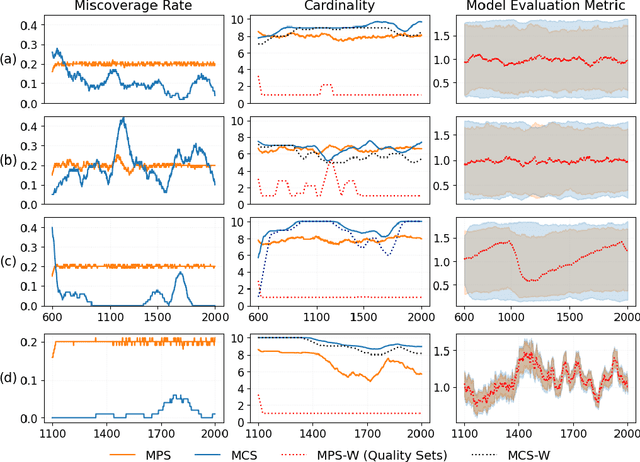
This paper introduces the MPS (Model Prediction Set), a novel framework for online model selection for nonstationary time series. Classical model selection methods, such as information criteria and cross-validation, rely heavily on the stationarity assumption and often fail in dynamic environments which undergo gradual or abrupt changes over time. Yet real-world data are rarely stationary, and model selection under nonstationarity remains a largely open problem. To tackle this challenge, we combine conformal inference with model confidence sets to develop a procedure that adaptively selects models best suited to the evolving dynamics at any given time. Concretely, the MPS updates in real time a confidence set of candidate models that covers the best model for the next time period with a specified long-run probability, while adapting to nonstationarity of unknown forms. Through simulations and real-world data analysis, we demonstrate that MPS reliably and efficiently identifies optimal models under nonstationarity, an essential capability lacking in offline methods. Moreover, MPS frequently produces high-quality sets with small cardinality, whose evolution offers deeper insights into changing dynamics. As a generic framework, MPS accommodates any data-generating process, data structure, model class, training method, and evaluation metric, making it broadly applicable across diverse problem settings.
ATOM: A Framework of Detecting Query-Based Model Extraction Attacks for Graph Neural Networks
Mar 20, 2025Graph Neural Networks (GNNs) have gained traction in Graph-based Machine Learning as a Service (GMLaaS) platforms, yet they remain vulnerable to graph-based model extraction attacks (MEAs), where adversaries reconstruct surrogate models by querying the victim model. Existing defense mechanisms, such as watermarking and fingerprinting, suffer from poor real-time performance, susceptibility to evasion, or reliance on post-attack verification, making them inadequate for handling the dynamic characteristics of graph-based MEA variants. To address these limitations, we propose ATOM, a novel real-time MEA detection framework tailored for GNNs. ATOM integrates sequential modeling and reinforcement learning to dynamically detect evolving attack patterns, while leveraging $k$-core embedding to capture the structural properties, enhancing detection precision. Furthermore, we provide theoretical analysis to characterize query behaviors and optimize detection strategies. Extensive experiments on multiple real-world datasets demonstrate that ATOM outperforms existing approaches in detection performance, maintaining stable across different time steps, thereby offering a more effective defense mechanism for GMLaaS environments.
Multi-Physics Simulations via Coupled Fourier Neural Operator
Jan 30, 2025



Physical simulations are essential tools across critical fields such as mechanical and aerospace engineering, chemistry, meteorology, etc. While neural operators, particularly the Fourier Neural Operator (FNO), have shown promise in predicting simulation results with impressive performance and efficiency, they face limitations when handling real-world scenarios involving coupled multi-physics outputs. Current neural operator methods either overlook the correlations between multiple physical processes or employ simplistic architectures that inadequately capture these relationships. To overcome these challenges, we introduce a novel coupled multi-physics neural operator learning (COMPOL) framework that extends the capabilities of Fourier operator layers to model interactions among multiple physical processes. Our approach implements feature aggregation through recurrent and attention mechanisms, enabling comprehensive modeling of coupled interactions. Our method's core is an innovative system for aggregating latent features from multi-physics processes. These aggregated features serve as enriched information sources for neural operator layers, allowing our framework to capture complex physical relationships accurately. We evaluated our coupled multi-physics neural operator across diverse physical simulation tasks, including biological systems, fluid mechanics, and multiphase flow in porous media. Our proposed model demonstrates a two to three-fold improvement in predictive performance compared to existing approaches.