 Add to Chrome
 Add to Firefox
 Add to Edge
Hierarchical Multi-to-Single-Modal Knowledge Distillation for Disruption Prediction in EAST
Jul 05, 2026
Plasma disruption is a critical threat to tokamak safety. Existing data-driven predictors mainly rely on time-series diagnostic signals, while visible images provide complementary spatial cues including plasma deformation, local brightening, and radiation-structure evolution. Although the image modality improves the model's discriminative capability, it also substantially increases the computational cost during inference. To address this issue, we propose a hierarchical multi-to-single-modal knowledge distillation framework for disruption prediction on a synchronized EAST multimodal dataset. During training, visible images and time-series signals are used to train a multimodal teacher, which learns disruption precursor representations through Transformer-based encoders and a prototype-guided spatiotemporal hypergraph module. During inference, only the time-series student is retained, with multimodal knowledge transferred through graph-structure-level, representation-level, and decision-level distillation. On the 640-discharge EAST dataset, the results demonstrate that the proposed framework can preserve the discriminative advantages of multimodal learning while substantially reducing inference cost, and providing an effective route for efficient disruption prediction in EAST. The source code of this paper will be released on https://github.com/Event-AHU/OpenFusion.

XiHeFusion: Harnessing Large Language Models for Science Communication in Nuclear Fusion
Feb 08, 2025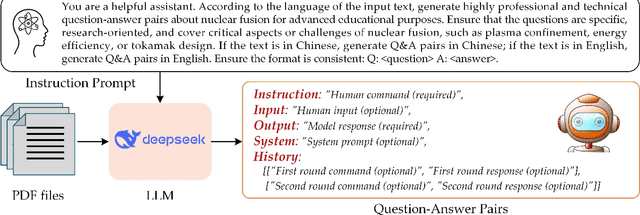
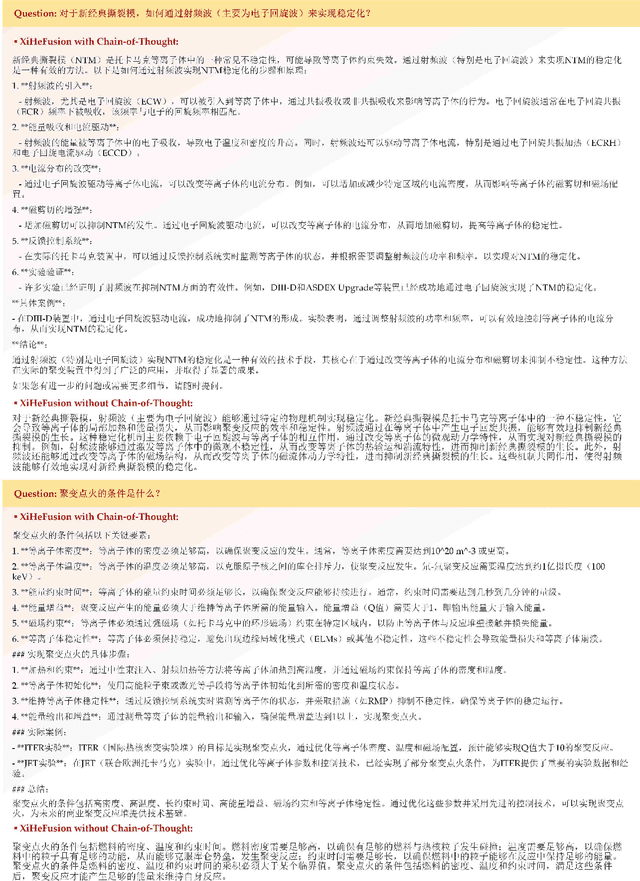
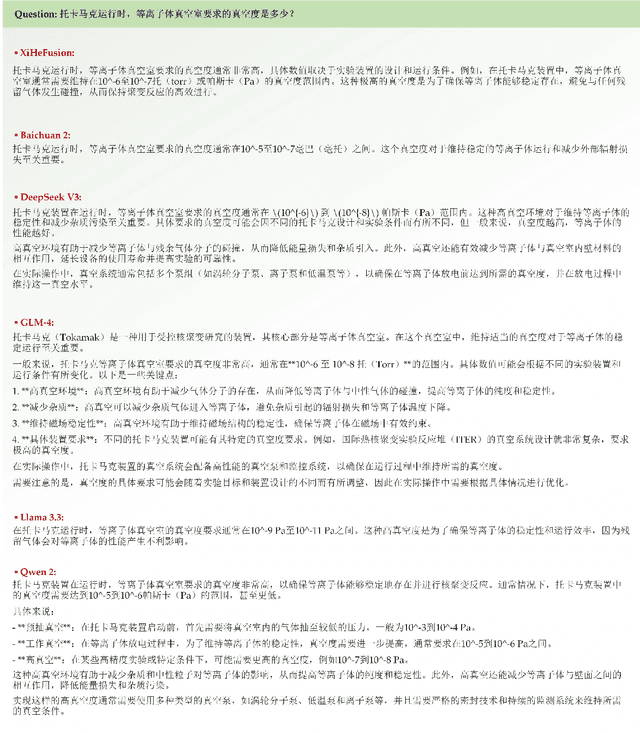
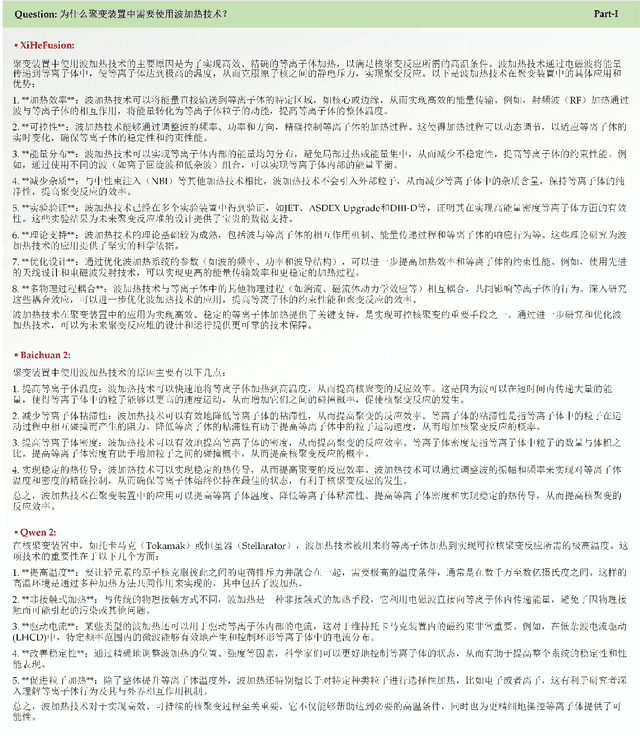
Nuclear fusion is one of the most promising ways for humans to obtain infinite energy. Currently, with the rapid development of artificial intelligence, the mission of nuclear fusion has also entered a critical period of its development. How to let more people to understand nuclear fusion and join in its research is one of the effective means to accelerate the implementation of fusion. This paper proposes the first large model in the field of nuclear fusion, XiHeFusion, which is obtained through supervised fine-tuning based on the open-source large model Qwen2.5-14B. We have collected multi-source knowledge about nuclear fusion tasks to support the training of this model, including the common crawl, eBooks, arXiv, dissertation, etc. After the model has mastered the knowledge of the nuclear fusion field, we further used the chain of thought to enhance its logical reasoning ability, making XiHeFusion able to provide more accurate and logical answers. In addition, we propose a test questionnaire containing 180+ questions to assess the conversational ability of this science popularization large model. Extensive experimental results show that our nuclear fusion dialogue model, XiHeFusion, can perform well in answering science popularization knowledge. The pre-trained XiHeFusion model is released on https://github.com/Event-AHU/XiHeFusion.