 Add to Chrome
 Add to Firefox
 Add to Edge
OpenMic: A Multi-Agent-Based Stand-Up Comedy Generation System
Jan 13, 2026
Chinese stand-up comedy generation goes beyond plain text generation, requiring culturally grounded humor, precise timing, stage-performance cues, and implicit multi-step reasoning. Moreover, commonly used Chinese humor datasets are often better suited for humor understanding and evaluation than for long-form stand-up generation, making direct supervision misaligned with the target task. To address these challenges, we present OpenMic, an end-to-end multi-agent system built on AutoGen that transforms a user-provided life topic into a 3-5 minute Chinese stand-up performance and further produces a narrated comedy video. OpenMic orchestrates multiple specialized agents in a multi-round iterative loop-planning to jointly optimize humor, timing, and performability. To mitigate the dataset-task mismatch, we augment generation with retrieval-augmented generation (RAG) for material grounding and idea expansion, and we fine-tune a dedicated JokeWriter to better internalize stand-up-specific setup-punchline structures and long-range callbacks.

Light Aircraft Game : Basic Implementation and training results analysis
Jun 17, 2025This paper investigates multi-agent reinforcement learning (MARL) in a partially observable, cooperative-competitive combat environment known as LAG. We describe the environment's setup, including agent actions, hierarchical controls, and reward design across different combat modes such as No Weapon and ShootMissile. Two representative algorithms are evaluated: HAPPO, an on-policy hierarchical variant of PPO, and HASAC, an off-policy method based on soft actor-critic. We analyze their training stability, reward progression, and inter-agent coordination capabilities. Experimental results show that HASAC performs well in simpler coordination tasks without weapons, while HAPPO demonstrates stronger adaptability in more dynamic and expressive scenarios involving missile combat. These findings provide insights into the trade-offs between on-policy and off-policy methods in multi-agent settings.
Repetitive Contrastive Learning Enhances Mamba's Selectivity in Time Series Prediction
Apr 12, 2025Long sequence prediction is a key challenge in time series forecasting. While Mamba-based models have shown strong performance due to their sequence selection capabilities, they still struggle with insufficient focus on critical time steps and incomplete noise suppression, caused by limited selective abilities. To address this, we introduce Repetitive Contrastive Learning (RCL), a token-level contrastive pretraining framework aimed at enhancing Mamba's selective capabilities. RCL pretrains a single Mamba block to strengthen its selective abilities and then transfers these pretrained parameters to initialize Mamba blocks in various backbone models, improving their temporal prediction performance. RCL uses sequence augmentation with Gaussian noise and applies inter-sequence and intra-sequence contrastive learning to help the Mamba module prioritize information-rich time steps while ignoring noisy ones. Extensive experiments show that RCL consistently boosts the performance of backbone models, surpassing existing methods and achieving state-of-the-art results. Additionally, we propose two metrics to quantify Mamba's selective capabilities, providing theoretical, qualitative, and quantitative evidence for the improvements brought by RCL.
Gradient Based Method for the Fusion of Lattice Quantizers
Feb 09, 2025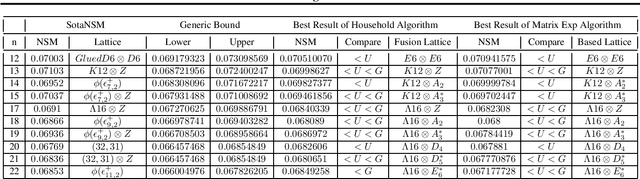
In practical applications, lattice quantizers leverage discrete lattice points to approximate arbitrary points in the lattice. An effective lattice quantizer significantly enhances both the accuracy and efficiency of these approximations. In the context of high-dimensional lattice quantization, previous work proposed utilizing low-dimensional optimal lattice quantizers and addressed the challenge of determining the optimal length ratio in orthogonal splicing. Notably, it was demonstrated that fixed length ratios and orthogonality yield suboptimal results when combining low-dimensional lattices. Building on this foundation, another approach employed gradient descent to identify optimal lattices, which inspired us to explore the use of neural networks to discover matrices that outperform those obtained from orthogonal splicing methods. We propose two novel approaches to tackle this problem: the Household Algorithm and the Matrix Exp Algorithm. Our results indicate that both the Household Algorithm and the Matrix Exp Algorithm achieve improvements in lattice quantizers across dimensions 13, 15, 17 to 19, 21, and 22. Moreover, the Matrix Exp Algorithm demonstrates superior efficacy in high-dimensional settings.