 Add to Chrome
 Add to Firefox
 Add to Edge
The Solution for the CVPR2023 NICE Image Captioning Challenge
Oct 10, 2023
In this paper, we present our solution to the New frontiers for Zero-shot Image Captioning Challenge. Different from the traditional image captioning datasets, this challenge includes a larger new variety of visual concepts from many domains (such as COVID-19) as well as various image types (photographs, illustrations, graphics). For the data level, we collect external training data from Laion-5B, a large-scale CLIP-filtered image-text dataset. For the model level, we use OFA, a large-scale visual-language pre-training model based on handcrafted templates, to perform the image captioning task. In addition, we introduce contrastive learning to align image-text pairs to learn new visual concepts in the pre-training stage. Then, we propose a similarity-bucket strategy and incorporate this strategy into the template to force the model to generate higher quality and more matching captions. Finally, by retrieval-augmented strategy, we construct a content-rich template, containing the most relevant top-k captions from other image-text pairs, to guide the model in generating semantic-rich captions. Our method ranks first on the leaderboard, achieving 105.17 and 325.72 Cider-Score in the validation and test phase, respectively.

Learning Dense Flow Field for Highly-accurate Cross-view Camera Localization
Sep 27, 2023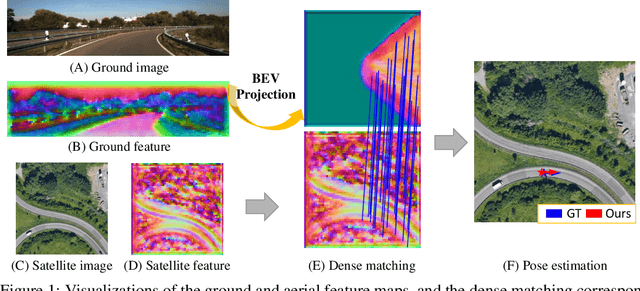
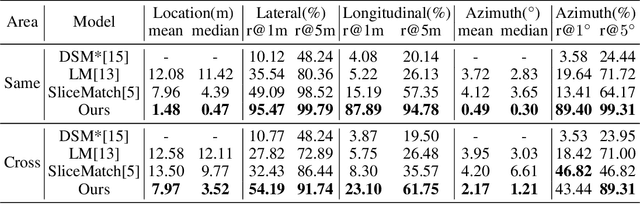
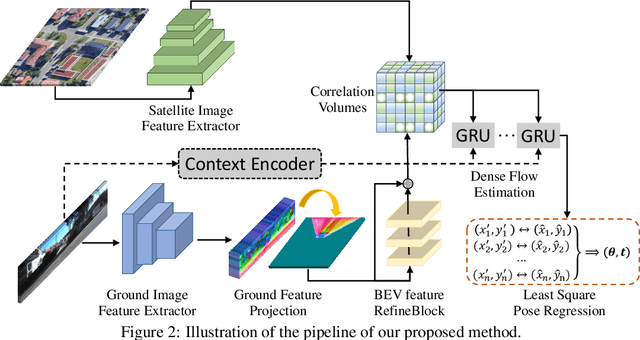
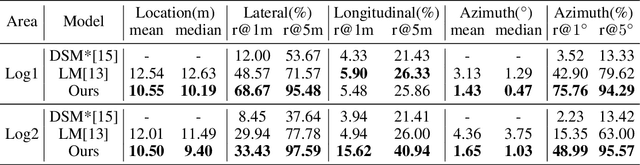
This paper addresses the problem of estimating the 3-DoF camera pose for a ground-level image with respect to a satellite image that encompasses the local surroundings. We propose a novel end-to-end approach that leverages the learning of dense pixel-wise flow fields in pairs of ground and satellite images to calculate the camera pose. Our approach differs from existing methods by constructing the feature metric at the pixel level, enabling full-image supervision for learning distinctive geometric configurations and visual appearances across views. Specifically, our method employs two distinct convolution networks for ground and satellite feature extraction. Then, we project the ground feature map to the bird's eye view (BEV) using a fixed camera height assumption to achieve preliminary geometric alignment. To further establish content association between the BEV and satellite features, we introduce a residual convolution block to refine the projected BEV feature. Optical flow estimation is performed on the refined BEV feature map and the satellite feature map using flow decoder networks based on RAFT. After obtaining dense flow correspondences, we apply the least square method to filter matching inliers and regress the ground camera pose. Extensive experiments demonstrate significant improvements compared to state-of-the-art methods. Notably, our approach reduces the median localization error by 89%, 19%, 80% and 35% on the KITTI, Ford multi-AV, VIGOR and Oxford RobotCar datasets, respectively.
Diffusion Methods for Generating Transition Paths
Sep 19, 2023In this work, we seek to simulate rare transitions between metastable states using score-based generative models. An efficient method for generating high-quality transition paths is valuable for the study of molecular systems since data is often difficult to obtain. We develop two novel methods for path generation in this paper: a chain-based approach and a midpoint-based approach. The first biases the original dynamics to facilitate transitions, while the second mirrors splitting techniques and breaks down the original transition into smaller transitions. Numerical results of generated transition paths for the M\"uller potential and for Alanine dipeptide demonstrate the effectiveness of these approaches in both the data-rich and data-scarce regimes.
NICE: CVPR 2023 Challenge on Zero-shot Image Captioning
Sep 11, 2023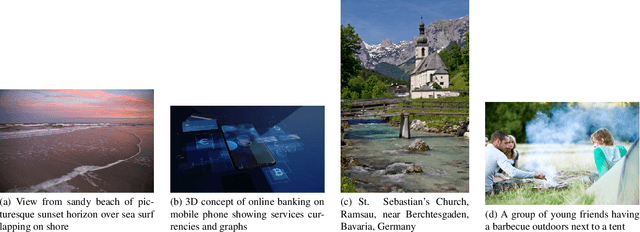
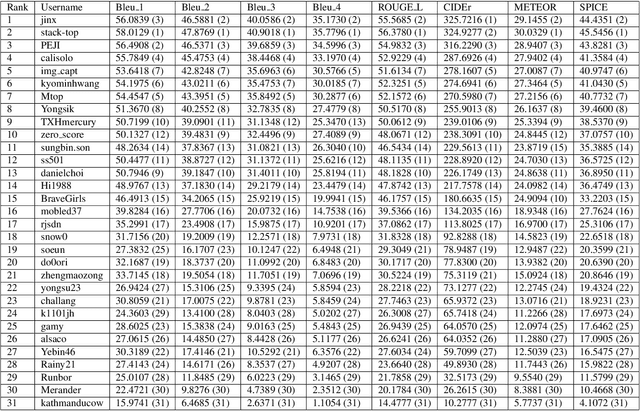
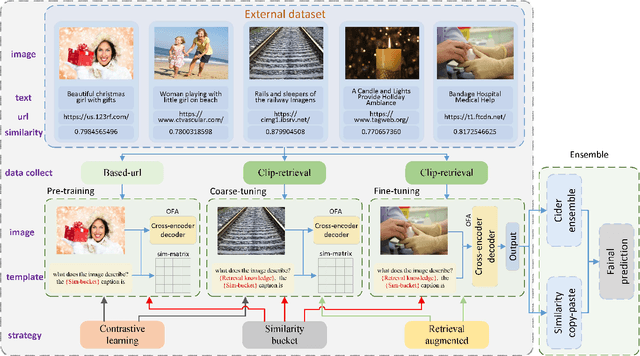
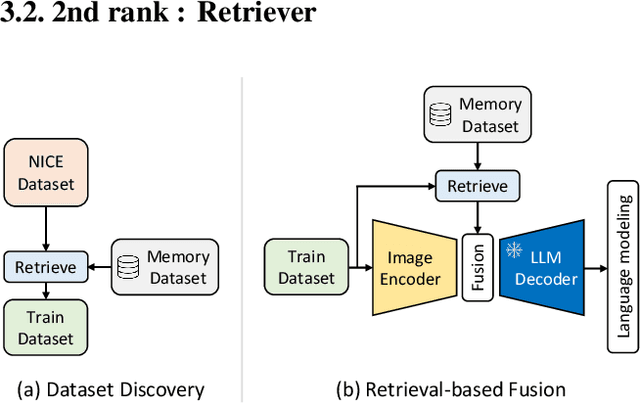
In this report, we introduce NICE (New frontiers for zero-shot Image Captioning Evaluation) project and share the results and outcomes of 2023 challenge. This project is designed to challenge the computer vision community to develop robust image captioning models that advance the state-of-the-art both in terms of accuracy and fairness. Through the challenge, the image captioning models were tested using a new evaluation dataset that includes a large variety of visual concepts from many domains. There was no specific training data provided for the challenge, and therefore the challenge entries were required to adapt to new types of image descriptions that had not been seen during training. This report includes information on the newly proposed NICE dataset, evaluation methods, challenge results, and technical details of top-ranking entries. We expect that the outcomes of the challenge will contribute to the improvement of AI models on various vision-language tasks.
Riemannian Langevin Monte Carlo schemes for sampling PSD matrices with fixed rank
Sep 08, 2023This paper introduces two explicit schemes to sample matrices from Gibbs distributions on $\mathcal S^{n,p}_+$, the manifold of real positive semi-definite (PSD) matrices of size $n\times n$ and rank $p$. Given an energy function $\mathcal E:\mathcal S^{n,p}_+\to \mathbb{R}$ and certain Riemannian metrics $g$ on $\mathcal S^{n,p}_+$, these schemes rely on an Euler-Maruyama discretization of the Riemannian Langevin equation (RLE) with Brownian motion on the manifold. We present numerical schemes for RLE under two fundamental metrics on $\mathcal S^{n,p}_+$: (a) the metric obtained from the embedding of $\mathcal S^{n,p}_+ \subset \mathbb{R}^{n\times n} $; and (b) the Bures-Wasserstein metric corresponding to quotient geometry. We also provide examples of energy functions with explicit Gibbs distributions that allow numerical validation of these schemes.
Benchmarking Ultra-High-Definition Image Reflection Removal
Aug 01, 2023Deep learning based methods have achieved significant success in the task of single image reflection removal (SIRR). However, the majority of these methods are focused on High-Definition/Standard-Definition (HD/SD) images, while ignoring higher resolution images such as Ultra-High-Definition (UHD) images. With the increasing prevalence of UHD images captured by modern devices, in this paper, we aim to address the problem of UHD SIRR. Specifically, we first synthesize two large-scale UHD datasets, UHDRR4K and UHDRR8K. The UHDRR4K dataset consists of $2,999$ and $168$ quadruplets of images for training and testing respectively, and the UHDRR8K dataset contains $1,014$ and $105$ quadruplets. To the best of our knowledge, these two datasets are the first largest-scale UHD datasets for SIRR. Then, we conduct a comprehensive evaluation of six state-of-the-art SIRR methods using the proposed datasets. Based on the results, we provide detailed discussions regarding the strengths and limitations of these methods when applied to UHD images. Finally, we present a transformer-based architecture named RRFormer for reflection removal. RRFormer comprises three modules, namely the Prepossessing Embedding Module, Self-attention Feature Extraction Module, and Multi-scale Spatial Feature Extraction Module. These modules extract hypercolumn features, global and partial attention features, and multi-scale spatial features, respectively. To ensure effective training, we utilize three terms in our loss function: pixel loss, feature loss, and adversarial loss. We demonstrate through experimental results that RRFormer achieves state-of-the-art performance on both the non-UHD dataset and our proposed UHDRR datasets. The code and datasets are publicly available at https://github.com/Liar-zzy/Benchmarking-Ultra-High-Definition-Single-Image-Reflection-Removal.
Deep Network Approximation: Beyond ReLU to Diverse Activation Functions
Jul 13, 2023


This paper explores the expressive power of deep neural networks for a diverse range of activation functions. An activation function set $\mathscr{A}$ is defined to encompass the majority of commonly used activation functions, such as $\mathtt{ReLU}$, $\mathtt{LeakyReLU}$, $\mathtt{ReLU}^2$, $\mathtt{ELU}$, $\mathtt{SELU}$, $\mathtt{Softplus}$, $\mathtt{GELU}$, $\mathtt{SiLU}$, $\mathtt{Swish}$, $\mathtt{Mish}$, $\mathtt{Sigmoid}$, $\mathtt{Tanh}$, $\mathtt{Arctan}$, $\mathtt{Softsign}$, $\mathtt{dSiLU}$, and $\mathtt{SRS}$. We demonstrate that for any activation function $\varrho\in \mathscr{A}$, a $\mathtt{ReLU}$ network of width $N$ and depth $L$ can be approximated to arbitrary precision by a $\varrho$-activated network of width $6N$ and depth $2L$ on any bounded set. This finding enables the extension of most approximation results achieved with $\mathtt{ReLU}$ networks to a wide variety of other activation functions, at the cost of slightly larger constants.
Understanding Text-driven Motion Synthesis with Keyframe Collaboration via Diffusion Models
May 23, 2023The emergence of text-driven motion synthesis technique provides animators with great potential to create efficiently. However, in most cases, textual expressions only contain general and qualitative motion descriptions, while lack fine depiction and sufficient intensity, leading to the synthesized motions that either (a) semantically compliant but uncontrollable over specific pose details, or (b) even deviates from the provided descriptions, bringing animators with undesired cases. In this paper, we propose DiffKFC, a conditional diffusion model for text-driven motion synthesis with keyframes collaborated. Different from plain text-driven designs, full interaction among texts, keyframes and the rest diffused frames are conducted at training, enabling realistic generation under efficient, collaborative dual-level control: coarse guidance at semantic level, with only few keyframes for direct and fine-grained depiction down to body posture level, to satisfy animator requirements without tedious labor. Specifically, we customize efficient Dilated Mask Attention modules, where only partial valid tokens participate in local-to-global attention, indicated by the dilated keyframe mask. For user flexibility, DiffKFC supports adjustment on importance of fine-grained keyframe control. Experimental results show that our model achieves state-of-the-art performance on text-to-motion datasets HumanML3D and KIT.
The probability flow ODE is provably fast
May 19, 2023We provide the first polynomial-time convergence guarantees for the probability flow ODE implementation (together with a corrector step) of score-based generative modeling. Our analysis is carried out in the wake of recent results obtaining such guarantees for the SDE-based implementation (i.e., denoising diffusion probabilistic modeling or DDPM), but requires the development of novel techniques for studying deterministic dynamics without contractivity. Through the use of a specially chosen corrector step based on the underdamped Langevin diffusion, we obtain better dimension dependence than prior works on DDPM ($O(\sqrt{d})$ vs. $O(d)$, assuming smoothness of the data distribution), highlighting potential advantages of the ODE framework.
Accelerate Langevin Sampling with Birth-Death process and Exploration Component
May 06, 2023Sampling a probability distribution with known likelihood is a fundamental task in computational science and engineering. Aiming at multimodality, we propose a new sampling method that takes advantage of both birth-death process and exploration component. The main idea of this method is \textit{look before you leap}. We keep two sets of samplers, one at warmer temperature and one at original temperature. The former one serves as pioneer in exploring new modes and passing useful information to the other, while the latter one samples the target distribution after receiving the information. We derive a mean-field limit and show how the exploration process determines sampling efficiency. Moreover, we prove exponential asymptotic convergence under mild assumption. Finally, we test on experiments from previous literature and compared our methodology to previous ones.