 Add to Chrome
 Add to Firefox
 Add to Edge
On the implicit regularization of Langevin dynamics with projected noise
Feb 12, 2026
We study Langevin dynamics with noise projected onto the directions orthogonal to an isometric group action. This mathematical model is introduced to shed new light on the effects of symmetry on stochastic gradient descent for over-parametrized models. Our main result identifies a novel form of implicit regularization: when the initial and target density are both invariant under the group action, Langevin dynamics with projected noise is equivalent in law to Langevin dynamics with isotropic diffusion but with an additional drift term proportional to the negative log volume of the group orbit. We prove this result by constructing a coupling of the two processes via a third process on the group itself, and identify the additional drift as the mean curvature of the orbits.

An entropy formula for the Deep Linear Network
Sep 11, 2025We study the Riemannian geometry of the Deep Linear Network (DLN) as a foundation for a thermodynamic description of the learning process. The main tools are the use of group actions to analyze overparametrization and the use of Riemannian submersion from the space of parameters to the space of observables. The foliation of the balanced manifold in the parameter space by group orbits is used to define and compute a Boltzmann entropy. We also show that the Riemannian geometry on the space of observables defined in [2] is obtained by Riemannian submersion of the balanced manifold. The main technical step is an explicit construction of an orthonormal basis for the tangent space of the balanced manifold using the theory of Jacobi matrices.
The geometry of the deep linear network
Nov 13, 2024This article provides an expository account of training dynamics in the Deep Linear Network (DLN) from the perspective of the geometric theory of dynamical systems. Rigorous results by several authors are unified into a thermodynamic framework for deep learning. The analysis begins with a characterization of the invariant manifolds and Riemannian geometry in the DLN. This is followed by exact formulas for a Boltzmann entropy, as well as stochastic gradient descent of free energy using a Riemannian Langevin Equation. Several links between the DLN and other areas of mathematics are discussed, along with some open questions.
Riemannian Langevin Monte Carlo schemes for sampling PSD matrices with fixed rank
Sep 08, 2023This paper introduces two explicit schemes to sample matrices from Gibbs distributions on $\mathcal S^{n,p}_+$, the manifold of real positive semi-definite (PSD) matrices of size $n\times n$ and rank $p$. Given an energy function $\mathcal E:\mathcal S^{n,p}_+\to \mathbb{R}$ and certain Riemannian metrics $g$ on $\mathcal S^{n,p}_+$, these schemes rely on an Euler-Maruyama discretization of the Riemannian Langevin equation (RLE) with Brownian motion on the manifold. We present numerical schemes for RLE under two fundamental metrics on $\mathcal S^{n,p}_+$: (a) the metric obtained from the embedding of $\mathcal S^{n,p}_+ \subset \mathbb{R}^{n\times n} $; and (b) the Bures-Wasserstein metric corresponding to quotient geometry. We also provide examples of energy functions with explicit Gibbs distributions that allow numerical validation of these schemes.
Deep Linear Networks for Matrix Completion -- An Infinite Depth Limit
Oct 22, 2022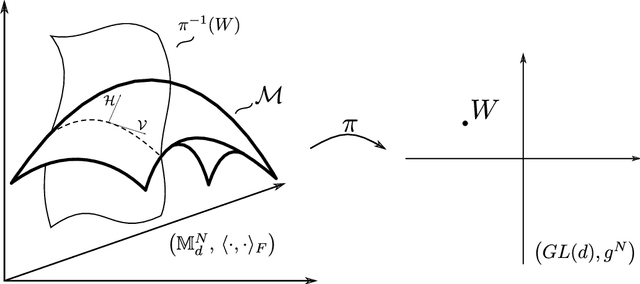
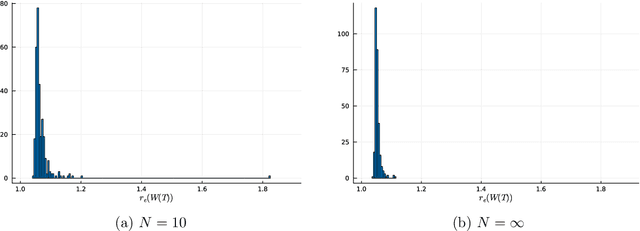
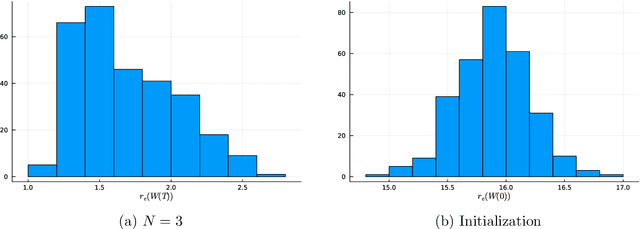
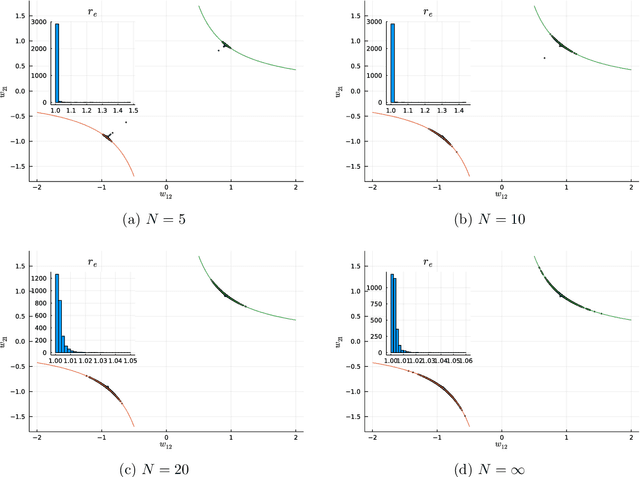
The deep linear network (DLN) is a model for implicit regularization in gradient based optimization of overparametrized learning architectures. Training the DLN corresponds to a Riemannian gradient flow, where the Riemannian metric is defined by the architecture of the network and the loss function is defined by the learning task. We extend this geometric framework, obtaining explicit expressions for the volume form, including the case when the network has infinite depth. We investigate the link between the Riemannian geometry and the training asymptotics for matrix completion with rigorous analysis and numerics. We propose that implicit regularization is a result of bias towards high state space volume.