 Add to Chrome
 Add to Firefox
 Add to Edge
SysEvolve: An AI-native, safe, autonomous adversarial attack-defense co-evolutionary system
Aug 15, 2026
The rapid advancement of large language models (LLMs) has created a growing asymmetry in cybersecurity, where attack accelerates toward autonomous execution while defense remains predominantly human-intensive. Despite substantial prior work across cyber ranges, AI-driven attack, and AI-driven defense, this asymmetry persists. We trace it to a deeper root cause, that evolution itself has stalled on both sides at three layers. To overcome this, we propose co-evolution as the integrating insight, where attack and defense AI agents autonomously and safely drive each other's evolution through adversarial confrontation. Based on this insight, we present \sysevolve, comprising three co-designed components, \sysfield, \sysspear, and \sysarmor. \sysfield constructs realistic multi-host ranges. \sysspear generates efficient, safe attack schemes. \sysarmor performs real-time, interpretable defense. Together they form a self-driven adversarial loop restoring evolution at all three layers. In evaluation, \sysfield achieves zero-loss collection at 2.1\% overhead and orchestrates 257 CVEs into 1,148 ranges, \sysspear improves attack success by over 25\% over baseline LLMs, and \sysarmor achieves 10--1000$\times$ greater precision than prior systems and detects real APT attacks in production at Huawei and Sangfor. Our evaluation also reveals three findings about LLM agent capabilities. First, multi-step composition and larger topologies expose agent capability gaps hidden by single-step evaluations. Second, the bottleneck lies after initial access in post-compromise state utilization. Third, LLM agents are susceptible to environmental interference. When decoy endpoints are deployed in the range, agent timeouts triple and downstream completion disappears despite the success rates of initial accesses are unchanged.

RangeFactory: Scalable Construction of Multi-Hop Cyber Ranges
Aug 10, 2026Real-world cyberattacks often require sustained progress across multiple hosts and network segments, making multi-hop cyber ranges essential infrastructure for studying and improving LLM agents' ability to sustain complete attack chains. Prior work has scaled isolated vulnerability tasks and constructed multi-host scenarios from manually specified vulnerability semantics. However, they are still unable to automatically orchestrate the growing supply of vulnerability environments into end-to-end validated multi-hop ranges. To this end, we present RangeFactory, an automated cyber-range orchestration framework that constructs multi-hop cyber ranges at scale from isolated vulnerability environments. RangeFactory formulates range construction as dependency resolution: it extracts dependency information from agents' actual attacks against real vulnerabilities, resolves known dependencies through template-guided orchestration, and uses end-to-end attack execution to validate runtime dependencies that emerge after composition. Using RangeFactory, we construct RangeBench with 1,148 validated range instances spanning 287 distinct attack chains and evaluate frontier attack agents across attack depth, network scale, and task information. Among runs that compromise the entry vulnerability, 24.5-47.0% still fail to complete the remaining attack path, revealing a substantial sustained-compromise gap between establishing an initial foothold and completing a multi-hop attack. RangeFactory further produces a corpus of 5,541 outcome-annotated multi-hop attack trajectories, providing execution data for attack-process analysis and future agent training.
3D-CoS: A New 3D Reconstruction Paradigm Based on VLM Code Synthesis
Jun 09, 2026Most recent 3D reconstruction and editing systems operate on implicit and explicit representations such as NeRF, point clouds, or meshes. While these representations enable high-fidelity rendering, they are fundamentally low-level and hard to control programmatically. In contrast, we propose and systematically evaluate a new 3D reconstruction paradigm, 3D Code Synthesis (3D-CoS), where 3D assets are constructed as executable Blender code, a programmatic and interpretable medium. To assess how well current VLMs can use code to represent 3D objects, we evaluate representative open-source and closed-source VLMs in code-based reconstruction under a unified protocol. We further introduce a suite of structured code-synthesis workflows, including blueprint-based planning, Retrieval-Augmented Generation (RAG) over Blender API documentation, few-shot geometric demonstrations, and a component-level Agent workflow for part-wise code generation. To demonstrate the unique advantages of this representation, we further evaluate localized text-driven modifications and compare our code-based edits with a point-cloud-based 3D editing baseline. Our study shows that code as a 3D representation offers strong controllability and locality, yielding stronger edit fidelity and better preservation of unedited regions in our targeted editing evaluation. Our work also analyzes the potential of this paradigm, delineates the current capability frontier of VLMs for programmatic 3D modeling, and highlights code synthesis as a promising direction for editable 3D reconstruction.
SceneCode: Executable World Programs for Editable Indoor Scenes with Articulated Objects
May 19, 2026Indoor scene synthesis underpins embodied AI, robotic manipulation, and simulation-based policy evaluation, where a useful scene must specify not only what the environment looks like, but also how its objects are structured. Existing pipelines, however, typically represent generated content as static meshes and inherit articulation only from curated asset libraries, which limits object-level controllability and prevents new interactable assets from being produced on demand. We address this gap by formulating physically interactable indoor scene synthesis as programmatic world generation, and present SceneCode, a framework that compiles a natural language prompt into an executable, code-driven indoor world rather than a collection of opaque meshes. A room-level agentic backbone first turns the prompt into a structured house layout and emits per-object AssetRequests through a planner--designer--critic loop. Each request is then routed to one of five code-generation strategies and converted into a synthesized part-wise Blender Python programs that are validated through an execution-guided repair-and-refine loop. The resulting programs are compiled into simulation-ready assets, and exported as SDF for physics simulation. A persistent scene-state registry links object requests, executable programs, rendered geometry, and simulation assets, turning scene assembly into a traceable and locally editable world-building process. We evaluate SceneCode across scene-level synthesis, object-level asset quality, human judgment, and downstream robot interaction. Results show that executable world programs improve prompt-faithful indoor scene generation and produce assets with cleaner mesh structure, and simulator-loadable articulation metadata. Project page: https://scene-code.github.io/.
Benchmarking AIGC Video Quality Assessment: A Dataset and Unified Model
Jul 31, 2024


In recent years, artificial intelligence (AI) driven video generation has garnered significant attention due to advancements in stable diffusion and large language model techniques. Thus, there is a great demand for accurate video quality assessment (VQA) models to measure the perceptual quality of AI-generated content (AIGC) videos as well as optimize video generation techniques. However, assessing the quality of AIGC videos is quite challenging due to the highly complex distortions they exhibit (e.g., unnatural action, irrational objects, etc.). Therefore, in this paper, we try to systemically investigate the AIGC-VQA problem from both subjective and objective quality assessment perspectives. For the subjective perspective, we construct a Large-scale Generated Vdeo Quality assessment (LGVQ) dataset, consisting of 2,808 AIGC videos generated by 6 video generation models using 468 carefully selected text prompts. Unlike previous subjective VQA experiments, we evaluate the perceptual quality of AIGC videos from three dimensions: spatial quality, temporal quality, and text-to-video alignment, which hold utmost importance for current video generation techniques. For the objective perspective, we establish a benchmark for evaluating existing quality assessment metrics on the LGVQ dataset, which reveals that current metrics perform poorly on the LGVQ dataset. Thus, we propose a Unify Generated Video Quality assessment (UGVQ) model to comprehensively and accurately evaluate the quality of AIGC videos across three aspects using a unified model, which uses visual, textual and motion features of video and corresponding prompt, and integrates key features to enhance feature expression. We hope that our benchmark can promote the development of quality evaluation metrics for AIGC videos. The LGVQ dataset and the UGVQ metric will be publicly released.
Large Multi-modality Model Assisted AI-Generated Image Quality Assessment
Apr 27, 2024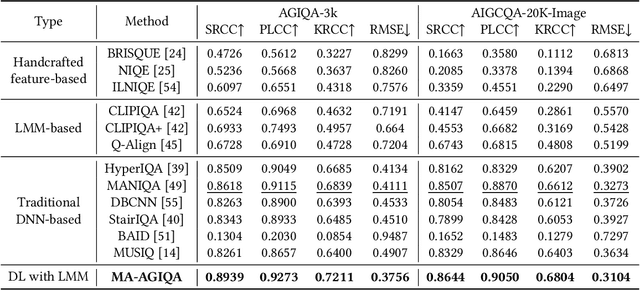

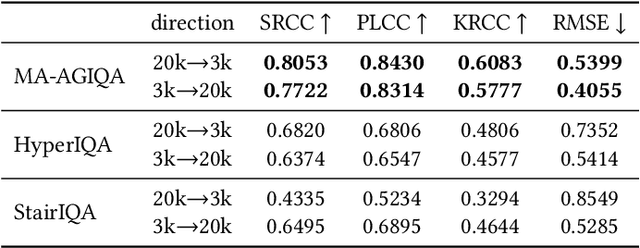
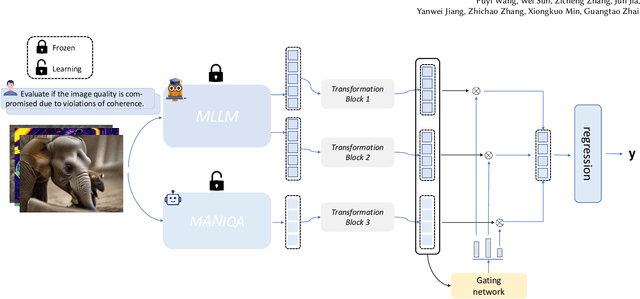
Traditional deep neural network (DNN)-based image quality assessment (IQA) models leverage convolutional neural networks (CNN) or Transformer to learn the quality-aware feature representation, achieving commendable performance on natural scene images. However, when applied to AI-Generated images (AGIs), these DNN-based IQA models exhibit subpar performance. This situation is largely due to the semantic inaccuracies inherent in certain AGIs caused by uncontrollable nature of the generation process. Thus, the capability to discern semantic content becomes crucial for assessing the quality of AGIs. Traditional DNN-based IQA models, constrained by limited parameter complexity and training data, struggle to capture complex fine-grained semantic features, making it challenging to grasp the existence and coherence of semantic content of the entire image. To address the shortfall in semantic content perception of current IQA models, we introduce a large Multi-modality model Assisted AI-Generated Image Quality Assessment (MA-AGIQA) model, which utilizes semantically informed guidance to sense semantic information and extract semantic vectors through carefully designed text prompts. Moreover, it employs a mixture of experts (MoE) structure to dynamically integrate the semantic information with the quality-aware features extracted by traditional DNN-based IQA models. Comprehensive experiments conducted on two AI-generated content datasets, AIGCQA-20k and AGIQA-3k show that MA-AGIQA achieves state-of-the-art performance, and demonstrate its superior generalization capabilities on assessing the quality of AGIs. Code is available at https://github.com/wangpuyi/MA-AGIQA.