 Add to Chrome
 Add to Firefox
 Add to Edge
Neuromorphic Energy-Aware Learning for Adaptive Deep Brain Stimulation
Jun 26, 2026
Neuromorphic and edge computing research has focused on reducing the inference cost of neural network controllers, yet in physical closed-loop systems the actuator can rival or exceed an efficient controller in energy. An efficient controller is therefore necessary but not sufficient, because the actuator becomes the cost worth reducing once inference no longer dominates it. Here, we introduce energy-aware learning, an approach that incorporates actuator energy directly into the reinforcement learning reward, and demonstrate it in closed-loop deep brain stimulation (DBS) for Parkinson's disease. A deep spiking Q-network, trained in a biophysical cortico-basal ganglia-thalamic circuit model, learns to suppress pathological alpha-beta oscillations by 45.2% while reducing stimulation charge by 80.0% relative to continuous DBS. Sparsity-constrained knowledge distillation compresses the policy onto the SynSense XyloAudio 3 neuromorphic processor at 0.52 mW inference power, yielding 28.1x lower energy per inference than an equivalent artificial neural network on conventional edge hardware. By co-optimizing stimulation energy and inference efficiency, the framework addresses both major power demands in implantable neuromodulation.

VisualClaw: A Real-Time, Personalized Agent for the Physical World
Jun 15, 2026Vision language models are serving as general-purpose interfaces for complex multimodal tasks. However, deployment still faces three gaps: VLMs typically incur high latency and cost when processing dense video frames and long prompts, the agent scaffold remains static after deployment, and standard video-QA benchmarks do not test whether agents can use visual evidence inside tool-using workspaces. We present VisualClaw, a self-evolving multimodal agent built around two principles. First, hybrid encoding reduces deployment cost by filtering less informative streaming frames with a cascaded gate and compressing the text skill bank through hot/cold top-k injection. Second, skill evolution lets the agent learn from failures: retrieved memories condition an evolver as direct concatenated context or as guided evidence, producing skill-bank updates that help future questions. Across 4 video-QA benchmarks with 2 VLMs, VisualClaw cuts per-question API cost by an average -98% versus full-frame upload and by -25.9% over the offline uniform 8 frame baseline, while boosting accuracy in most settings, e.g., an average +3.85% and a peak +15.80% on EgoSchema with Gemini 3 Flash. To address the gap, we curate VisualClawArena, a 200-scenario multimodal agentic benchmark built through a strict five-stage pipeline; models must use video evidence, documents, dynamic updates, and executable checks inside a workspace. On VisualClawArena, the same framework with computer-use agent backends improves macro accuracy by +2.9% for Codex (GPT-5.5) and +3.2% for Claude Code (Sonnet 4.6) over no-evolution baselines, with a -9.5% cost reduction compared to the uniform-sampled baseline. These properties make VisualClaw a natural fit for edge applications, where the cascade reduces a 1-hour streaming session from ~3,600 API uploads down to only 5-20 calls and the self-evolution makes it a perfect personalized assistant.
Implicit Behavioral Decoding from Next-Step Spike Forecasts at Population Scale
May 13, 2026Closed-loop brain-computer interfaces often require both a forecast of upcoming neural population activity and a readout of the animal's behavioral state. A single Mamba forecaster, trained only on next-step spike counts at Neuropixels scale, can deliver both in one forward pass. A lightweight per-session linear head reading the model's predicted rates decodes behavior better than the same linear classifier reading the raw spike counts, under matched temporal context. We test on the Steinmetz visual-discrimination benchmark, which spans 39 sessions, roughly 27,000 neurons, and 1,994 held-out trials. Across three training seeds, Mamba's predicted rates decode mouse choice at 75.7$\pm$0.2% trial vote, roughly 2.3 times chance level, and stimulus side at 66.1$\pm$0.6%, about twice chance. Compared to a matched 500 ms-context linear decoder on the raw spike counts, Mamba wins at trial vote by 4-6 pp on response and 4-6 pp on stimulus side. A session-start calibration block of about 100-150 trials brings the readout within 1-2 pp of asymptote, and the full pipeline fits inside the 50 ms bin budget on workstation-class GPUs typical of tethered chronic Neuropixels recordings.
Transformers with Selective Access to Early Representations
May 05, 2026Several recent Transformer architectures expose later layers to representations computed in the earliest layers, motivated by the observation that low-level features can become harder to recover as the residual stream is repeatedly transformed through depth. The cheapest among these methods add static value residuals: learned mixing coefficients that expose the first-layer value projection V_1 uniformly across tokens and heads. More expressive dense or dynamic alternatives recover finer-grained access, but at higher memory cost and lower throughput. The usefulness of V_1 is unlikely to be constant across tokens, heads, and contexts; different positions plausibly require different amounts of access to early lexical or semantic information. We therefore treat early-representation reuse as a retrieval problem rather than a connectivity problem, and introduce Selective Access Transformer (SATFormer), which preserves the first-layer value pathway while controlling access with a context-dependent gate. Across models from 130M to 1.3B parameters, SATFormer consistently improves validation loss and zero-shot accuracy over the static value-residual and Transformer baselines. Its strongest gains appear on retrieval-intensive benchmarks, where it improves over static value residuals by approximately 1.5 average points, while maintaining throughput and memory usage close to the baseline Transformer. Gate analyses suggest sparse, depth-dependent, head-specific, and category-sensitive access patterns, supporting the interpretation that SATFormer learns selective reuse of early representations rather than uniform residual copying. Our code is available at https://github.com/SkyeGunasekaran/SATFormer.
Direct Semantic Communication Between Large Language Models via Vector Translation
Nov 06, 2025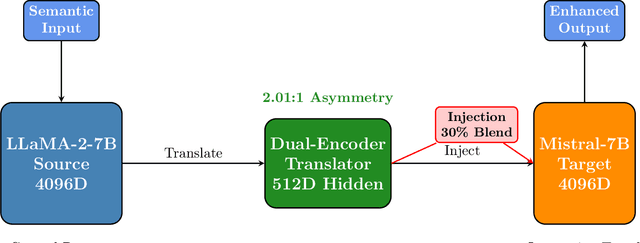
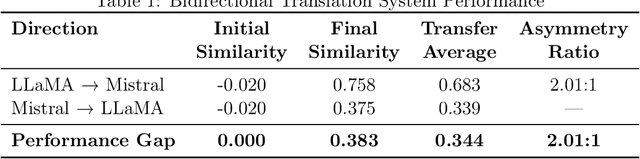
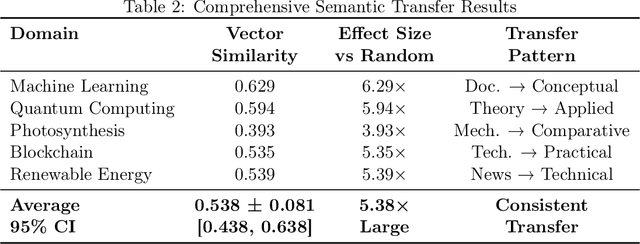
In multi-agent settings, such as debate, reflection, or tool-calling, large language models (LLMs) pass messages as plain tokens, discarding most latent semantics. This constrains information transfer and adds unnecessary computational overhead. We form a latent bridge via vector translations, which use learned mappings that enable direct semantic exchange between representation spaces. A dual-encoder translator trained between Llama-2-7B and Mistral-7B-Instruct attains an average cosine alignment of 0.538. Injecting the translated vectors at 30 percent blending strength steers the target model's generation without destabilizing logits. Bidirectional evaluation shows a 2.01:1 transfer asymmetry, indicating that general-purpose models yield more transferable representations than instruction-tuned variants. This conservative injection preserves computational stability while demonstrating that cross-model latent communication is feasible, enabling collaborative AI systems that share meaning rather than tokens.
Scaling Latent Reasoning via Looped Language Models
Oct 29, 2025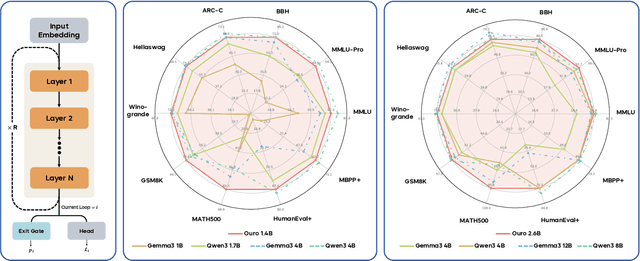
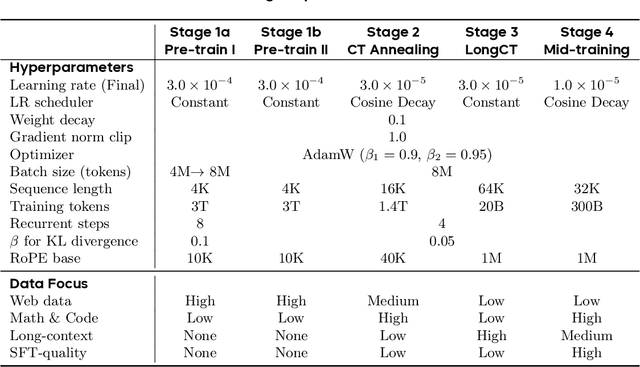
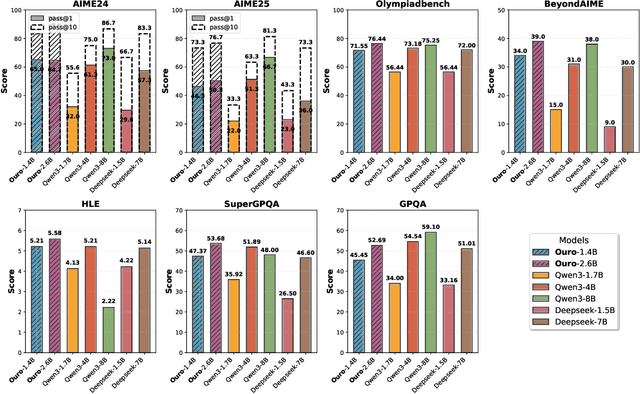

Modern LLMs are trained to "think" primarily via explicit text generation, such as chain-of-thought (CoT), which defers reasoning to post-training and under-leverages pre-training data. We present and open-source Ouro, named after the recursive Ouroboros, a family of pre-trained Looped Language Models (LoopLM) that instead build reasoning into the pre-training phase through (i) iterative computation in latent space, (ii) an entropy-regularized objective for learned depth allocation, and (iii) scaling to 7.7T tokens. Ouro 1.4B and 2.6B models enjoy superior performance that match the results of up to 12B SOTA LLMs across a wide range of benchmarks. Through controlled experiments, we show this advantage stems not from increased knowledge capacity, but from superior knowledge manipulation capabilities. We also show that LoopLM yields reasoning traces more aligned with final outputs than explicit CoT. We hope our results show the potential of LoopLM as a novel scaling direction in the reasoning era. Our model could be found in: http://ouro-llm.github.io.
A Survey on Latent Reasoning
Jul 08, 2025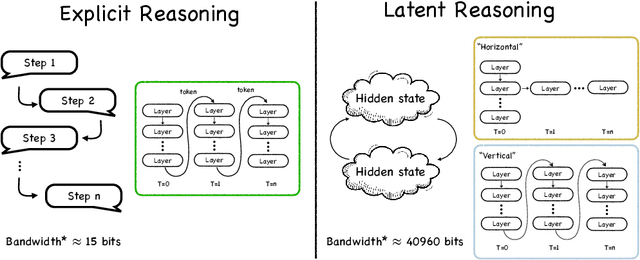

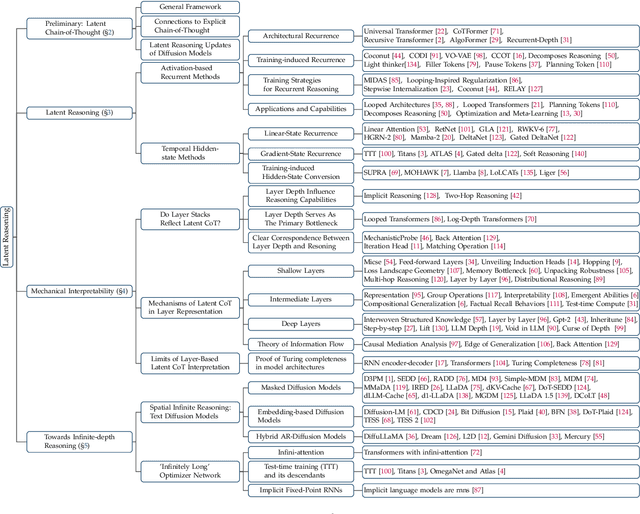
Large Language Models (LLMs) have demonstrated impressive reasoning capabilities, especially when guided by explicit chain-of-thought (CoT) reasoning that verbalizes intermediate steps. While CoT improves both interpretability and accuracy, its dependence on natural language reasoning limits the model's expressive bandwidth. Latent reasoning tackles this bottleneck by performing multi-step inference entirely in the model's continuous hidden state, eliminating token-level supervision. To advance latent reasoning research, this survey provides a comprehensive overview of the emerging field of latent reasoning. We begin by examining the foundational role of neural network layers as the computational substrate for reasoning, highlighting how hierarchical representations support complex transformations. Next, we explore diverse latent reasoning methodologies, including activation-based recurrence, hidden state propagation, and fine-tuning strategies that compress or internalize explicit reasoning traces. Finally, we discuss advanced paradigms such as infinite-depth latent reasoning via masked diffusion models, which enable globally consistent and reversible reasoning processes. By unifying these perspectives, we aim to clarify the conceptual landscape of latent reasoning and chart future directions for research at the frontier of LLM cognition. An associated GitHub repository collecting the latest papers and repos is available at: https://github.com/multimodal-art-projection/LatentCoT-Horizon/.
A Systematic Analysis of Hybrid Linear Attention
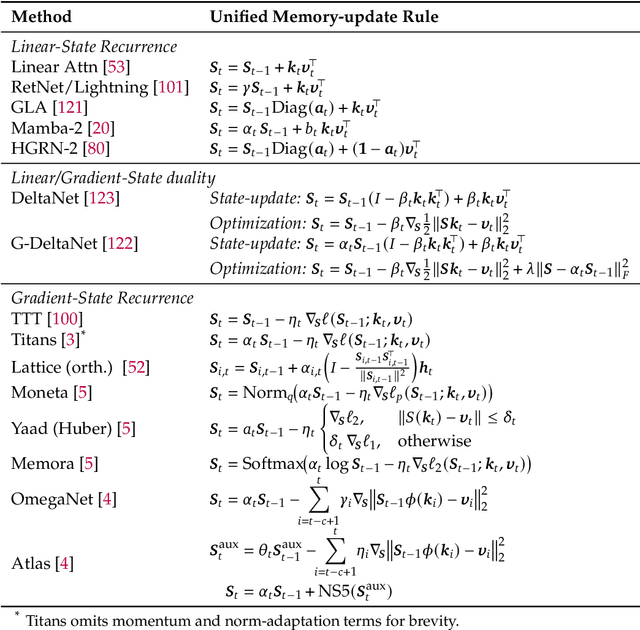
Jul 08, 2025Transformers face quadratic complexity and memory issues with long sequences, prompting the adoption of linear attention mechanisms using fixed-size hidden states. However, linear models often suffer from limited recall performance, leading to hybrid architectures that combine linear and full attention layers. Despite extensive hybrid architecture research, the choice of linear attention component has not been deeply explored. We systematically evaluate various linear attention models across generations - vector recurrences to advanced gating mechanisms - both standalone and hybridized. To enable this comprehensive analysis, we trained and open-sourced 72 models: 36 at 340M parameters (20B tokens) and 36 at 1.3B parameters (100B tokens), covering six linear attention variants across five hybridization ratios. Benchmarking on standard language modeling and recall tasks reveals that superior standalone linear models do not necessarily excel in hybrids. While language modeling remains stable across linear-to-full attention ratios, recall significantly improves with increased full attention layers, particularly below a 3:1 ratio. Our study highlights selective gating, hierarchical recurrence, and controlled forgetting as critical for effective hybrid models. We recommend architectures such as HGRN-2 or GatedDeltaNet with a linear-to-full ratio between 3:1 and 6:1 to achieve Transformer-level recall efficiently. Our models are open-sourced at https://huggingface.co/collections/m-a-p/hybrid-linear-attention-research-686c488a63d609d2f20e2b1e.
ARFlow: Autogressive Flow with Hybrid Linear Attention
Jan 27, 2025


Flow models are effective at progressively generating realistic images, but they generally struggle to capture long-range dependencies during the generation process as they compress all the information from previous time steps into a single corrupted image. To address this limitation, we propose integrating autoregressive modeling -- known for its excellence in modeling complex, high-dimensional joint probability distributions -- into flow models. During training, at each step, we construct causally-ordered sequences by sampling multiple images from the same semantic category and applying different levels of noise, where images with higher noise levels serve as causal predecessors to those with lower noise levels. This design enables the model to learn broader category-level variations while maintaining proper causal relationships in the flow process. During generation, the model autoregressively conditions the previously generated images from earlier denoising steps, forming a contextual and coherent generation trajectory. Additionally, we design a customized hybrid linear attention mechanism tailored to our modeling approach to enhance computational efficiency. Our approach, termed ARFlow, under 400k training steps, achieves 14.08 FID scores on ImageNet at 128 * 128 without classifier-free guidance, reaching 4.34 FID with classifier-free guidance 1.5, significantly outperforming the previous flow-based model SiT's 9.17 FID. Extensive ablation studies demonstrate the effectiveness of our modeling strategy and chunk-wise attention design.
Future-Guided Learning: A Predictive Approach To Enhance Time-Series Forecasting
Oct 19, 2024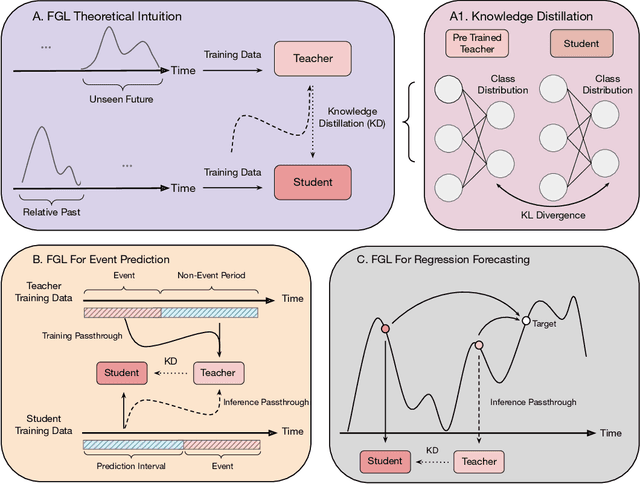
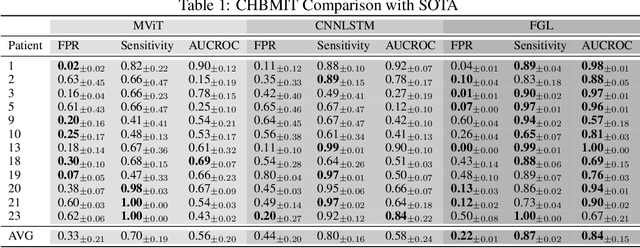
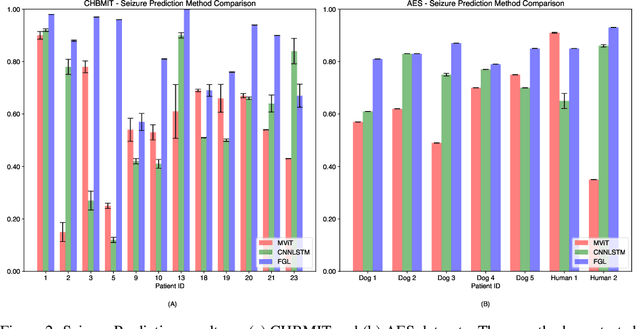
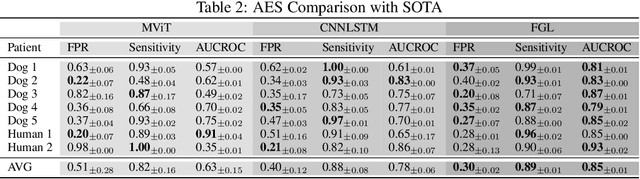
Accurate time-series forecasting is essential across a multitude of scientific and industrial domains, yet deep learning models often struggle with challenges such as capturing long-term dependencies and adapting to drift in data distributions over time. We introduce Future-Guided Learning, an approach that enhances time-series event forecasting through a dynamic feedback mechanism inspired by predictive coding. Our approach involves two models: a detection model that analyzes future data to identify critical events and a forecasting model that predicts these events based on present data. When discrepancies arise between the forecasting and detection models, the forecasting model undergoes more substantial updates, effectively minimizing surprise and adapting to shifts in the data distribution by aligning its predictions with actual future outcomes. This feedback loop, drawing upon principles of predictive coding, enables the forecasting model to dynamically adjust its parameters, improving accuracy by focusing on features that remain relevant despite changes in the underlying data. We validate our method on a variety of tasks such as seizure prediction in biomedical signal analysis and forecasting in dynamical systems, achieving a 40\% increase in the area under the receiver operating characteristic curve (AUC-ROC) and a 10\% reduction in mean absolute error (MAE), respectively. By incorporating a predictive feedback mechanism that adapts to data distribution drift, Future-Guided Learning offers a promising avenue for advancing time-series forecasting with deep learning.