 Add to Chrome
 Add to Firefox
 Add to Edge
Transformers with Selective Access to Early Representations
May 05, 2026
Several recent Transformer architectures expose later layers to representations computed in the earliest layers, motivated by the observation that low-level features can become harder to recover as the residual stream is repeatedly transformed through depth. The cheapest among these methods add static value residuals: learned mixing coefficients that expose the first-layer value projection V_1 uniformly across tokens and heads. More expressive dense or dynamic alternatives recover finer-grained access, but at higher memory cost and lower throughput. The usefulness of V_1 is unlikely to be constant across tokens, heads, and contexts; different positions plausibly require different amounts of access to early lexical or semantic information. We therefore treat early-representation reuse as a retrieval problem rather than a connectivity problem, and introduce Selective Access Transformer (SATFormer), which preserves the first-layer value pathway while controlling access with a context-dependent gate. Across models from 130M to 1.3B parameters, SATFormer consistently improves validation loss and zero-shot accuracy over the static value-residual and Transformer baselines. Its strongest gains appear on retrieval-intensive benchmarks, where it improves over static value residuals by approximately 1.5 average points, while maintaining throughput and memory usage close to the baseline Transformer. Gate analyses suggest sparse, depth-dependent, head-specific, and category-sensitive access patterns, supporting the interpretation that SATFormer learns selective reuse of early representations rather than uniform residual copying. Our code is available at https://github.com/SkyeGunasekaran/SATFormer.

Measuring Contextual Informativeness in Child-Directed Text
Dec 23, 2024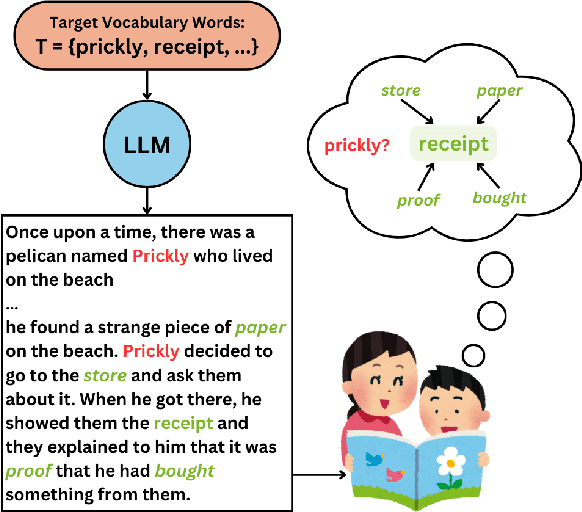
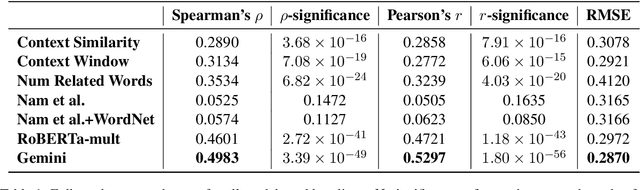
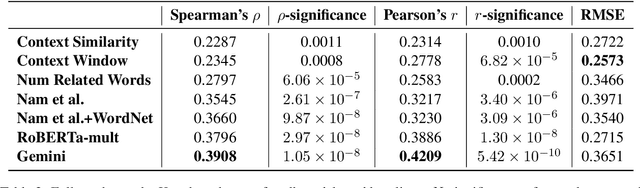
To address an important gap in creating children's stories for vocabulary enrichment, we investigate the automatic evaluation of how well stories convey the semantics of target vocabulary words, a task with substantial implications for generating educational content. We motivate this task, which we call measuring contextual informativeness in children's stories, and provide a formal task definition as well as a dataset for the task. We further propose a method for automating the task using a large language model (LLM). Our experiments show that our approach reaches a Spearman correlation of 0.4983 with human judgments of informativeness, while the strongest baseline only obtains a correlation of 0.3534. An additional analysis shows that the LLM-based approach is able to generalize to measuring contextual informativeness in adult-directed text, on which it also outperforms all baselines.
On the Automatic Generation and Simplification of Children's Stories
Oct 27, 2023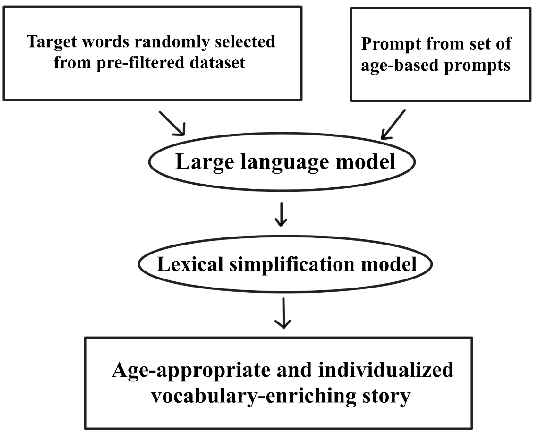
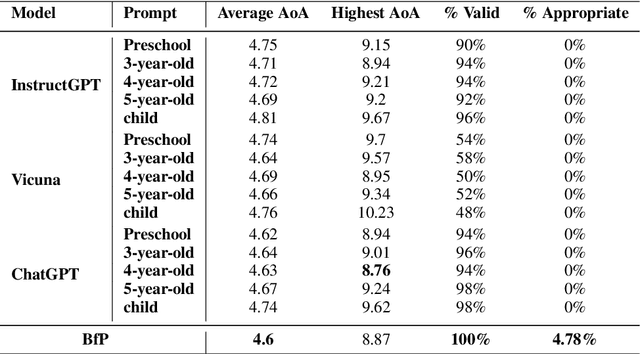
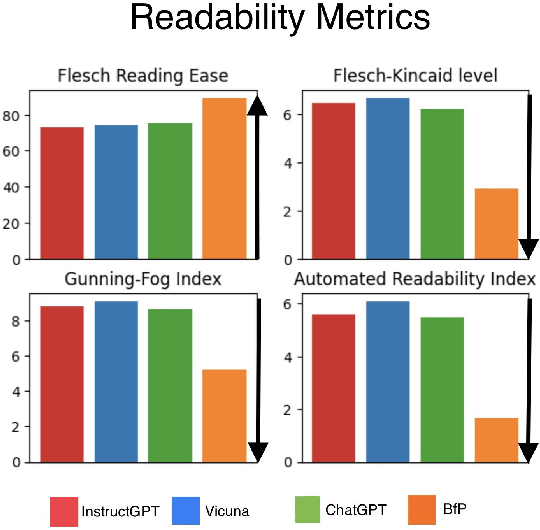
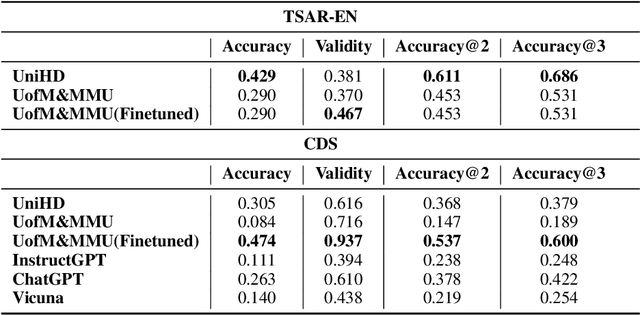
With recent advances in large language models (LLMs), the concept of automatically generating children's educational materials has become increasingly realistic. Working toward the goal of age-appropriate simplicity in generated educational texts, we first examine the ability of several popular LLMs to generate stories with properly adjusted lexical and readability levels. We find that, in spite of the growing capabilities of LLMs, they do not yet possess the ability to limit their vocabulary to levels appropriate for younger age groups. As a second experiment, we explore the ability of state-of-the-art lexical simplification models to generalize to the domain of children's stories and, thus, create an efficient pipeline for their automatic generation. In order to test these models, we develop a dataset of child-directed lexical simplification instances, with examples taken from the LLM-generated stories in our first experiment. We find that, while the strongest-performing current lexical simplification models do not perform as well on material designed for children due to their reliance on large language models behind the scenes, some models that still achieve fairly strong results on general data can mimic or even improve their performance on children-directed data with proper fine-tuning, which we conduct using our newly created child-directed simplification dataset.