 Add to Chrome
 Add to Firefox
 Add to Edge
Exploiting Contextual Target Attributes for Target Sentiment Classification
Dec 21, 2023
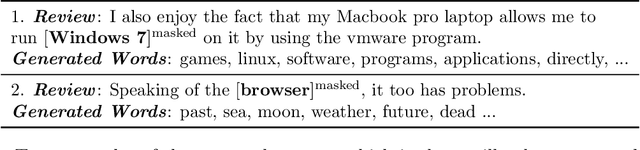
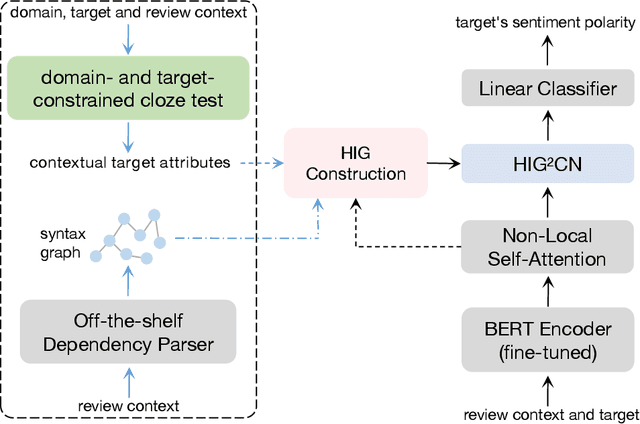
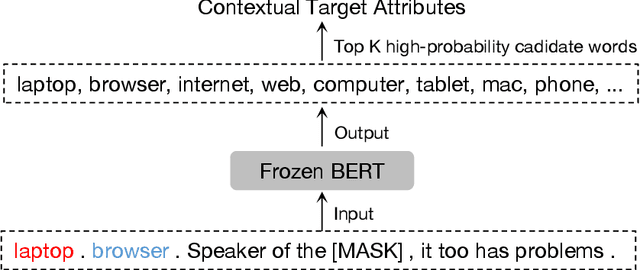
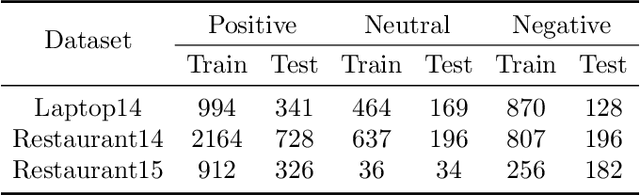
Existing PTLM-based models for TSC can be categorized into two groups: 1) fine-tuning-based models that adopt PTLM as the context encoder; 2) prompting-based models that transfer the classification task to the text/word generation task. In this paper, we present a new perspective of leveraging PTLM for TSC: simultaneously leveraging the merits of both language modeling and explicit target-context interactions via contextual target attributes. Specifically, we design the domain- and target-constrained cloze test, which can leverage the PTLMs' strong language modeling ability to generate the given target's attributes pertaining to the review context. The attributes contain the background and property information of the target, which can help to enrich the semantics of the review context and the target. To exploit the attributes for tackling TSC, we first construct a heterogeneous information graph by treating the attributes as nodes and combining them with (1) the syntax graph automatically produced by the off-the-shelf dependency parser and (2) the semantics graph of the review context, which is derived from the self-attention mechanism. Then we propose a heterogeneous information gated graph convolutional network to model the interactions among the attribute information, the syntactic information, and the contextual information. The experimental results on three benchmark datasets demonstrate the superiority of our model, which achieves new state-of-the-art performance.

Co-guiding for Multi-intent Spoken Language Understanding
Nov 22, 2023Recent graph-based models for multi-intent SLU have obtained promising results through modeling the guidance from the prediction of intents to the decoding of slot filling. However, existing methods (1) only model the unidirectional guidance from intent to slot, while there are bidirectional inter-correlations between intent and slot; (2) adopt homogeneous graphs to model the interactions between the slot semantics nodes and intent label nodes, which limit the performance. In this paper, we propose a novel model termed Co-guiding Net, which implements a two-stage framework achieving the mutual guidances between the two tasks. In the first stage, the initial estimated labels of both tasks are produced, and then they are leveraged in the second stage to model the mutual guidances. Specifically, we propose two heterogeneous graph attention networks working on the proposed two heterogeneous semantics label graphs, which effectively represent the relations among the semantics nodes and label nodes. Besides, we further propose Co-guiding-SCL Net, which exploits the single-task and dual-task semantics contrastive relations. For the first stage, we propose single-task supervised contrastive learning, and for the second stage, we propose co-guiding supervised contrastive learning, which considers the two tasks' mutual guidances in the contrastive learning procedure. Experiment results on multi-intent SLU show that our model outperforms existing models by a large margin, obtaining a relative improvement of 21.3% over the previous best model on MixATIS dataset in overall accuracy. We also evaluate our model on the zero-shot cross-lingual scenario and the results show that our model can relatively improve the state-of-the-art model by 33.5% on average in terms of overall accuracy for the total 9 languages.
Aggregation Weighting of Federated Learning via Generalization Bound Estimation
Nov 10, 2023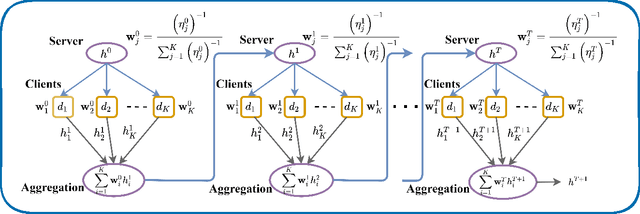
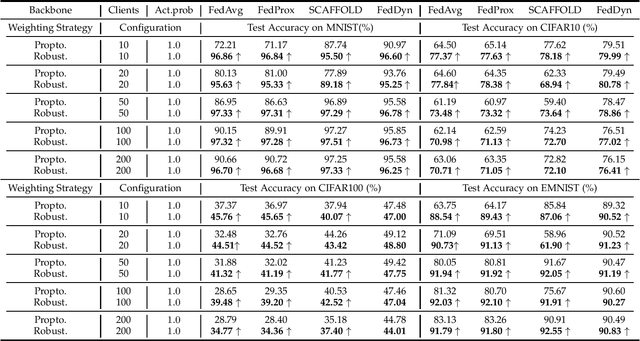
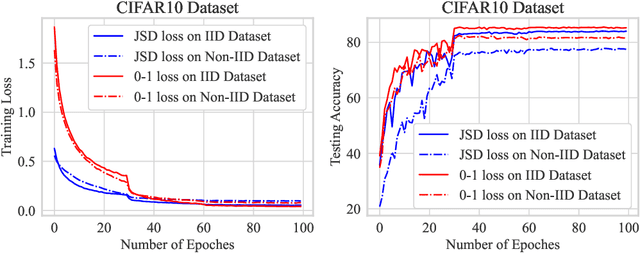
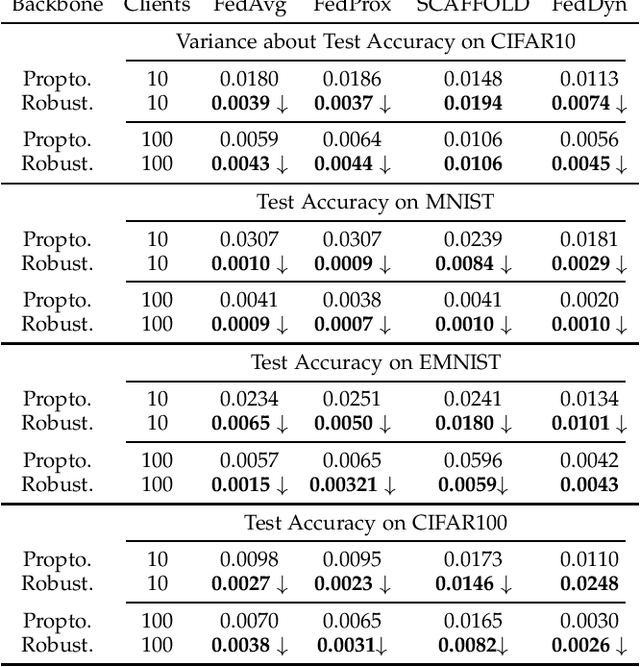
Federated Learning (FL) typically aggregates client model parameters using a weighting approach determined by sample proportions. However, this naive weighting method may lead to unfairness and degradation in model performance due to statistical heterogeneity and the inclusion of noisy data among clients. Theoretically, distributional robustness analysis has shown that the generalization performance of a learning model with respect to any shifted distribution is bounded. This motivates us to reconsider the weighting approach in federated learning. In this paper, we replace the aforementioned weighting method with a new strategy that considers the generalization bounds of each local model. Specifically, we estimate the upper and lower bounds of the second-order origin moment of the shifted distribution for the current local model, and then use these bounds disagreements as the aggregation proportions for weightings in each communication round. Experiments demonstrate that the proposed weighting strategy significantly improves the performance of several representative FL algorithms on benchmark datasets.
Sanitized Clustering against Confounding Bias
Nov 02, 2023
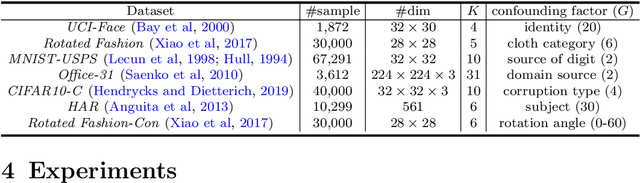
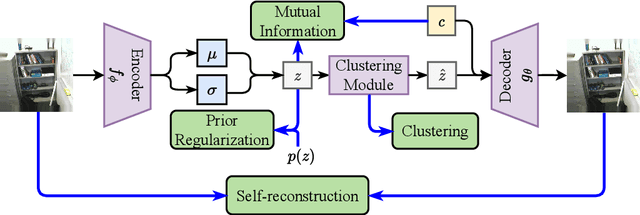
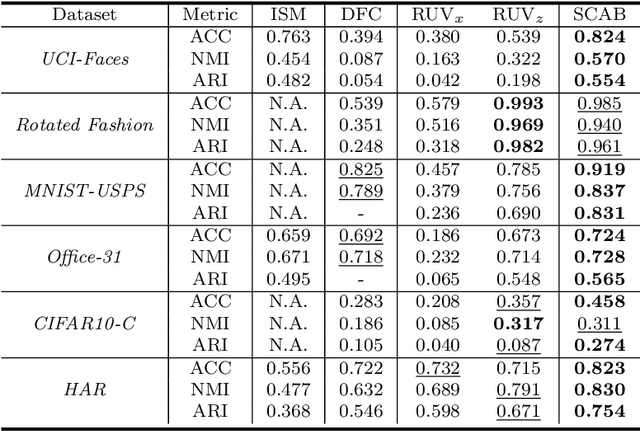
Real-world datasets inevitably contain biases that arise from different sources or conditions during data collection. Consequently, such inconsistency itself acts as a confounding factor that disturbs the cluster analysis. Existing methods eliminate the biases by projecting data onto the orthogonal complement of the subspace expanded by the confounding factor before clustering. Therein, the interested clustering factor and the confounding factor are coarsely considered in the raw feature space, where the correlation between the data and the confounding factor is ideally assumed to be linear for convenient solutions. These approaches are thus limited in scope as the data in real applications is usually complex and non-linearly correlated with the confounding factor. This paper presents a new clustering framework named Sanitized Clustering Against confounding Bias (SCAB), which removes the confounding factor in the semantic latent space of complex data through a non-linear dependence measure. To be specific, we eliminate the bias information in the latent space by minimizing the mutual information between the confounding factor and the latent representation delivered by Variational Auto-Encoder (VAE). Meanwhile, a clustering module is introduced to cluster over the purified latent representations. Extensive experiments on complex datasets demonstrate that our SCAB achieves a significant gain in clustering performance by removing the confounding bias. The code is available at \url{https://github.com/EvaFlower/SCAB}.
Ladder-of-Thought: Using Knowledge as Steps to Elevate Stance Detection
Sep 07, 2023Stance detection aims to identify the attitude expressed in a document towards a given target. Techniques such as Chain-of-Thought (CoT) prompting have advanced this task, enhancing a model's reasoning capabilities through the derivation of intermediate rationales. However, CoT relies primarily on a model's pre-trained internal knowledge during reasoning, thereby neglecting the valuable external information that is previously unknown to the model. This omission, especially within the unsupervised reasoning process, can affect the model's overall performance. Moreover, while CoT enhances Large Language Models (LLMs), smaller LMs, though efficient operationally, face challenges in delivering nuanced reasoning. In response to these identified gaps, we introduce the Ladder-of-Thought (LoT) for the stance detection task. Constructed through a dual-phase Progressive Optimization Framework, LoT directs the small LMs to assimilate high-quality external knowledge, refining the intermediate rationales produced. These bolstered rationales subsequently serve as the foundation for more precise predictions - akin to how a ladder facilitates reaching elevated goals. LoT achieves a balance between efficiency and performance. Our empirical evaluations underscore LoT's efficacy, marking a 16% improvement over GPT-3.5 and a 10% enhancement compared to GPT-3.5 with CoT on stance detection task.
Decentralized Riemannian Conjugate Gradient Method on the Stiefel Manifold
Aug 21, 2023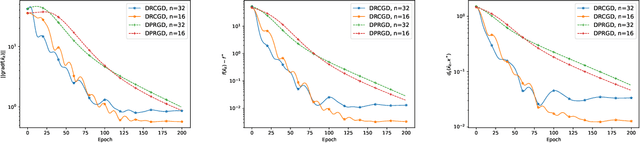
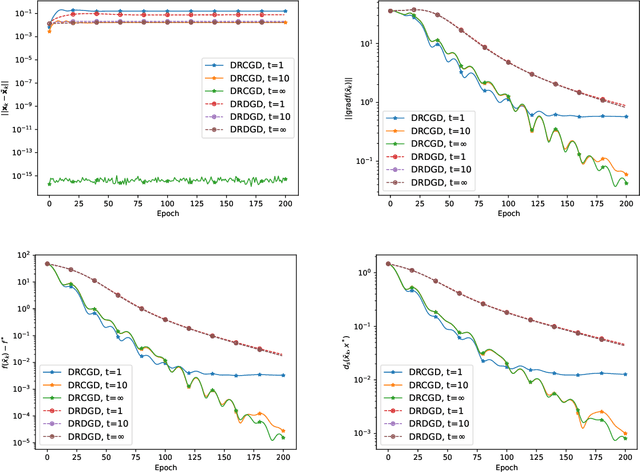
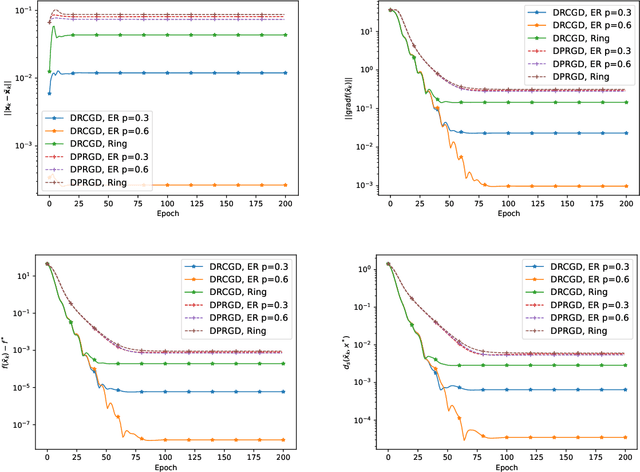
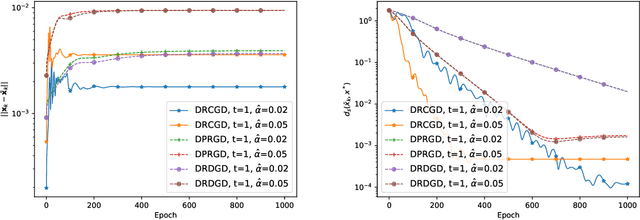
The conjugate gradient method is a crucial first-order optimization method that generally converges faster than the steepest descent method, and its computational cost is much lower than the second-order methods. However, while various types of conjugate gradient methods have been studied in Euclidean spaces and on Riemannian manifolds, there has little study for those in distributed scenarios. This paper proposes a decentralized Riemannian conjugate gradient descent (DRCGD) method that aims at minimizing a global function over the Stiefel manifold. The optimization problem is distributed among a network of agents, where each agent is associated with a local function, and communication between agents occurs over an undirected connected graph. Since the Stiefel manifold is a non-convex set, a global function is represented as a finite sum of possibly non-convex (but smooth) local functions. The proposed method is free from expensive Riemannian geometric operations such as retractions, exponential maps, and vector transports, thereby reducing the computational complexity required by each agent. To the best of our knowledge, DRCGD is the first decentralized Riemannian conjugate gradient algorithm to achieve global convergence over the Stiefel manifold.
Relational Temporal Graph Reasoning for Dual-task Dialogue Language Understanding
Jun 15, 2023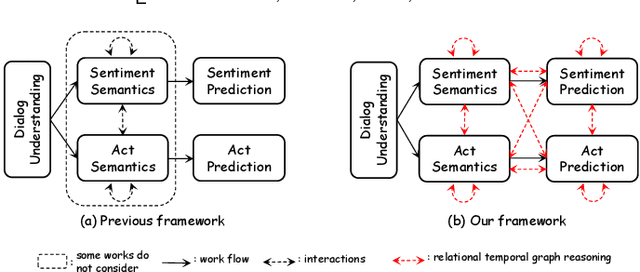
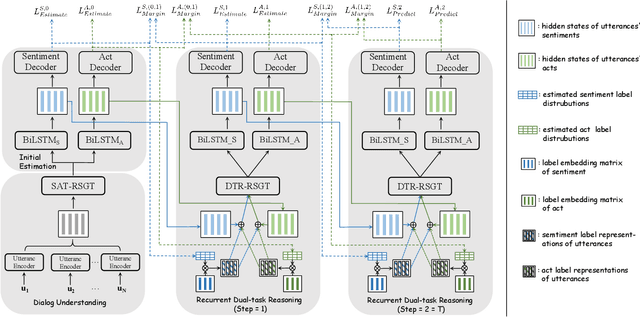
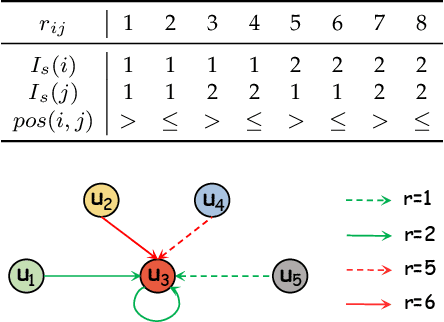
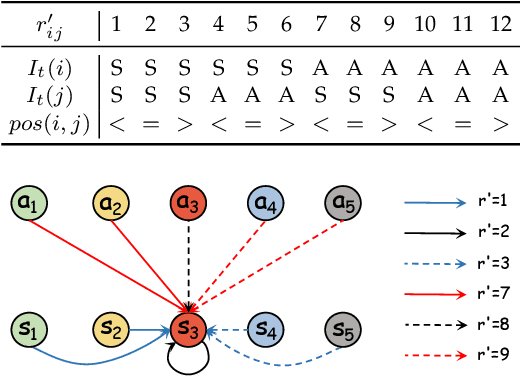
Dual-task dialog language understanding aims to tackle two correlative dialog language understanding tasks simultaneously via leveraging their inherent correlations. In this paper, we put forward a new framework, whose core is relational temporal graph reasoning.We propose a speaker-aware temporal graph (SATG) and a dual-task relational temporal graph (DRTG) to facilitate relational temporal modeling in dialog understanding and dual-task reasoning. Besides, different from previous works that only achieve implicit semantics-level interactions, we propose to model the explicit dependencies via integrating prediction-level interactions. To implement our framework, we first propose a novel model Dual-tAsk temporal Relational rEcurrent Reasoning network (DARER), which first generates the context-, speaker- and temporal-sensitive utterance representations through relational temporal modeling of SATG, then conducts recurrent dual-task relational temporal graph reasoning on DRTG, in which process the estimated label distributions act as key clues in prediction-level interactions. And the relational temporal modeling in DARER is achieved by relational convolutional networks (RGCNs). Then we further propose Relational Temporal Transformer (ReTeFormer), which achieves fine-grained relational temporal modeling via Relation- and Structure-aware Disentangled Multi-head Attention. Accordingly, we propose DARER with ReTeFormer (DARER2), which adopts two variants of ReTeFormer to achieve the relational temporal modeling of SATG and DTRG, respectively. The extensive experiments on different scenarios verify that our models outperform state-of-the-art models by a large margin. Remarkably, on the dialog sentiment classification task in the Mastodon dataset, DARER and DARER2 gain relative improvements of about 28% and 34% over the previous best model in terms of F1.
Co-evolving Graph Reasoning Network for Emotion-Cause Pair Extraction
Jun 07, 2023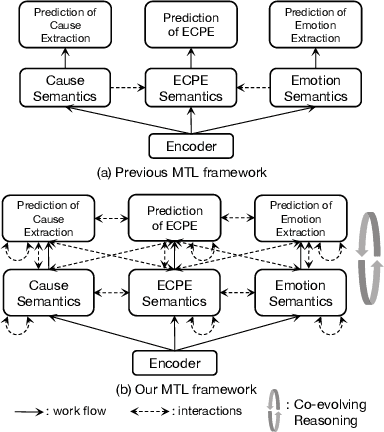
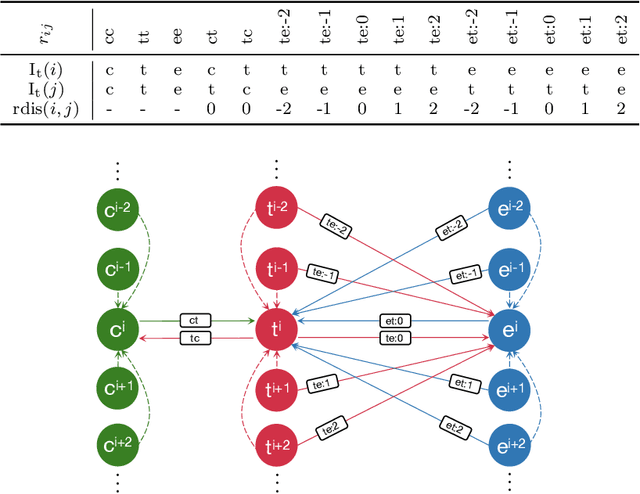
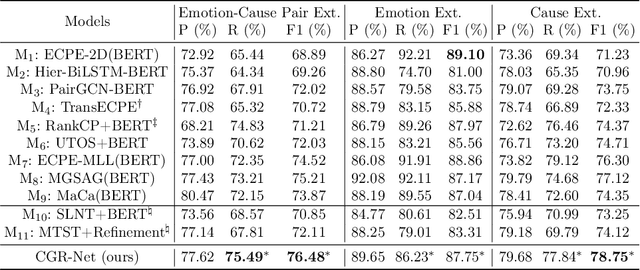
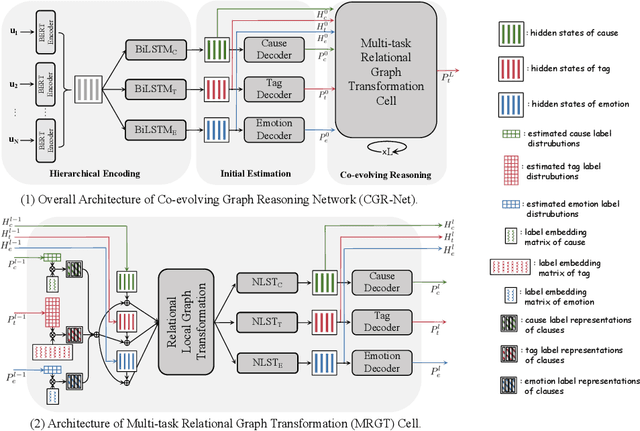
Emotion-Cause Pair Extraction (ECPE) aims to extract all emotion clauses and their corresponding cause clauses from a document. Existing approaches tackle this task through multi-task learning (MTL) framework in which the two subtasks provide indicative clues for ECPE. However, the previous MTL framework considers only one round of multi-task reasoning and ignores the reverse feedbacks from ECPE to the subtasks. Besides, its multi-task reasoning only relies on semantics-level interactions, which cannot capture the explicit dependencies, and both the encoder sharing and multi-task hidden states concatenations can hardly capture the causalities. To solve these issues, we first put forward a new MTL framework based on Co-evolving Reasoning. It (1) models the bidirectional feedbacks between ECPE and its subtasks; (2) allows the three tasks to evolve together and prompt each other recurrently; (3) integrates prediction-level interactions to capture explicit dependencies. Then we propose a novel multi-task relational graph (MRG) to sufficiently exploit the causal relations. Finally, we propose a Co-evolving Graph Reasoning Network (CGR-Net) that implements our MTL framework and conducts Co-evolving Reasoning on MRG. Experimental results show that our model achieves new state-of-the-art performance, and further analysis confirms the advantages of our method.
On the Robustness of Segment Anything
May 25, 2023Segment anything model (SAM) has presented impressive objectness identification capability with the idea of prompt learning and a new collected large-scale dataset. Given a prompt (e.g., points, bounding boxes, or masks) and an input image, SAM is able to generate valid segment masks for all objects indicated by the prompts, presenting high generalization across diverse scenarios and being a general method for zero-shot transfer to downstream vision tasks. Nevertheless, it remains unclear whether SAM may introduce errors in certain threatening scenarios. Clarifying this is of significant importance for applications that require robustness, such as autonomous vehicles. In this paper, we aim to study the testing-time robustness of SAM under adversarial scenarios and common corruptions. To this end, we first build a testing-time robustness evaluation benchmark for SAM by integrating existing public datasets. Second, we extend representative adversarial attacks against SAM and study the influence of different prompts on robustness. Third, we study the robustness of SAM under diverse corruption types by evaluating SAM on corrupted datasets with different prompts. With experiments conducted on SA-1B and KITTI datasets, we find that SAM exhibits remarkable robustness against various corruptions, except for blur-related corruption. Furthermore, SAM remains susceptible to adversarial attacks, particularly when subjected to PGD and BIM attacks. We think such a comprehensive study could highlight the importance of the robustness issues of SAM and trigger a series of new tasks for SAM as well as downstream vision tasks.
Learning Structured Components: Towards Modular and Interpretable Multivariate Time Series Forecasting
May 24, 2023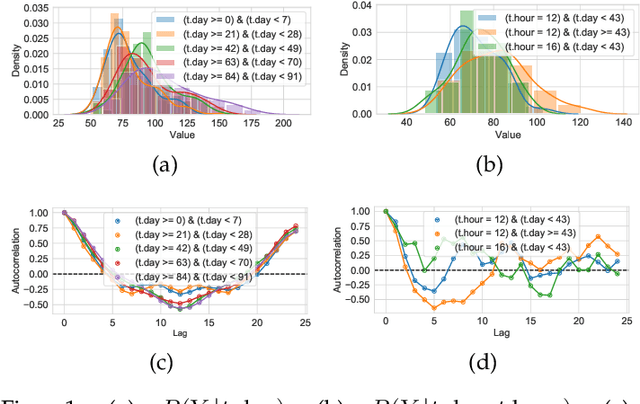



Multivariate time-series (MTS) forecasting is a paramount and fundamental problem in many real-world applications. The core issue in MTS forecasting is how to effectively model complex spatial-temporal patterns. In this paper, we develop a modular and interpretable forecasting framework, which seeks to individually model each component of the spatial-temporal patterns. We name this framework SCNN, short for Structured Component-based Neural Network. SCNN works with a pre-defined generative process of MTS, which arithmetically characterizes the latent structure of the spatial-temporal patterns. In line with its reverse process, SCNN decouples MTS data into structured and heterogeneous components and then respectively extrapolates the evolution of these components, the dynamics of which is more traceable and predictable than the original MTS. Extensive experiments are conducted to demonstrate that SCNN can achieve superior performance over state-of-the-art models on three real-world datasets. Additionally, we examine SCNN with different configurations and perform in-depth analyses of the properties of SCNN.