 Add to Chrome
 Add to Firefox
 Add to Edge
Semantic Forwarding and Codebook-Enhanced Model Division Multiple Access for Satellite-Terrestrial Networks
Mar 03, 2026
Satellite-terrestrial communications are severely constrained by high path loss, limited spectrum resources, and time-varying channel conditions, rendering conventional bit-level transmission schemes inefficient and fragile, particularly in low signal-to-noise ratio (SNR) regimes. Semantic communication has emerged as a promising paradigm to address these challenges by prioritizing task-relevant information over exact bit recovery. In this paper, we propose a semantic forwarding-based semantic communication (SFSC) framework optimized for satellite-terrestrial networks. Specifically, we develop a vector-quantized joint semantic coding and modulation scheme, in which the semantic encoder and semantic codebook are jointly optimized to shape the constellation symbol distribution, improving channel adaptability and semantic compression efficiency. To mitigate noise accumulation and reduce on-board computational burden, we introduce a satellite semantic forwarding mechanism, enabling relay satellites to forward signals directly at the semantic level without full decoding and re-encoding. Furthermore, we design a channel-aware semantic reconstruction scheme based on feature-wise linear modulation (FiLM) to fuse the received SNR with semantic features, enhancing robustness under dynamic channel conditions. To support multi-user access, we further propose a codebook split-enhanced model division multiple access (CS-MDMA) method to improve spectral efficiency. Simulation results show that the proposed SFSC framework achieves a peak signal-to-noise ratio (PSNR) gain of approximately 7.9 dB over existing benchmarks in the low-SNR regime, demonstrating its effectiveness for robust and spectrum-efficient semantic transmission in satellite-terrestrial networks.

Generative Reasoning Re-ranker
Feb 08, 2026Recent studies increasingly explore Large Language Models (LLMs) as a new paradigm for recommendation systems due to their scalability and world knowledge. However, existing work has three key limitations: (1) most efforts focus on retrieval and ranking, while the reranking phase, critical for refining final recommendations, is largely overlooked; (2) LLMs are typically used in zero-shot or supervised fine-tuning settings, leaving their reasoning abilities, especially those enhanced through reinforcement learning (RL) and high-quality reasoning data, underexploited; (3) items are commonly represented by non-semantic IDs, creating major scalability challenges in industrial systems with billions of identifiers. To address these gaps, we propose the Generative Reasoning Reranker (GR2), an end-to-end framework with a three-stage training pipeline tailored for reranking. First, a pretrained LLM is mid-trained on semantic IDs encoded from non-semantic IDs via a tokenizer achieving $\ge$99% uniqueness. Next, a stronger larger-scale LLM generates high-quality reasoning traces through carefully designed prompting and rejection sampling, which are used for supervised fine-tuning to impart foundational reasoning skills. Finally, we apply Decoupled Clip and Dynamic sAmpling Policy Optimization (DAPO), enabling scalable RL supervision with verifiable rewards designed specifically for reranking. Experiments on two real-world datasets demonstrate GR2's effectiveness: it surpasses the state-of-the-art OneRec-Think by 2.4% in Recall@5 and 1.3% in NDCG@5. Ablations confirm that advanced reasoning traces yield substantial gains across metrics. We further find that RL reward design is crucial in reranking: LLMs tend to exploit reward hacking by preserving item order, motivating conditional verifiable rewards to mitigate this behavior and optimize reranking performance.
Semantic Radio Access Networks: Architecture, State-of-the-Art, and Future Directions
Dec 24, 2025Radio Access Network (RAN) is a bridge between user devices and the core network in mobile communication systems, responsible for the transmission and reception of wireless signals and air interface management. In recent years, Semantic Communication (SemCom) has represented a transformative communication paradigm that prioritizes meaning-level transmission over conventional bit-level delivery, thus providing improved spectrum efficiency, anti-interference ability in complex environments, flexible resource allocation, and enhanced user experience for RAN. However, there is still a lack of comprehensive reviews on the integration of SemCom into RAN. Motivated by this, we systematically explore recent advancements in Semantic RAN (SemRAN). We begin by introducing the fundamentals of RAN and SemCom, identifying the limitations of conventional RAN, and outlining the overall architecture of SemRAN. Subsequently, we review representative techniques of SemRAN across physical layer, data link layer, network layer, and security plane. Furthermore, we envision future services and applications enabled by SemRAN, alongside its current standardization progress. Finally, we conclude by identifying critical research challenges and outlining forward-looking directions to guide subsequent investigations in this burgeoning field.
Image Steganography For Securing Intellicise Wireless Networks: "Invisible Encryption" Against Eavesdroppers
May 07, 2025As one of the most promising technologies for intellicise (intelligent and consice) wireless networks, Semantic Communication (SemCom) significantly improves communication efficiency by extracting, transmitting, and recovering semantic information, while reducing transmission delay. However, an integration of communication and artificial intelligence (AI) also exposes SemCom to security and privacy threats posed by intelligent eavesdroppers. To address this challenge, image steganography in SemCom embeds secret semantic features within cover semantic features, allowing intelligent eavesdroppers to decode only the cover image. This technique offers a form of "invisible encryption" for SemCom. Motivated by these advancements, this paper conducts a comprehensive exploration of integrating image steganography into SemCom. Firstly, we review existing encryption techniques in SemCom and assess the potential of image steganography in enhancing its security. Secondly, we delve into various image steganographic paradigms designed to secure SemCom, encompassing three categories of joint source-channel coding (JSCC) models tailored for image steganography SemCom, along with multiple training strategies. Thirdly, we present a case study to illustrate the effectiveness of coverless steganography SemCom. Finally, we propose future research directions for image steganography SemCom.
Secure Semantic Communication With Homomorphic Encryption
Jan 17, 2025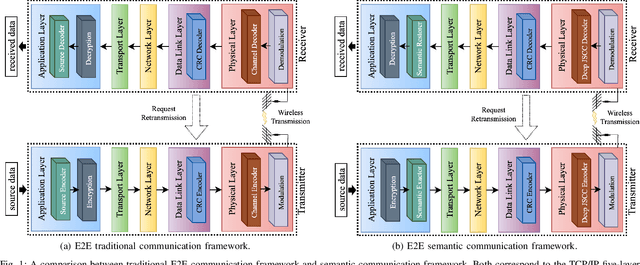
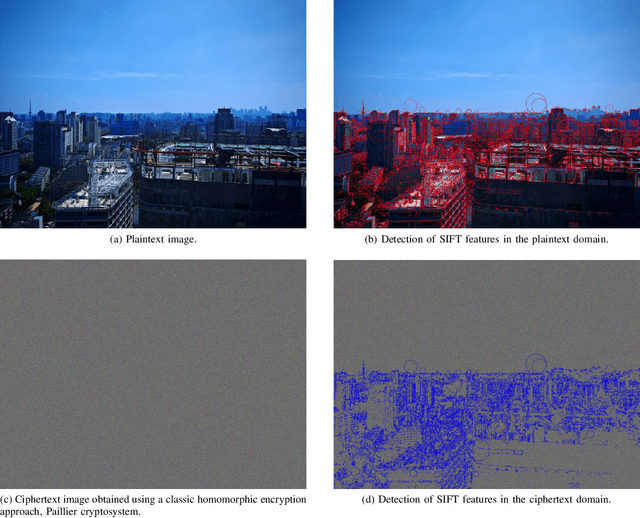

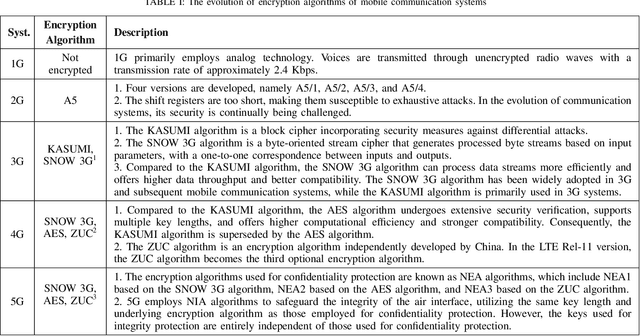
In recent years, Semantic Communication (SemCom), which aims to achieve efficient and reliable transmission of meaning between agents, has garnered significant attention from both academia and industry. To ensure the security of communication systems, encryption techniques are employed to safeguard confidentiality and integrity. However, traditional cryptography-based encryption algorithms encounter obstacles when applied to SemCom. Motivated by this, this paper explores the feasibility of applying homomorphic encryption to SemCom. Initially, we review the encryption algorithms utilized in mobile communication systems and analyze the challenges associated with their application to SemCom. Subsequently, we employ scale-invariant feature transform to demonstrate that semantic features can be preserved in homomorphic encrypted ciphertext. Based on this finding, we propose a task-oriented SemCom scheme secured through homomorphic encryption. We design the privacy preserved deep joint source-channel coding (JSCC) encoder and decoder, and the frequency of key updates can be adjusted according to service requirements without compromising transmission performance. Simulation results validate that, when compared to plaintext images, the proposed scheme can achieve almost the same classification accuracy performance when dealing with homomorphic ciphertext images. Furthermore, we provide potential future research directions for homomorphic encrypted SemCom.
A Survey of Secure Semantic Communications
Jan 01, 2025


Semantic communication (SemCom) is regarded as a promising and revolutionary technology in 6G, aiming to transcend the constraints of ``Shannon's trap" by filtering out redundant information and extracting the core of effective data. Compared to traditional communication paradigms, SemCom offers several notable advantages, such as reducing the burden on data transmission, enhancing network management efficiency, and optimizing resource allocation. Numerous researchers have extensively explored SemCom from various perspectives, including network architecture, theoretical analysis, potential technologies, and future applications. However, as SemCom continues to evolve, a multitude of security and privacy concerns have arisen, posing threats to the confidentiality, integrity, and availability of SemCom systems. This paper presents a comprehensive survey of the technologies that can be utilized to secure SemCom. Firstly, we elaborate on the entire life cycle of SemCom, which includes the model training, model transfer, and semantic information transmission phases. Then, we identify the security and privacy issues that emerge during these three stages. Furthermore, we summarize the techniques available to mitigate these security and privacy threats, including data cleaning, robust learning, defensive strategies against backdoor attacks, adversarial training, differential privacy, cryptography, blockchain technology, model compression, and physical-layer security. Lastly, this paper outlines future research directions to guide researchers in related fields.
Cross-Layer Encrypted Semantic Communication Framework for Panoramic Video Transmission
Nov 19, 2024In this paper, we propose a cross-layer encrypted semantic communication (CLESC) framework for panoramic video transmission, incorporating feature extraction, encoding, encryption, cyclic redundancy check (CRC), and retransmission processes to achieve compatibility between semantic communication and traditional communication systems. Additionally, we propose an adaptive cross-layer transmission mechanism that dynamically adjusts CRC, channel coding, and retransmission schemes based on the importance of semantic information. This ensures that important information is prioritized under poor transmission conditions. To verify the aforementioned framework, we also design an end-to-end adaptive panoramic video semantic transmission (APVST) network that leverages a deep joint source-channel coding (Deep JSCC) structure and attention mechanism, integrated with a latitude adaptive module that facilitates adaptive semantic feature extraction and variable-length encoding of panoramic videos. The proposed CLESC is also applicable to the transmission of other modal data. Simulation results demonstrate that the proposed CLESC effectively achieves compatibility and adaptation between semantic communication and traditional communication systems, improving both transmission efficiency and channel adaptability. Compared to traditional cross-layer transmission schemes, the CLESC framework can reduce bandwidth consumption by 85% while showing significant advantages under low signal-to-noise ratio (SNR) conditions.
Semantic Communication-Enabled Wireless Adaptive Panoramic Video Transmission
Feb 26, 2024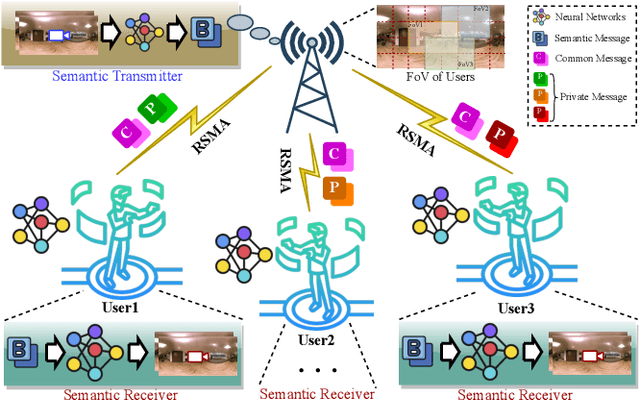

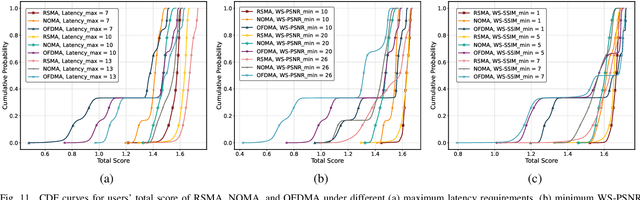
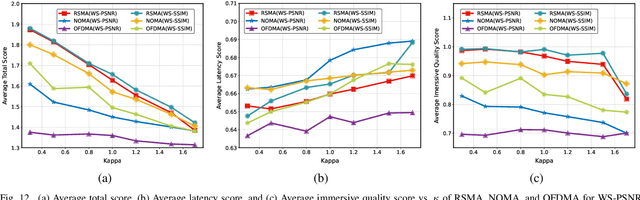
In this paper, we propose an adaptive panoramic video semantic transmission (APVST) network built on the deep joint source-channel coding (Deep JSCC) structure for the efficient end-to-end transmission of panoramic videos. The proposed APVST network can adaptively extract semantic features of panoramic frames and achieve semantic feature encoding. To achieve high spectral efficiency and save bandwidth, we propose a transmission rate control mechanism for the APVST via the entropy model and the latitude adaptive model. Besides, we take weighted-to-spherically-uniform peak signal-to-noise ratio (WS-PSNR) and weighted-to-spherically-uniform structural similarity (WS-SSIM) as distortion evaluation metrics, and propose the weight attention module to fuse the weights with the semantic features to achieve better quality of immersive experiences. Finally, we evaluate our proposed scheme on a panoramic video dataset containing 208 panoramic videos. The simulation results show that the APVST can save up to 20% and 50% on channel bandwidth cost compared with other semantic communication-based and traditional video transmission schemes.
AutoML for Large Capacity Modeling of Meta's Ranking Systems
Nov 16, 2023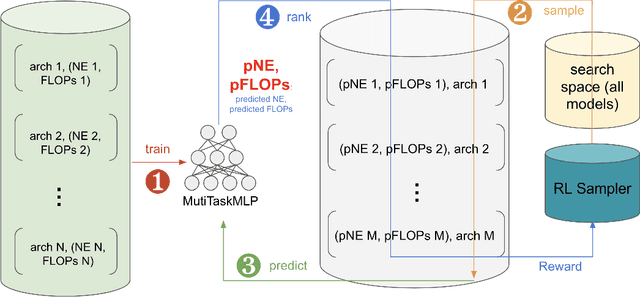

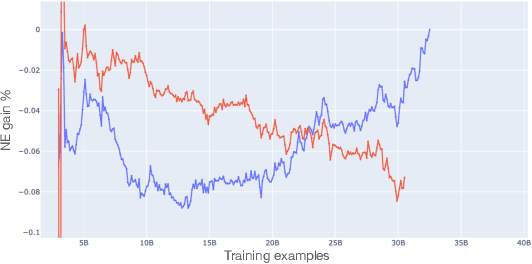

Web-scale ranking systems at Meta serving billions of users is complex. Improving ranking models is essential but engineering heavy. Automated Machine Learning (AutoML) can release engineers from labor intensive work of tuning ranking models; however, it is unknown if AutoML is efficient enough to meet tight production timeline in real-world and, at the same time, bring additional improvements to the strong baselines. Moreover, to achieve higher ranking performance, there is an ever-increasing demand to scale up ranking models to even larger capacity, which imposes more challenges on the efficiency. The large scale of models and tight production schedule requires AutoML to outperform human baselines by only using a small number of model evaluation trials (around 100). We presents a sampling-based AutoML method, focusing on neural architecture search and hyperparameter optimization, addressing these challenges in Meta-scale production when building large capacity models. Our approach efficiently handles large-scale data demands. It leverages a lightweight predictor-based searcher and reinforcement learning to explore vast search spaces, significantly reducing the number of model evaluations. Through experiments in large capacity modeling for CTR and CVR applications, we show that our method achieves outstanding Return on Investment (ROI) versus human tuned baselines, with up to 0.09% Normalized Entropy (NE) loss reduction or $25\%$ Query per Second (QPS) increase by only sampling one hundred models on average from a curated search space. The proposed AutoML method has already made real-world impact where a discovered Instagram CTR model with up to -0.36% NE gain (over existing production baseline) was selected for large-scale online A/B test and show statistically significant gain. These production results proved AutoML efficacy and accelerated its adoption in ranking systems at Meta.
Rankitect: Ranking Architecture Search Battling World-class Engineers at Meta Scale
Nov 14, 2023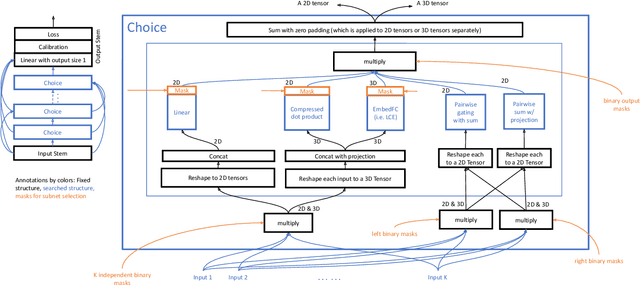

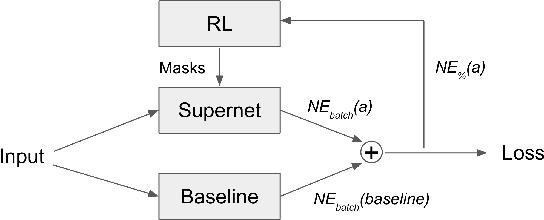
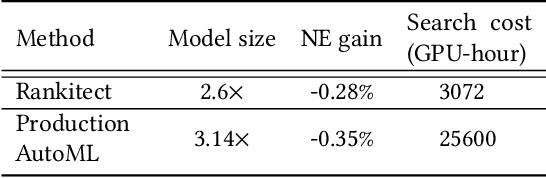
Neural Architecture Search (NAS) has demonstrated its efficacy in computer vision and potential for ranking systems. However, prior work focused on academic problems, which are evaluated at small scale under well-controlled fixed baselines. In industry system, such as ranking system in Meta, it is unclear whether NAS algorithms from the literature can outperform production baselines because of: (1) scale - Meta ranking systems serve billions of users, (2) strong baselines - the baselines are production models optimized by hundreds to thousands of world-class engineers for years since the rise of deep learning, (3) dynamic baselines - engineers may have established new and stronger baselines during NAS search, and (4) efficiency - the search pipeline must yield results quickly in alignment with the productionization life cycle. In this paper, we present Rankitect, a NAS software framework for ranking systems at Meta. Rankitect seeks to build brand new architectures by composing low level building blocks from scratch. Rankitect implements and improves state-of-the-art (SOTA) NAS methods for comprehensive and fair comparison under the same search space, including sampling-based NAS, one-shot NAS, and Differentiable NAS (DNAS). We evaluate Rankitect by comparing to multiple production ranking models at Meta. We find that Rankitect can discover new models from scratch achieving competitive tradeoff between Normalized Entropy loss and FLOPs. When utilizing search space designed by engineers, Rankitect can generate better models than engineers, achieving positive offline evaluation and online A/B test at Meta scale.