 Add to Chrome
 Add to Firefox
 Add to Edge
REFACT: Adaptive Fact Restatement for Compact and Faithful Chain-of-Thought Reasoning
Jul 23, 2026
Large language models increasingly rely on long-form reasoning for complex tasks, yet their reasoning traces may drift away from the supplied context when evidence is sparse, noisy, or in conflict with parametric knowledge. Existing grounding methods either attach citations after generation or encourage evidence retrieval inside the trace, but they often do not ensure that cited content is sufficient for the local inference and final answer. We propose REFACT, an adaptive fact-restatement citation framework that trains models to decide when a reasoning step needs contextual grounding and at what granularity source facts should be restated. This design avoids both unsupported inference and indiscriminate fact copying by turning citations into answer-supporting intermediate states. REFACT is optimized with a two-stage SFT-to-RL pipeline in which a citation-utility reward encourages cited facts to be well-formed, source-traceable, and answer-sufficient. Experiments on LongBench, LV-Eval, and ConFiQA show that REFACT improves long-context QA and counterfactual faithfulness while substantially reducing token consumption. Further analysis shows that REFACT preserves more answer-bearing evidence with fewer restated facts, yielding reasoning traces that are denser rather than longer. All code and data are available at https://github.com/NEUIR/REFACT.

ReCUT: Balancing Reasoning Length and Accuracy in LLMs via Stepwise Trails and Preference Optimization
Jun 12, 2025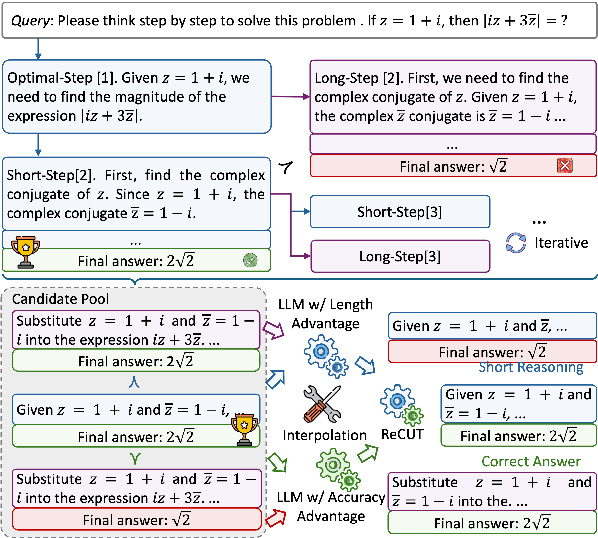
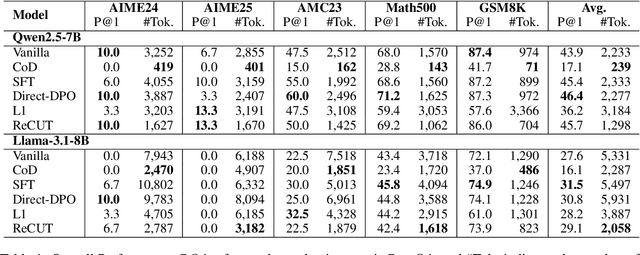
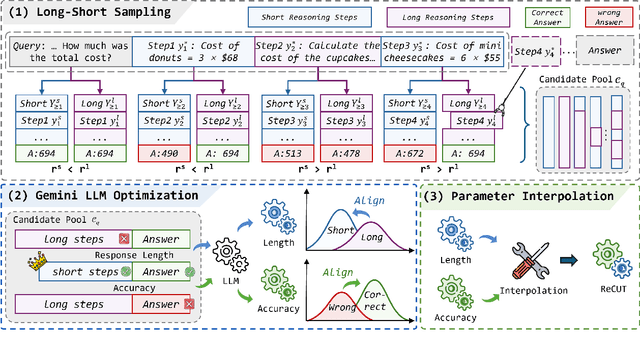
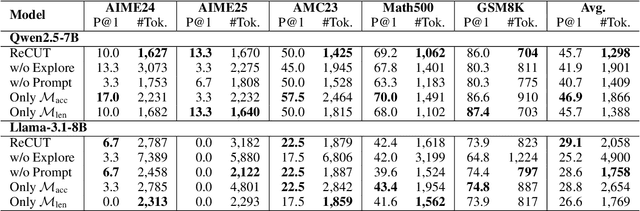
Recent advances in Chain-of-Thought (CoT) prompting have substantially improved the reasoning capabilities of Large Language Models (LLMs). However, these methods often suffer from overthinking, leading to unnecessarily lengthy or redundant reasoning traces. Existing approaches attempt to mitigate this issue through curating multiple reasoning chains for training LLMs, but their effectiveness is often constrained by the quality of the generated data and prone to overfitting. To address the challenge, we propose Reasoning Compression ThroUgh Stepwise Trials (ReCUT), a novel method aimed at balancing the accuracy and length of reasoning trajectory. Specifically, ReCUT employs a stepwise exploration mechanism and a long-short switched sampling strategy, enabling LLMs to incrementally generate diverse reasoning paths. These paths are evaluated and used to construct preference pairs to train two specialized models (Gemini LLMs)-one optimized for reasoning accuracy, the other for shorter reasoning. A final integrated model is obtained by interpolating the parameters of these two models. Experimental results across multiple math reasoning datasets and backbone models demonstrate that ReCUT significantly reduces reasoning lengths by approximately 30-50%, while maintaining or improving reasoning accuracy compared to various baselines. All codes and data will be released via https://github.com/NEUIR/ReCUT.