 Add to Chrome
 Add to Firefox
 Add to Edge
SO-Mamba: State-Ownership Mamba for Unrolled MRI Reconstruction
May 21, 2026
Accelerated MRI reconstruction requires recovering missing details while preserving anatomically coherent structures across large spatial regions. State-space models such as Mamba provide efficient long-range modeling, making them attractive learned regularizers for unrolled reconstruction. However, in a data-consistency-coupled unrolled solver, different stages operate on different reconstruction iterates, where the resident carrier should preserve coherent reconstruction content across stages while stage-dependent non-resident evidence is tied to the current update. Treating these roles uniformly can place persistent resident-carrier evidence and update-dependent non-resident evidence into the same recurrent content route. We therefore propose SO-Mamba, a state-ownership Mamba regularizer that assigns reconstruction evidence within each Mamba stage to recurrent residency, state-interface access, and non-state output correction. SO-Mamba implements this ownership rule with a State-Ownership Router (SOR), which constructs a resident carrier for recurrent content and routes non-resident evidence to affine modulation of the B/C state interfaces and an output correction outlet. The resident carrier supplies the Mamba content route, while the non-resident evidence stream adapts the state interfaces and contributes through the output outlet without entering the recurrent content route. We further introduce a two-level outer-band leakage diagnostic that separates hidden-state storage from readout expression by measuring outer-band energy in the selective-scan state trajectory and the post-scan Mamba readout. Experiments on five public MRI reconstruction benchmarks spanning diverse anatomies, sampling patterns, and coil configurations show that SO-Mamba consistently improves over CNN-, Transformer-, and Mamba-based baselines with competitive computational efficiency.

CHASM: Cross-frequency Harmonized Axis-Separable Mixing for Spectral Token Operators
May 14, 2026Spectral token mixers based on Fourier transforms provide an efficient way to model global interactions in visual feature maps. Existing designs often either apply filter-wise spectral responses along fixed channel axes, or learn adaptive frequency-indexed channel mixing without explicitly aligning the channel directions used across frequencies. We propose CHASM, a Cross-frequency Harmonized Axis-Separable Mixer, as a structured middle ground. CHASM separates what should be shared from what should remain frequency-specific: all frequencies share a learned channel eigenbasis, while each frequency retains its own positive spectral gains. The shared basis makes channel directions comparable across the spectrum, whereas the positive gains preserve local spectral adaptivity. CHASM applies this structured operator separably along the height and width axes and is used as a drop-in replacement mixer inside existing backbones. We provide a structural characterization of the shared-basis operator family and evaluate CHASM through controlled same-backbone comparisons. Across accelerated MRI reconstruction, undersampled MRI segmentation, and natural-image reconstruction, CHASM consistently improves over same-backbone spectral-mixer baselines. Ablations show that removing the shared-basis constraint weakens performance, and randomizing coherent sampling geometry substantially reduces the gain, supporting cross-frequency harmonization as a useful inductive bias for spectral token operators.
Privileged Foresight Distillation: Zero-Cost Future Correction for World Action Models
Apr 28, 2026World action models jointly predict future video and action during training, raising an open question about what role the future-prediction branch actually plays. A recent finding shows that this branch can be removed at inference with little to no loss on common manipulation benchmarks, suggesting that future information may act merely as a regularizer on the shared visual backbone. We propose instead that joint training induces an action-conditioned correction that privileged future observations impose on action denoising, and that current-only policies capture this correction only partially. Making the account precise, we formulate privileged foresight as a residual in the action-denoising direction -- the difference between what a model predicts given the true future and what it predicts given only the current frame -- and introduce \emph{Privileged Foresight Distillation (PFD)}, which transfers this residual from a training-time teacher into a small adapter on a current-only student. The teacher and student share the same backbone and differ only in the attention mask over video tokens; future video is never generated at inference. Controlled experiments verify that this gain reflects a genuine future-conditioned correction rather than a side effect of capacity or regularization. Empirically, PFD achieves consistent improvements on LIBERO and RoboTwin manipulation benchmarks while preserving the current-only inference interface at negligible added latency. This view reframes the role of future information in world action models: not as a target to predict, nor as a regularizer to absorb, but as a compressible correction to be distilled.
Image Reconstruction with B0 Inhomogeneity using an Interpretable Deep Unrolled Network on an Open-bore MRI-Linac
Apr 15, 2024


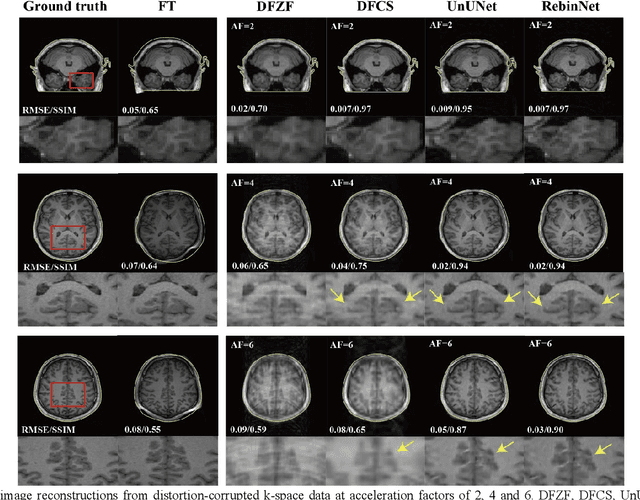
MRI-Linac systems require fast image reconstruction with high geometric fidelity to localize and track tumours for radiotherapy treatments. However, B0 field inhomogeneity distortions and slow MR acquisition potentially limit the quality of the image guidance and tumour treatments. In this study, we develop an interpretable unrolled network, referred to as RebinNet, to reconstruct distortion-free images from B0 inhomogeneity-corrupted k-space for fast MRI-guided radiotherapy applications. RebinNet includes convolutional neural network (CNN) blocks to perform image regularizations and nonuniform fast Fourier Transform (NUFFT) modules to incorporate B0 inhomogeneity information. The RebinNet was trained on a publicly available MR dataset from eleven healthy volunteers for both fully sampled and subsampled acquisitions. Grid phantom and human brain images acquired from an open-bore 1T MRI-Linac scanner were used to evaluate the performance of the proposed network. The RebinNet was compared with the conventional regularization algorithm and our recently developed UnUNet method in terms of root mean squared error (RMSE), structural similarity (SSIM), residual distortions, and computation time. Imaging results demonstrated that the RebinNet reconstructed images with lowest RMSE (<0.05) and highest SSIM (>0.92) at four-time acceleration for simulated brain images. The RebinNet could better preserve structural details and substantially improve the computational efficiency (ten-fold faster) compared to the conventional regularization methods, and had better generalization ability than the UnUNet method. The proposed RebinNet can achieve rapid image reconstruction and overcome the B0 inhomogeneity distortions simultaneously, which would facilitate accurate and fast image guidance in radiotherapy treatments.