 Add to Chrome
 Add to Firefox
 Add to Edge
ChainVLA: Chaining Vision-Language-Action Queries through a Unified Execution State for Long-Horizon Manipulation
Aug 03, 2026
Humans perform long-horizon manipulation by retaining knowledge of what earlier actions have established while continuously adapting the motion underway. By contrast, action-chunked vision-language-action (VLA) policies repeatedly replan from the current input at each query. Existing methods preserve either long-term task evidence through memory or short-term motion through action reuse and ensembling, leaving the cross-query handoff incomplete. We introduce ChainVLA, a 1.2B-parameter VLA policy that chains successive queries through a joint and revisable execution state. Progress Context combines a recurrent Working State with sparse event memory to carry observation-derived task progress, while Motion Tail feeds the preceding prediction's unexecuted continuation into state construction and action generation. Together, the two components condition a decoder that regenerates each action horizon under the latest observation, allowing the carried state to guide the next prediction without fixing it. ChainVLA reaches 62.8% average success on RMBench and 98.8% across four LIBERO suites, while removing Motion Tail or Progress Context reduces RMBench success to 11.2% and 3.0%, respectively. These asymmetric ablations are consistent with motion continuity helping preserve the observation stream from which task progress is inferred.

Exposure Bias Can Alleviate Itself via Directional and Frequency Rectification in Flow Matching
Jun 26, 2026Flow Matching (FM) has achieved remarkable generative performance, yet it suffers from exposure bias due to discrepancies between training and inference. Existing mitigation strategies typically rely on static constraints or external heuristics. In this work, we propose that exposure bias itself inherently contains dynamic signals that can guide its own rectification. To leverage this, we introduce DEFAR (DirEctional-Frequency Adaptive Rectification). This framework simulates the single-step inference process during training to identify exposure bias. It utilizes directional and frequency-adaptive feedback signals from the bias itself to enhance the model's bias tolerance. It consists of two key components: (1) Anti-Drift Rectification (ADR). ADR treats inference-time drift as a signal to learn the direction to steer deviated states back toward the target. ADR endows the model with intrinsic active self-rectification capabilities; (2) Frequency Compensation (FC). Empirically, we observe that accumulated bias often stems from a lack of low-frequency components in high-noise stages, and exposure bias carries the missing frequency. FC leverages the bias itself as a self-feedback weighting factor to reinforce the missing frequency components. Experiments on CIFAR-10, CelebA-64, and ImageNet-256/512 show that DEFAR outperforms prior baselines and further demonstrates favorable scalability, compatibility, and inference robustness.
PRM-as-a-Judge: A Dense Evaluation Paradigm for Fine-Grained Robotic Auditing
Mar 23, 2026Current robotic evaluation is still largely dominated by binary success rates, which collapse rich execution processes into a single outcome and obscure critical qualities such as progress, efficiency, and stability. To address this limitation, we propose PRM-as-a-Judge, a dense evaluation paradigm that leverages Process Reward Models (PRMs) to audit policy execution directly from trajectory videos by estimating task progress from observation sequences. Central to this paradigm is the OPD (Outcome-Process-Diagnosis) metric system, which explicitly formalizes execution quality via a task-aligned progress potential. We characterize dense robotic evaluation through two axiomatic properties: macro-consistency, which requires additive and path-consistent aggregation, and micro-resolution, which requires sensitivity to fine-grained physical evolution. Under this formulation, potential-based PRM judges provide a natural instantiation of dense evaluation, with macro-consistency following directly from the induced scalar potential. We empirically validate the micro-resolution property using RoboPulse, a diagnostic benchmark specifically designed for probing micro-scale progress discrimination, where several trajectory-trained PRM judges outperform discriminative similarity-based methods and general-purpose foundation-model judges. Finally, leveraging PRM-as-a-Judge and the OPD metric system, we conduct a structured audit of mainstream policy paradigms across long-horizon tasks, revealing behavioral signatures and failure modes that are invisible to outcome-only metrics.
MoETTA: Test-Time Adaptation Under Mixed Distribution Shifts with MoE-LayerNorm
Nov 14, 2025Test-Time adaptation (TTA) has proven effective in mitigating performance drops under single-domain distribution shifts by updating model parameters during inference. However, real-world deployments often involve mixed distribution shifts, where test samples are affected by diverse and potentially conflicting domain factors, posing significant challenges even for SOTA TTA methods. A key limitation in existing approaches is their reliance on a unified adaptation path, which fails to account for the fact that optimal gradient directions can vary significantly across different domains. Moreover, current benchmarks focus only on synthetic or homogeneous shifts, failing to capture the complexity of real-world heterogeneous mixed distribution shifts. To address this, we propose MoETTA, a novel entropy-based TTA framework that integrates the Mixture-of-Experts (MoE) architecture. Rather than enforcing a single parameter update rule for all test samples, MoETTA introduces a set of structurally decoupled experts, enabling adaptation along diverse gradient directions. This design allows the model to better accommodate heterogeneous shifts through flexible and disentangled parameter updates. To simulate realistic deployment conditions, we introduce two new benchmarks: potpourri and potpourri+. While classical settings focus solely on synthetic corruptions, potpourri encompasses a broader range of domain shifts--including natural, artistic, and adversarial distortions--capturing more realistic deployment challenges. Additionally, potpourri+ further includes source-domain samples to evaluate robustness against catastrophic forgetting. Extensive experiments across three mixed distribution shifts settings show that MoETTA consistently outperforms strong baselines, establishing SOTA performance and highlighting the benefit of modeling multiple adaptation directions via expert-level diversity.
COSMIC: Clique-Oriented Semantic Multi-space Integration for Robust CLIP Test-Time Adaptation
Mar 30, 2025Recent vision-language models (VLMs) face significant challenges in test-time adaptation to novel domains. While cache-based methods show promise by leveraging historical information, they struggle with both caching unreliable feature-label pairs and indiscriminately using single-class information during querying, significantly compromising adaptation accuracy. To address these limitations, we propose COSMIC (Clique-Oriented Semantic Multi-space Integration for CLIP), a robust test-time adaptation framework that enhances adaptability through multi-granular, cross-modal semantic caching and graph-based querying mechanisms. Our framework introduces two key innovations: Dual Semantics Graph (DSG) and Clique Guided Hyper-class (CGH). The Dual Semantics Graph constructs complementary semantic spaces by incorporating textual features, coarse-grained CLIP features, and fine-grained DINOv2 features to capture rich semantic relationships. Building upon these dual graphs, the Clique Guided Hyper-class component leverages structured class relationships to enhance prediction robustness through correlated class selection. Extensive experiments demonstrate COSMIC's superior performance across multiple benchmarks, achieving significant improvements over state-of-the-art methods: 15.81% gain on out-of-distribution tasks and 5.33% on cross-domain generation with CLIP RN-50. Code is available at github.com/hf618/COSMIC.
DTBS: Dual-Teacher Bi-directional Self-training for Domain Adaptation in Nighttime Semantic Segmentation
Jan 02, 2024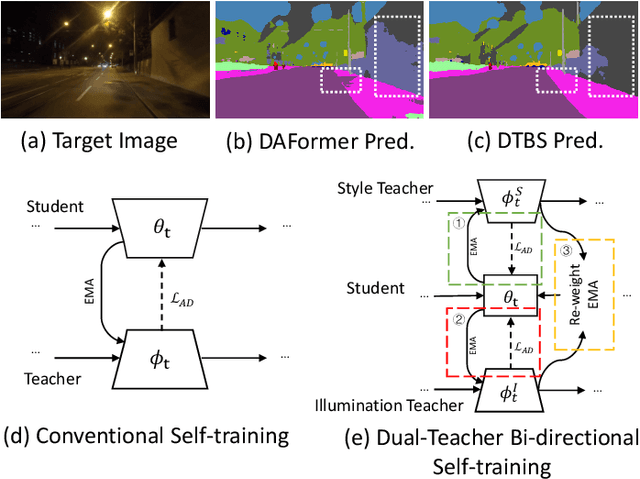
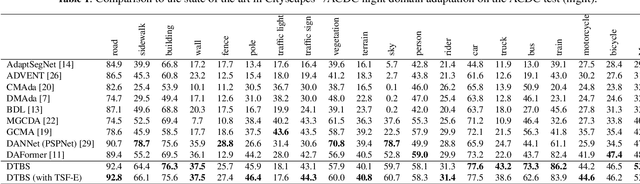
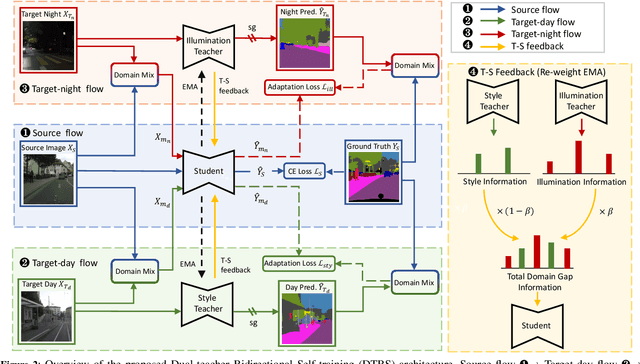
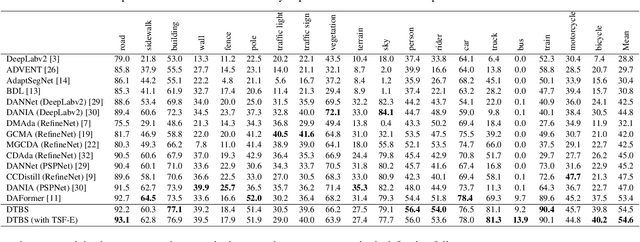
Due to the poor illumination and the difficulty in annotating, nighttime conditions pose a significant challenge for autonomous vehicle perception systems. Unsupervised domain adaptation (UDA) has been widely applied to semantic segmentation on such images to adapt models from normal conditions to target nighttime-condition domains. Self-training (ST) is a paradigm in UDA, where a momentum teacher is utilized for pseudo-label prediction, but a confirmation bias issue exists. Because the one-directional knowledge transfer from a single teacher is insufficient to adapt to a large domain shift. To mitigate this issue, we propose to alleviate domain gap by incrementally considering style influence and illumination change. Therefore, we introduce a one-stage Dual-Teacher Bi-directional Self-training (DTBS) framework for smooth knowledge transfer and feedback. Based on two teacher models, we present a novel pipeline to respectively decouple style and illumination shift. In addition, we propose a new Re-weight exponential moving average (EMA) to merge the knowledge of style and illumination factors, and provide feedback to the student model. In this way, our method can be embedded in other UDA methods to enhance their performance. For example, the Cityscapes to ACDC night task yielded 53.8 mIoU (\%), which corresponds to an improvement of +5\% over the previous state-of-the-art. The code is available at \url{https://github.com/hf618/DTBS}.