 Add to Chrome
 Add to Firefox
 Add to Edge
AndroidDaily: A Verifiable Benchmark for Mobile GUI Agents on Real-World Closed-Source Applications
May 26, 2026
The rapid development of GUI foundation models and mobile GUI agents has spurred numerous evaluation benchmarks, yet most rely on simulated environments or open-source applications, leaving real-world closed-source applications largely unevaluated. The core difficulty is that closed-source applications do not expose internal states, making traditional automatic verification inapplicable. To bridge this gap, we introduce AndroidDaily, a large-scale benchmark comprising 350 realistic daily-use tasks across 94 high-frequency Android applications spanning transportation, shopping, local services, entertainment, content creation, social media, and everyday utilities. To enable automatic and verifiable assessment in these opaque environments, we propose Guideline-grounded Reviewer for Automatic Diagnostic Evaluation (GRADE), a process-aware evaluator built on a three-tiered system of observable external guidelines: operational obligations, output quality, and negative constraints. GRADE tracks the agent's visual trajectory against these criteria and produces step-level diagnostic judgments, turning long-horizon, open-ended mobile interactions into verifiable evaluation without relying on hidden internal states. Experiments show that GRADE achieves 87.37\% agreement with human evaluators. The strongest model reaches a 62.0\% success rate on AndroidDaily, highlighting a substantial gap between current reasoning capabilities and practical execution in realistic mobile workflows.

DetailVerifyBench: A Benchmark for Dense Hallucination Localization in Long Image Captions
Apr 07, 2026Accurately detecting and localizing hallucinations is a critical task for ensuring high reliability of image captions. In the era of Multimodal Large Language Models (MLLMs), captions have evolved from brief sentences into comprehensive narratives, often spanning hundreds of words. This shift exponentially increases the challenge: models must now pinpoint specific erroneous spans or words within extensive contexts, rather than merely flag response-level inconsistencies. However, existing benchmarks lack the fine granularity and domain diversity required to evaluate this capability. To bridge this gap, we introduce DetailVerifyBench, a rigorous benchmark comprising 1,000 high-quality images across five distinct domains. With an average caption length of over 200 words and dense, token-level annotations of multiple hallucination types, it stands as the most challenging benchmark for precise hallucination localization in the field of long image captioning to date. Our benchmark is available at https://zyx-hhnkh.github.io/DetailVerifyBench/.
A Proposal-Free Query-Guided Network for Grounded Multimodal Named Entity Recognition
Mar 19, 2026Grounded Multimodal Named Entity Recognition (GMNER) identifies named entities, including their spans and types, in natural language text and grounds them to the corresponding regions in associated images. Most existing approaches split this task into two steps: they first detect objects using a pre-trained general-purpose detector and then match named entities to the detected objects. However, these methods face a major limitation. Because pre-trained general-purpose object detectors operate independently of textual entities, they tend to detect common objects and frequently overlook specific fine-grained regions required by named entities. This misalignment between object detectors and entities introduces imprecision and can impair overall system performance. In this paper, we propose a proposal-free Query-Guided Network (QGN) that unifies multimodal reasoning and decoding through text guidance and cross- modal interaction. QGN enables accurate grounding and robust performance in open-domain scenarios. Extensive experiments demonstrate that QGN achieves top performance among compared GMNER models on widely used benchmarks.
BARE: Towards Bias-Aware and Reasoning-Enhanced One-Tower Visual Grounding
Jan 04, 2026Visual Grounding (VG), which aims to locate a specific region referred to by expressions, is a fundamental yet challenging task in the multimodal understanding fields. While recent grounding transfer works have advanced the field through one-tower architectures, they still suffer from two primary limitations: (1) over-entangled multimodal representations that exacerbate deceptive modality biases, and (2) insufficient semantic reasoning that hinders the comprehension of referential cues. In this paper, we propose BARE, a bias-aware and reasoning-enhanced framework for one-tower visual grounding. BARE introduces a mechanism that preserves modality-specific features and constructs referential semantics through three novel modules: (i) language salience modulator, (ii) visual bias correction and (iii) referential relationship enhancement, which jointly mitigate multimodal distractions and enhance referential comprehension. Extensive experimental results on five benchmarks demonstrate that BARE not only achieves state-of-the-art performance but also delivers superior computational efficiency compared to existing approaches. The code is publicly accessible at https://github.com/Marloweeee/BARE.
Step-GUI Technical Report
Dec 19, 2025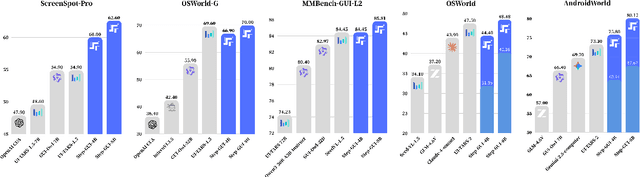
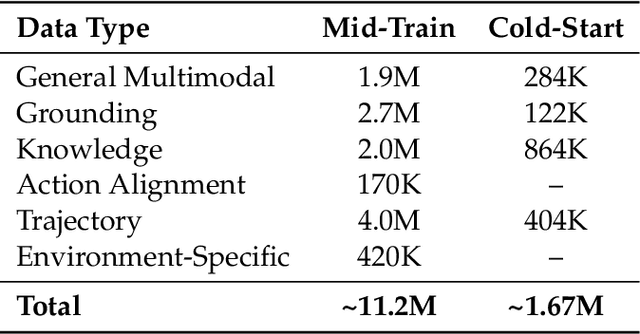
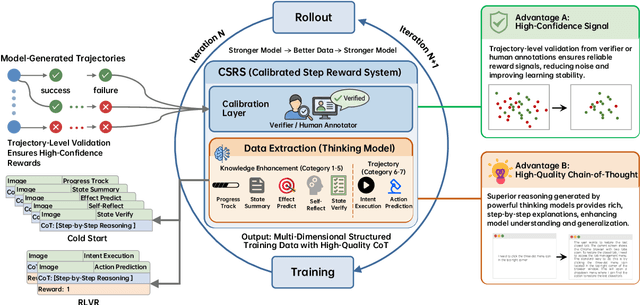
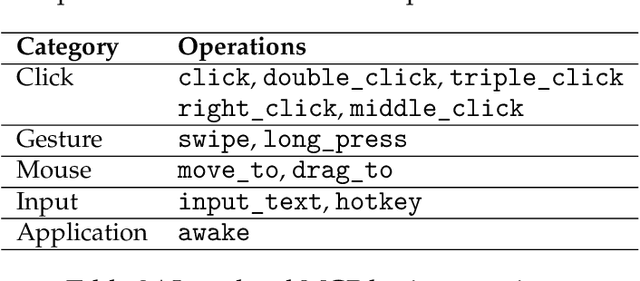
Recent advances in multimodal large language models unlock unprecedented opportunities for GUI automation. However, a fundamental challenge remains: how to efficiently acquire high-quality training data while maintaining annotation reliability? We introduce a self-evolving training pipeline powered by the Calibrated Step Reward System, which converts model-generated trajectories into reliable training signals through trajectory-level calibration, achieving >90% annotation accuracy with 10-100x lower cost. Leveraging this pipeline, we introduce Step-GUI, a family of models (4B/8B) that achieves state-of-the-art GUI performance (8B: 80.2% AndroidWorld, 48.5% OSWorld, 62.6% ScreenShot-Pro) while maintaining robust general capabilities. As GUI agent capabilities improve, practical deployment demands standardized interfaces across heterogeneous devices while protecting user privacy. To this end, we propose GUI-MCP, the first Model Context Protocol for GUI automation with hierarchical architecture that combines low-level atomic operations and high-level task delegation to local specialist models, enabling high-privacy execution where sensitive data stays on-device. Finally, to assess whether agents can handle authentic everyday usage, we introduce AndroidDaily, a benchmark grounded in real-world mobile usage patterns with 3146 static actions and 235 end-to-end tasks across high-frequency daily scenarios (8B: static 89.91%, end-to-end 52.50%). Our work advances the development of practical GUI agents and demonstrates strong potential for real-world deployment in everyday digital interactions.