 Add to Chrome
 Add to Firefox
 Add to Edge
AndroidDaily: A Verifiable Benchmark for Mobile GUI Agents on Real-World Closed-Source Applications
May 26, 2026
The rapid development of GUI foundation models and mobile GUI agents has spurred numerous evaluation benchmarks, yet most rely on simulated environments or open-source applications, leaving real-world closed-source applications largely unevaluated. The core difficulty is that closed-source applications do not expose internal states, making traditional automatic verification inapplicable. To bridge this gap, we introduce AndroidDaily, a large-scale benchmark comprising 350 realistic daily-use tasks across 94 high-frequency Android applications spanning transportation, shopping, local services, entertainment, content creation, social media, and everyday utilities. To enable automatic and verifiable assessment in these opaque environments, we propose Guideline-grounded Reviewer for Automatic Diagnostic Evaluation (GRADE), a process-aware evaluator built on a three-tiered system of observable external guidelines: operational obligations, output quality, and negative constraints. GRADE tracks the agent's visual trajectory against these criteria and produces step-level diagnostic judgments, turning long-horizon, open-ended mobile interactions into verifiable evaluation without relying on hidden internal states. Experiments show that GRADE achieves 87.37\% agreement with human evaluators. The strongest model reaches a 62.0\% success rate on AndroidDaily, highlighting a substantial gap between current reasoning capabilities and practical execution in realistic mobile workflows.

Act While Thinking: Accelerating LLM Agents via Pattern-Aware Speculative Tool Execution
Mar 19, 2026LLM-powered agents are emerging as a dominant paradigm for autonomous task solving. Unlike standard inference workloads, agents operate in a strictly serial "LLM-tool" loop, where the LLM must wait for external tool execution at every step. This execution model introduces severe latency bottlenecks. To address this problem, we propose PASTE, a Pattern-Aware Speculative Tool Execution method designed to hide tool latency through speculation. PASTE is based on the insight that although agent requests are semantically diverse, they exhibit stable application level control flows (recurring tool-call sequences) and predictable data dependencies (parameter passing between tools). By exploiting these properties, PASTE improves agent serving performance through speculative tool execution. Experimental results against state of the art baselines show that PASTE reduces average task completion time by 48.5% and improves tool execution throughput by 1.8x.
Step-GUI Technical Report
Dec 19, 2025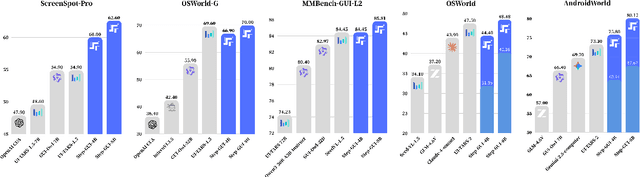
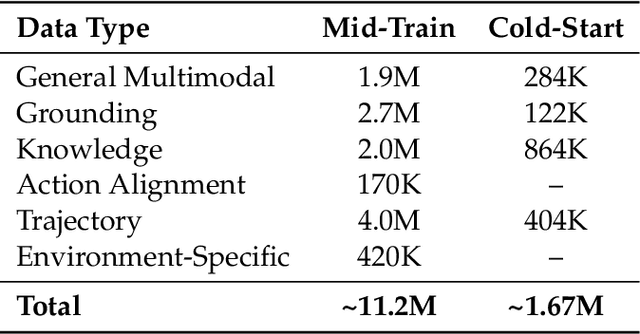
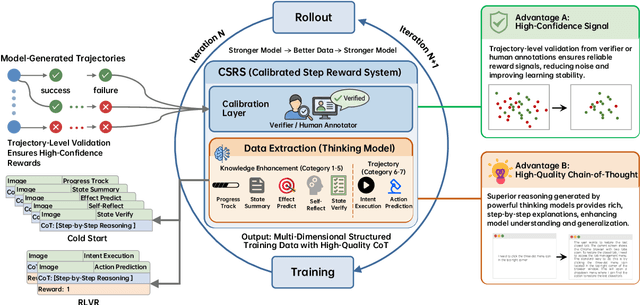
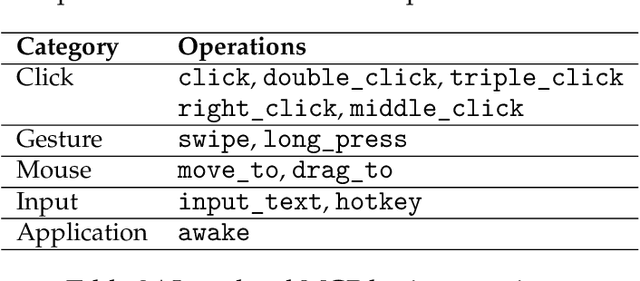
Recent advances in multimodal large language models unlock unprecedented opportunities for GUI automation. However, a fundamental challenge remains: how to efficiently acquire high-quality training data while maintaining annotation reliability? We introduce a self-evolving training pipeline powered by the Calibrated Step Reward System, which converts model-generated trajectories into reliable training signals through trajectory-level calibration, achieving >90% annotation accuracy with 10-100x lower cost. Leveraging this pipeline, we introduce Step-GUI, a family of models (4B/8B) that achieves state-of-the-art GUI performance (8B: 80.2% AndroidWorld, 48.5% OSWorld, 62.6% ScreenShot-Pro) while maintaining robust general capabilities. As GUI agent capabilities improve, practical deployment demands standardized interfaces across heterogeneous devices while protecting user privacy. To this end, we propose GUI-MCP, the first Model Context Protocol for GUI automation with hierarchical architecture that combines low-level atomic operations and high-level task delegation to local specialist models, enabling high-privacy execution where sensitive data stays on-device. Finally, to assess whether agents can handle authentic everyday usage, we introduce AndroidDaily, a benchmark grounded in real-world mobile usage patterns with 3146 static actions and 235 end-to-end tasks across high-frequency daily scenarios (8B: static 89.91%, end-to-end 52.50%). Our work advances the development of practical GUI agents and demonstrates strong potential for real-world deployment in everyday digital interactions.
ServerlessLoRA: Minimizing Latency and Cost in Serverless Inference for LoRA-Based LLMs
May 20, 2025Serverless computing has grown rapidly for serving Large Language Model (LLM) inference due to its pay-as-you-go pricing, fine-grained GPU usage, and rapid scaling. However, our analysis reveals that current serverless can effectively serve general LLM but fail with Low-Rank Adaptation (LoRA) inference due to three key limitations: 1) massive parameter redundancy among functions where 99% of weights are unnecessarily duplicated, 2) costly artifact loading latency beyond LLM loading, and 3) magnified resource contention when serving multiple LoRA LLMs. These inefficiencies lead to massive GPU wastage, increased Time-To-First-Token (TTFT), and high monetary costs. We propose ServerlessLoRA, a novel serverless inference system designed for faster and cheaper LoRA LLM serving. ServerlessLoRA enables secure backbone LLM sharing across isolated LoRA functions to reduce redundancy. We design a pre-loading method that pre-loads comprehensive LoRA artifacts to minimize cold-start latency. Furthermore, ServerlessLoRA employs contention aware batching and offloading to mitigate GPU resource conflicts during bursty workloads. Experiment on industrial workloads demonstrates that ServerlessLoRA reduces TTFT by up to 86% and cuts monetary costs by up to 89% compared to state-of-the-art LLM inference solutions.