 Add to Chrome
 Add to Firefox
 Add to Edge
Skill-Guided Continuation Distillation for GUI Agents
Jun 17, 2026
Improving GUI agents typically relies on behavior cloning on expert trajectories. However, as the current policy deviates from the expert policy, it inevitably encounters policy-induced off-trajectory states during closed-loop execution, i.e., states that fall outside the expert trajectories. Since expert trajectories provide no demonstrations for these unseen states, such states receive no effective supervision, leaving the policy unable to select the correct action. To close this supervision gap, we propose Skill-Guided Continuation Distillation (SGCD), an iterative self-improvement framework. SGCD first runs the plain policy without skill guidance for a few steps to reach realistic off-trajectory states. From these states, a skill-guided policy then completes the task and produces successful continuations, which are mixed with expert trajectories to supply supervision over policy-induced off-trajectory states. The skills are extracted from both successful and failed rollouts, consisting of Continuation Plans, Critical Targets, Failure Traps, and Success Criteria. On OSWorld-Verified, SGCD improves the success rate of three base models from the low-30\% range to over 50\%, demonstrating its effectiveness and generality.

SilLang: Improving Gait Recognition with Silhouette Language Encoding
Mar 25, 2026Gait silhouettes, which can be encoded into binary gait codes, are widely adopted to representing motion patterns of pedestrian. Recent approaches commonly leverage visual backbones to encode gait silhouettes, achieving successful performance. However, they primarily focus on continuous visual features, overlooking the discrete nature of binary silhouettes that inherently share a discrete encoding space with natural language. Large Language Models (LLMs) have demonstrated exceptional capability in extracting discriminative features from discrete sequences and modeling long-range dependencies, highlighting their potential to capture temporal motion patterns by identifying subtle variations. Motivated by these observations, we explore bridging binary gait silhouettes and natural language within a binary encoding space. However, the encoding spaces of text tokens and binary gait silhouettes remain misaligned, primarily due to differences in token frequency and density. To address this issue, we propose the Contour-Velocity Tokenizer, which encodes binary gait silhouettes while reshaping their distribution to better align with the text token space. We then establish a dual-branch framework termed Silhouette Language Model, which enhances visual silhouettes by integrating discrete linguistic embeddings derived from LLMs. Implemented on mainstream gait backbones, SilLang consistently improves state-of-the-art methods across SUSTech1K, GREW, and Gait3D.
Step-GUI Technical Report
Dec 19, 2025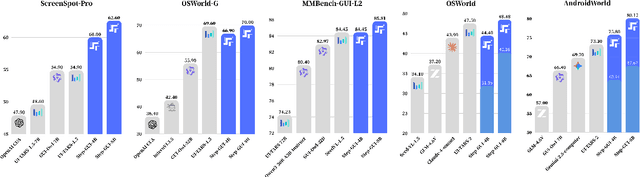
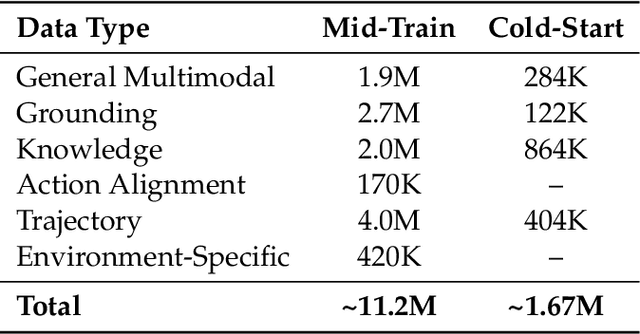
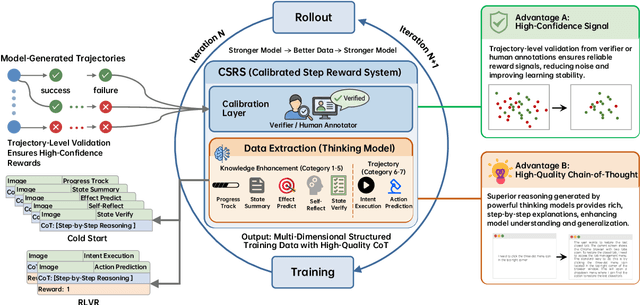
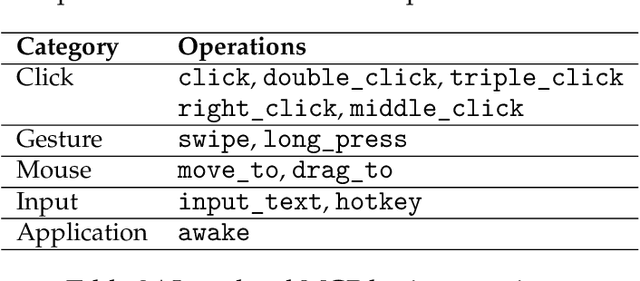
Recent advances in multimodal large language models unlock unprecedented opportunities for GUI automation. However, a fundamental challenge remains: how to efficiently acquire high-quality training data while maintaining annotation reliability? We introduce a self-evolving training pipeline powered by the Calibrated Step Reward System, which converts model-generated trajectories into reliable training signals through trajectory-level calibration, achieving >90% annotation accuracy with 10-100x lower cost. Leveraging this pipeline, we introduce Step-GUI, a family of models (4B/8B) that achieves state-of-the-art GUI performance (8B: 80.2% AndroidWorld, 48.5% OSWorld, 62.6% ScreenShot-Pro) while maintaining robust general capabilities. As GUI agent capabilities improve, practical deployment demands standardized interfaces across heterogeneous devices while protecting user privacy. To this end, we propose GUI-MCP, the first Model Context Protocol for GUI automation with hierarchical architecture that combines low-level atomic operations and high-level task delegation to local specialist models, enabling high-privacy execution where sensitive data stays on-device. Finally, to assess whether agents can handle authentic everyday usage, we introduce AndroidDaily, a benchmark grounded in real-world mobile usage patterns with 3146 static actions and 235 end-to-end tasks across high-frequency daily scenarios (8B: static 89.91%, end-to-end 52.50%). Our work advances the development of practical GUI agents and demonstrates strong potential for real-world deployment in everyday digital interactions.
GLGait: A Global-Local Temporal Receptive Field Network for Gait Recognition in the Wild
Aug 13, 2024


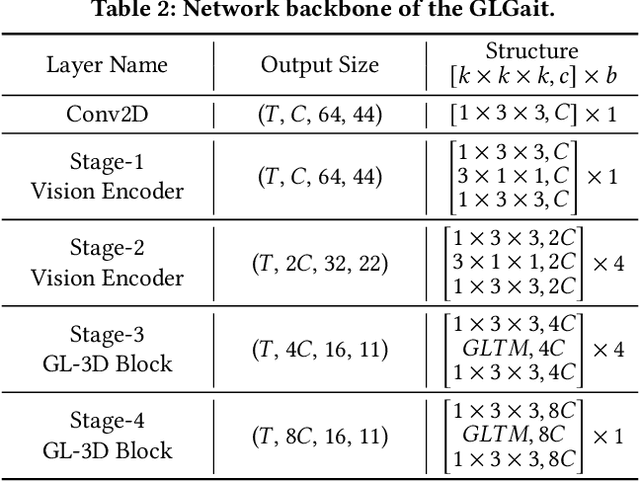
Gait recognition has attracted increasing attention from academia and industry as a human recognition technology from a distance in non-intrusive ways without requiring cooperation. Although advanced methods have achieved impressive success in lab scenarios, most of them perform poorly in the wild. Recently, some Convolution Neural Networks (ConvNets) based methods have been proposed to address the issue of gait recognition in the wild. However, the temporal receptive field obtained by convolution operations is limited for long gait sequences. If directly replacing convolution blocks with visual transformer blocks, the model may not enhance a local temporal receptive field, which is important for covering a complete gait cycle. To address this issue, we design a Global-Local Temporal Receptive Field Network (GLGait). GLGait employs a Global-Local Temporal Module (GLTM) to establish a global-local temporal receptive field, which mainly consists of a Pseudo Global Temporal Self-Attention (PGTA) and a temporal convolution operation. Specifically, PGTA is used to obtain a pseudo global temporal receptive field with less memory and computation complexity compared with a multi-head self-attention (MHSA). The temporal convolution operation is used to enhance the local temporal receptive field. Besides, it can also aggregate pseudo global temporal receptive field to a true holistic temporal receptive field. Furthermore, we also propose a Center-Augmented Triplet Loss (CTL) in GLGait to reduce the intra-class distance and expand the positive samples in the training stage. Extensive experiments show that our method obtains state-of-the-art results on in-the-wild datasets, $i.e.$, Gait3D and GREW. The code is available at https://github.com/bgdpgz/GLGait.