 Add to Chrome
 Add to Firefox
 Add to Edge
GoLF-NRT: Integrating Global Context and Local Geometry for Few-Shot View Synthesis
May 26, 2025
Neural Radiance Fields (NeRF) have transformed novel view synthesis by modeling scene-specific volumetric representations directly from images. While generalizable NeRF models can generate novel views across unknown scenes by learning latent ray representations, their performance heavily depends on a large number of multi-view observations. However, with limited input views, these methods experience significant degradation in rendering quality. To address this limitation, we propose GoLF-NRT: a Global and Local feature Fusion-based Neural Rendering Transformer. GoLF-NRT enhances generalizable neural rendering from few input views by leveraging a 3D transformer with efficient sparse attention to capture global scene context. In parallel, it integrates local geometric features extracted along the epipolar line, enabling high-quality scene reconstruction from as few as 1 to 3 input views. Furthermore, we introduce an adaptive sampling strategy based on attention weights and kernel regression, improving the accuracy of transformer-based neural rendering. Extensive experiments on public datasets show that GoLF-NRT achieves state-of-the-art performance across varying numbers of input views, highlighting the effectiveness and superiority of our approach. Code is available at https://github.com/KLMAV-CUC/GoLF-NRT.

SATURN: SAT-based Reinforcement Learning to Unleash Language Model Reasoning
May 22, 2025How to design reinforcement learning (RL) tasks that effectively unleash the reasoning capability of large language models (LLMs) remains an open question. Existing RL tasks (e.g., math, programming, and constructing reasoning tasks) suffer from three key limitations: (1) Scalability. They rely heavily on human annotation or expensive LLM synthesis to generate sufficient training data. (2) Verifiability. LLMs' outputs are hard to verify automatically and reliably. (3) Controllable Difficulty. Most tasks lack fine-grained difficulty control, making it hard to train LLMs to develop reasoning ability from easy to hard. To address these limitations, we propose Saturn, a SAT-based RL framework that uses Boolean Satisfiability (SAT) problems to train and evaluate LLM reasoning. Saturn enables scalable task construction, rule-based verification, and precise difficulty control. Saturn designs a curriculum learning pipeline that continuously improves LLMs' reasoning capability by constructing SAT tasks of increasing difficulty and training LLMs from easy to hard. To ensure stable training, we design a principled mechanism to control difficulty transitions. We introduce Saturn-2.6k, a dataset of 2,660 SAT problems with varying difficulty. It supports the evaluation of how LLM reasoning changes with problem difficulty. We apply Saturn to DeepSeek-R1-Distill-Qwen and obtain Saturn-1.5B and Saturn-7B. We achieve several notable results: (1) On SAT problems, Saturn-1.5B and Saturn-7B achieve average pass@3 improvements of +14.0 and +28.1, respectively. (2) On math and programming tasks, Saturn-1.5B and Saturn-7B improve average scores by +4.9 and +1.8 on benchmarks (e.g., AIME, LiveCodeBench). (3) Compared to the state-of-the-art (SOTA) approach in constructing RL tasks, Saturn achieves further improvements of +8.8%. We release the source code, data, and models to support future research.
3D Gaussian Adaptive Reconstruction for Fourier Light-Field Microscopy
May 19, 2025Compared to light-field microscopy (LFM), which enables high-speed volumetric imaging but suffers from non-uniform spatial sampling, Fourier light-field microscopy (FLFM) introduces sub-aperture division at the pupil plane, thereby ensuring spatially invariant sampling and enhancing spatial resolution. Conventional FLFM reconstruction methods, such as Richardson-Lucy (RL) deconvolution, exhibit poor axial resolution and signal degradation due to the ill-posed nature of the inverse problem. While data-driven approaches enhance spatial resolution by leveraging high-quality paired datasets or imposing structural priors, Neural Radiance Fields (NeRF)-based methods employ physics-informed self-supervised learning to overcome these limitations, yet they are hindered by substantial computational costs and memory demands. Therefore, we propose 3D Gaussian Adaptive Tomography (3DGAT) for FLFM, a 3D gaussian splatting based self-supervised learning framework that significantly improves the volumetric reconstruction quality of FLFM while maintaining computational efficiency. Experimental results indicate that our approach achieves higher resolution and improved reconstruction accuracy, highlighting its potential to advance FLFM imaging and broaden its applications in 3D optical microscopy.
AutoLibra: Agent Metric Induction from Open-Ended Feedback
May 05, 2025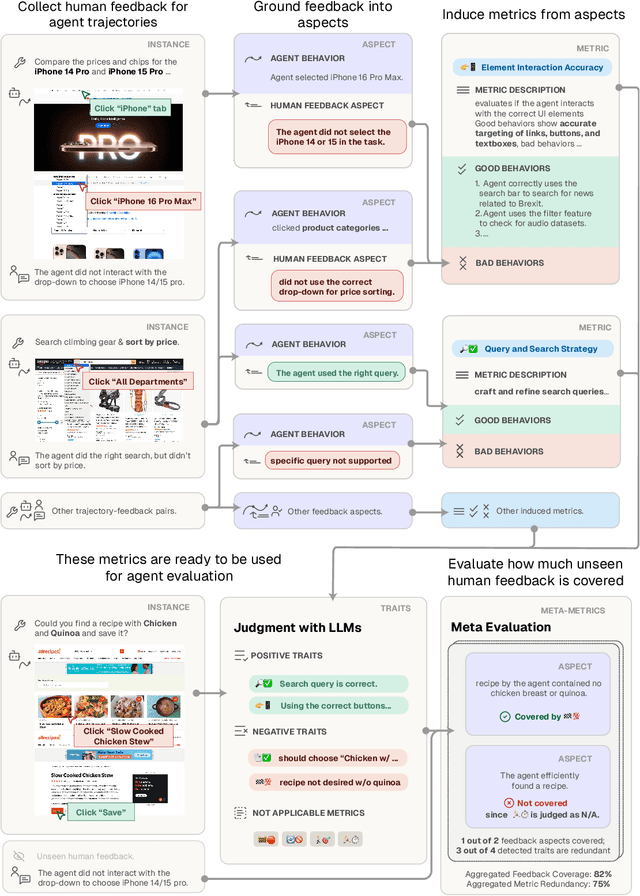

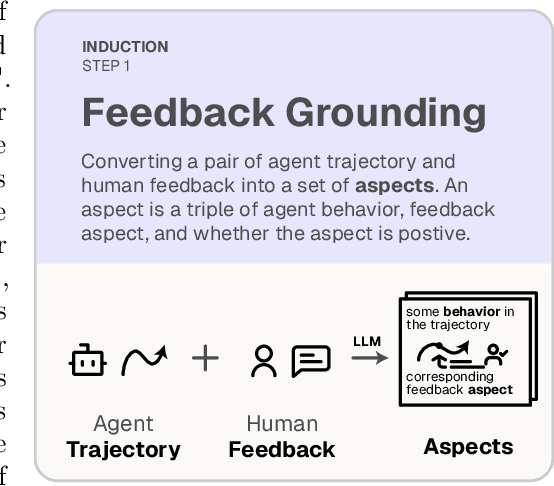
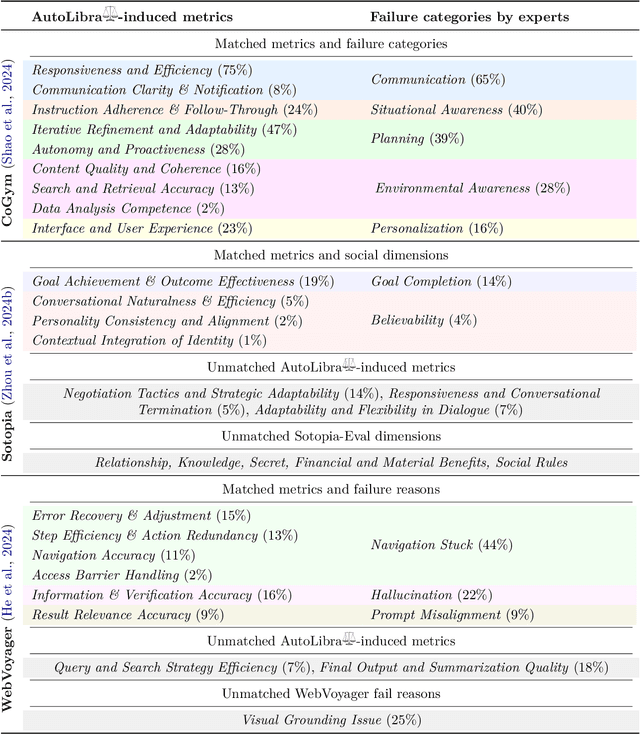
Agents are predominantly evaluated and optimized via task success metrics, which are coarse, rely on manual design from experts, and fail to reward intermediate emergent behaviors. We propose AutoLibra, a framework for agent evaluation, that transforms open-ended human feedback, e.g., "If you find that the button is disabled, don't click it again", or "This agent has too much autonomy to decide what to do on its own", into metrics for evaluating fine-grained behaviors in agent trajectories. AutoLibra accomplishes this by grounding feedback to an agent's behavior, clustering similar positive and negative behaviors, and creating concrete metrics with clear definitions and concrete examples, which can be used for prompting LLM-as-a-Judge as evaluators. We further propose two meta-metrics to evaluate the alignment of a set of (induced) metrics with open feedback: "coverage" and "redundancy". Through optimizing these meta-metrics, we experimentally demonstrate AutoLibra's ability to induce more concrete agent evaluation metrics than the ones proposed in previous agent evaluation benchmarks and discover new metrics to analyze agents. We also present two applications of AutoLibra in agent improvement: First, we show that AutoLibra-induced metrics serve as better prompt-engineering targets than the task success rate on a wide range of text game tasks, improving agent performance over baseline by a mean of 20%. Second, we show that AutoLibra can iteratively select high-quality fine-tuning data for web navigation agents. Our results suggest that AutoLibra is a powerful task-agnostic tool for evaluating and improving language agents.
A Diff-Attention Aware State Space Fusion Model for Remote Sensing Classification
Apr 23, 2025Multispectral (MS) and panchromatic (PAN) images describe the same land surface, so these images not only have their own advantages, but also have a lot of similar information. In order to separate these similar information and their respective advantages, reduce the feature redundancy in the fusion stage. This paper introduces a diff-attention aware state space fusion model (DAS2F-Model) for multimodal remote sensing image classification. Based on the selective state space model, a cross-modal diff-attention module (CMDA-Module) is designed to extract and separate the common features and their respective dominant features of MS and PAN images. Among this, space preserving visual mamba (SPVM) retains image spatial features and captures local features by optimizing visual mamba's input reasonably. Considering that features in the fusion stage will have large semantic differences after feature separation and simple fusion operations struggle to effectively integrate these significantly different features, an attention-aware linear fusion module (AALF-Module) is proposed. It performs pixel-wise linear fusion by calculating influence coefficients. This mechanism can fuse features with large semantic differences while keeping the feature size unchanged. Empirical evaluations indicate that the presented method achieves better results than alternative approaches. The relevant code can be found at:https://github.com/AVKSKVL/DAS-F-Model
SOTOPIA-S4: a user-friendly system for flexible, customizable, and large-scale social simulation
Apr 19, 2025Social simulation through large language model (LLM) agents is a promising approach to explore and validate hypotheses related to social science questions and LLM agents behavior. We present SOTOPIA-S4, a fast, flexible, and scalable social simulation system that addresses the technical barriers of current frameworks while enabling practitioners to generate multi-turn and multi-party LLM-based interactions with customizable evaluation metrics for hypothesis testing. SOTOPIA-S4 comes as a pip package that contains a simulation engine, an API server with flexible RESTful APIs for simulation management, and a web interface that enables both technical and non-technical users to design, run, and analyze simulations without programming. We demonstrate the usefulness of SOTOPIA-S4 with two use cases involving dyadic hiring negotiation and multi-party planning scenarios.
Multi-convex Programming for Discrete Latent Factor Models Prototyping
Apr 02, 2025Discrete latent factor models (DLFMs) are widely used in various domains such as machine learning, economics, neuroscience, psychology, etc. Currently, fitting a DLFM to some dataset relies on a customized solver for individual models, which requires lots of effort to implement and is limited to the targeted specific instance of DLFMs. In this paper, we propose a generic framework based on CVXPY, which allows users to specify and solve the fitting problem of a wide range of DLFMs, including both regression and classification models, within a very short script. Our framework is flexible and inherently supports the integration of regularization terms and constraints on the DLFM parameters and latent factors, such that the users can easily prototype the DLFM structure according to their dataset and application scenario. We introduce our open-source Python implementation and illustrate the framework in several examples.
Mitigating Ambiguities in 3D Classification with Gaussian Splatting
Mar 11, 20253D classification with point cloud input is a fundamental problem in 3D vision. However, due to the discrete nature and the insufficient material description of point cloud representations, there are ambiguities in distinguishing wire-like and flat surfaces, as well as transparent or reflective objects. To address these issues, we propose Gaussian Splatting (GS) point cloud-based 3D classification. We find that the scale and rotation coefficients in the GS point cloud help characterize surface types. Specifically, wire-like surfaces consist of multiple slender Gaussian ellipsoids, while flat surfaces are composed of a few flat Gaussian ellipsoids. Additionally, the opacity in the GS point cloud represents the transparency characteristics of objects. As a result, ambiguities in point cloud-based 3D classification can be mitigated utilizing GS point cloud as input. To verify the effectiveness of GS point cloud input, we construct the first real-world GS point cloud dataset in the community, which includes 20 categories with 200 objects in each category. Experiments not only validate the superiority of GS point cloud input, especially in distinguishing ambiguous objects, but also demonstrate the generalization ability across different classification methods.
FANformer: Improving Large Language Models Through Effective Periodicity Modeling
Feb 28, 2025Periodicity, as one of the most important basic characteristics, lays the foundation for facilitating structured knowledge acquisition and systematic cognitive processes within human learning paradigms. However, the potential flaws of periodicity modeling in Transformer affect the learning efficiency and establishment of underlying principles from data for large language models (LLMs) built upon it. In this paper, we demonstrate that integrating effective periodicity modeling can improve the learning efficiency and performance of LLMs. We introduce FANformer, which integrates Fourier Analysis Network (FAN) into attention mechanism to achieve efficient periodicity modeling, by modifying the feature projection process of attention mechanism. Extensive experimental results on language modeling show that FANformer consistently outperforms Transformer when scaling up model size and training tokens, underscoring its superior learning efficiency. To further validate the effectiveness of FANformer, we pretrain a FANformer-1B on 1 trillion tokens. FANformer-1B exhibits marked improvements on downstream tasks compared to open-source LLMs with similar model parameters or training tokens. The results position FANformer as an effective and promising architecture for advancing LLMs.
EgoNormia: Benchmarking Physical Social Norm Understanding
Feb 27, 2025Human activity is moderated by norms. When performing actions in the real world, humans not only follow norms, but also consider the trade-off between different norms However, machines are often trained without explicit supervision on norm understanding and reasoning, especially when the norms are grounded in a physical and social context. To improve and evaluate the normative reasoning capability of vision-language models (VLMs), we present EgoNormia $\|\epsilon\|$, consisting of 1,853 ego-centric videos of human interactions, each of which has two related questions evaluating both the prediction and justification of normative actions. The normative actions encompass seven categories: safety, privacy, proxemics, politeness, cooperation, coordination/proactivity, and communication/legibility. To compile this dataset at scale, we propose a novel pipeline leveraging video sampling, automatic answer generation, filtering, and human validation. Our work demonstrates that current state-of-the-art vision-language models lack robust norm understanding, scoring a maximum of 45% on EgoNormia (versus a human bench of 92%). Our analysis of performance in each dimension highlights the significant risks of safety, privacy, and the lack of collaboration and communication capability when applied to real-world agents. We additionally show that through a retrieval-based generation method, it is possible to use EgoNomia to enhance normative reasoning in VLMs.