 Add to Chrome
 Add to Firefox
 Add to Edge
GuardianAgentBench: Where Agents Fail and How to Guard Them
Jul 23, 2026
As large language model agents increasingly operate autonomously with access to tools and external environments, ensuring their safe and reliable behavior becomes critical. We present GuardianAgentBench (GABench), a benchmark of 580 scenarios across six domains evaluated on three production-ready frameworks: LangChain, LlamaIndex, and Vectara. The benchmark incorporates rigorous multi-stage validation and five adversarial attack modes. Experiments with six state-of-the-art models reveal that even the strongest configuration achieves only 74.8% overall accuracy and expose two distinct failure regimes: stronger models under-call required tools, while weaker models mis-select and over-call tools. Performance degrades monotonically with both tool-set size and sequential turn depth, with long-horizon planning proving the steeper bottleneck. Our guardrail implementation consistently outperforms system-prompt-based defenses across all models, recovering 19.9% of failures at a false positive rate of just 0.5%. These results demonstrate that execution-time structural intervention improves safety without disrupting correct agent behavior.

Trajectory Optimization for Collision-Aware Redundant Robotic Multi-Axis Additive Manufacturing by Constrained Gradient Projection
Jun 29, 2026Redundant robotic multi-axis additive manufacturing (MAAM) enables support-free and conformal fabrication, but trajectory optimization for long-horizon paths remains challenging under strict deposition-position constraints and time-varying collision constraints. This work proposes a computational framework for collision-aware trajectory optimization in redundant robotic MAAM. We first formulate nozzle-workpiece relative kinematics using a relative Jacobian, and develop a differentiable SDF-based collision model that captures fabrication-induced geometry evolution and provides optimization gradients. The deposition position is then enforced as a hard waypoint-wise equality constraint through iterative projection onto the self-motion manifold, with the loss gradient restricted to the corresponding tangent space. Experiments on an 8-DOF robotic MAAM platform with diverse long-horizon support-free and conformal toolpaths show that our method maintains a mean nozzle-position error below 10μm, reduces maximum joint jerk by up to $77.6\%$, and eliminates all sampled collision and orientation violations. Compared with the SQP-based baseline, it achieves up to a 10.2x speedup and improved convergence. Physical fabrication experiments further verify that the resulting smooth, collision-free trajectories enable successful printing of complex geometries with fewer visible deposition artifacts.
3D Gaussian Adaptive Reconstruction for Fourier Light-Field Microscopy
May 19, 2025Compared to light-field microscopy (LFM), which enables high-speed volumetric imaging but suffers from non-uniform spatial sampling, Fourier light-field microscopy (FLFM) introduces sub-aperture division at the pupil plane, thereby ensuring spatially invariant sampling and enhancing spatial resolution. Conventional FLFM reconstruction methods, such as Richardson-Lucy (RL) deconvolution, exhibit poor axial resolution and signal degradation due to the ill-posed nature of the inverse problem. While data-driven approaches enhance spatial resolution by leveraging high-quality paired datasets or imposing structural priors, Neural Radiance Fields (NeRF)-based methods employ physics-informed self-supervised learning to overcome these limitations, yet they are hindered by substantial computational costs and memory demands. Therefore, we propose 3D Gaussian Adaptive Tomography (3DGAT) for FLFM, a 3D gaussian splatting based self-supervised learning framework that significantly improves the volumetric reconstruction quality of FLFM while maintaining computational efficiency. Experimental results indicate that our approach achieves higher resolution and improved reconstruction accuracy, highlighting its potential to advance FLFM imaging and broaden its applications in 3D optical microscopy.
Benchmarking LLM Faithfulness in RAG with Evolving Leaderboards
May 07, 2025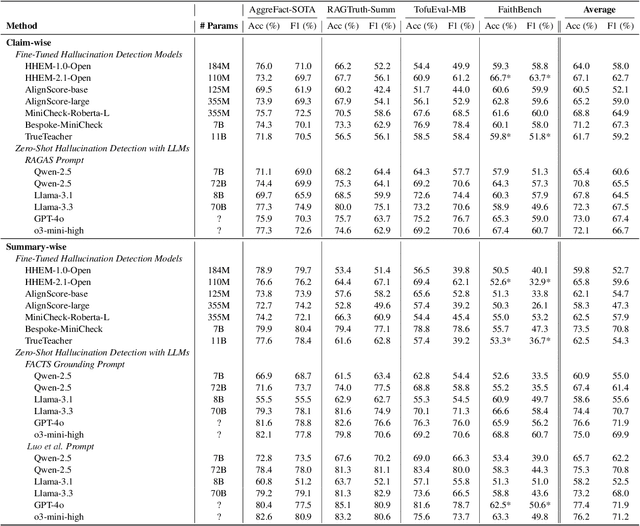
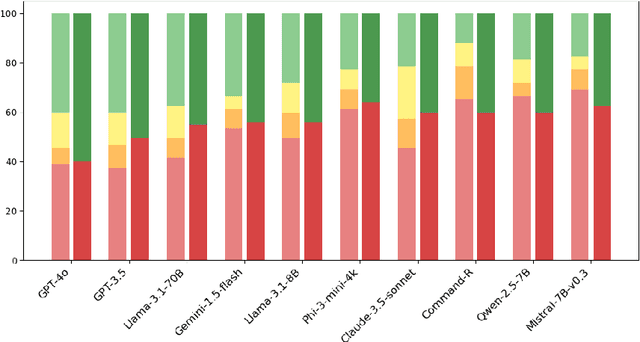
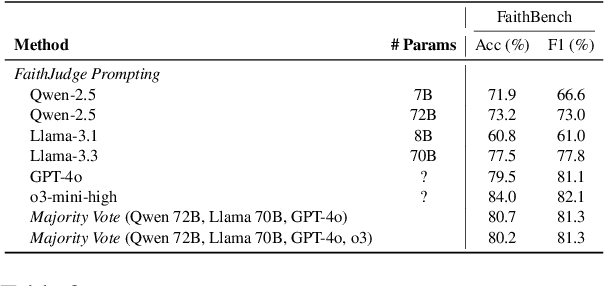
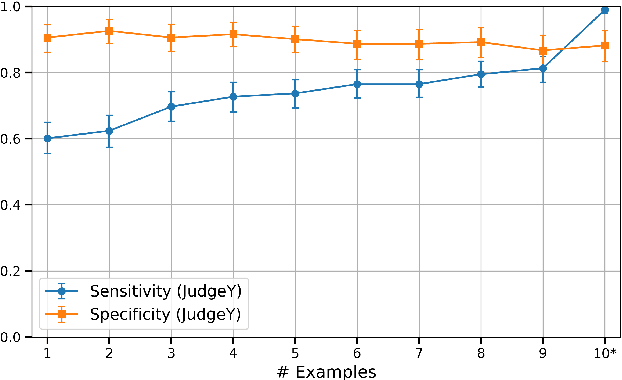
Hallucinations remain a persistent challenge for LLMs. RAG aims to reduce hallucinations by grounding responses in contexts. However, even when provided context, LLMs still frequently introduce unsupported information or contradictions. This paper presents our efforts to measure LLM hallucinations with a focus on summarization tasks, assessing how often various LLMs introduce hallucinations when summarizing documents. We discuss Vectara's existing LLM hallucination leaderboard, based on the Hughes Hallucination Evaluation Model (HHEM). While HHEM and Vectara's Hallucination Leaderboard have garnered great research interest, we examine challenges faced by HHEM and current hallucination detection methods by analyzing the effectiveness of these methods on existing hallucination datasets. To address these limitations, we propose FaithJudge, an LLM-as-a-judge approach guided by few-shot human hallucination annotations, which substantially improves automated LLM hallucination evaluation over current methods. We introduce an enhanced hallucination leaderboard centered on FaithJudge, alongside our current hallucination leaderboard, enabling more reliable benchmarking of LLMs for hallucinations in RAG.
FaithBench: A Diverse Hallucination Benchmark for Summarization by Modern LLMs
Oct 17, 2024

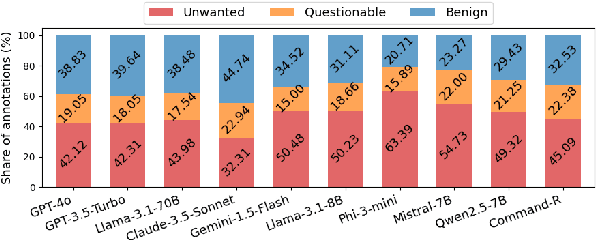

Summarization is one of the most common tasks performed by large language models (LLMs), especially in applications like Retrieval-Augmented Generation (RAG). However, existing evaluations of hallucinations in LLM-generated summaries, and evaluations of hallucination detection models both suffer from a lack of diversity and recency in the LLM and LLM families considered. This paper introduces FaithBench, a summarization hallucination benchmark comprising challenging hallucinations made by 10 modern LLMs from 8 different families, with ground truth annotations by human experts. ``Challenging'' here means summaries on which popular, state-of-the-art hallucination detection models, including GPT-4o-as-a-judge, disagreed on. Our results show GPT-4o and GPT-3.5-Turbo produce the least hallucinations. However, even the best hallucination detection models have near 50\% accuracies on FaithBench, indicating lots of room for future improvement. The repo is https://github.com/vectara/FaithBench
MMLN: Leveraging Domain Knowledge for Multimodal Diagnosis
Feb 09, 2022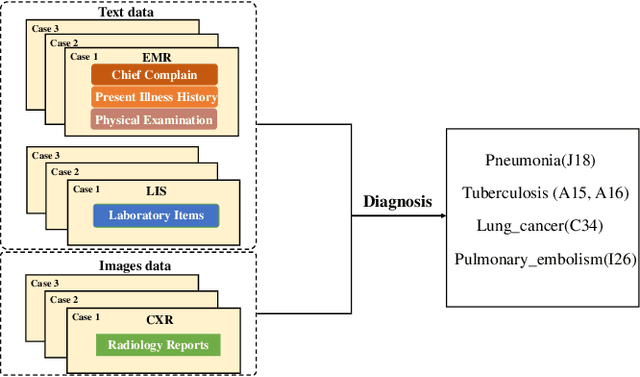
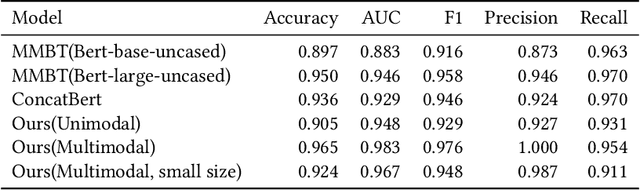
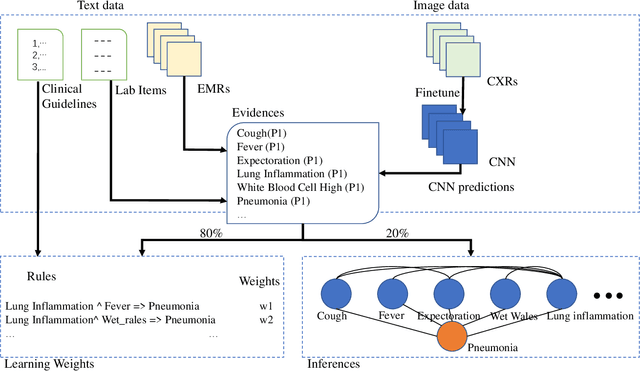
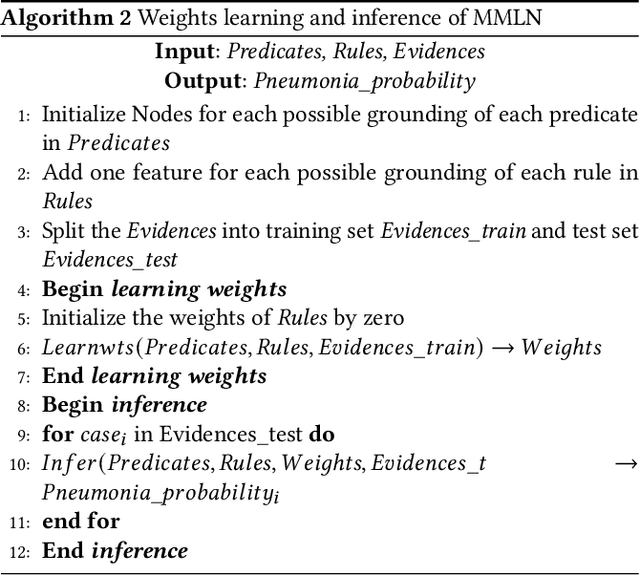
Recent studies show that deep learning models achieve good performance on medical imaging tasks such as diagnosis prediction. Among the models, multimodality has been an emerging trend, integrating different forms of data such as chest X-ray (CXR) images and electronic medical records (EMRs). However, most existing methods incorporate them in a model-free manner, which lacks theoretical support and ignores the intrinsic relations between different data sources. To address this problem, we propose a knowledge-driven and data-driven framework for lung disease diagnosis. By incorporating domain knowledge, machine learning models can reduce the dependence on labeled data and improve interpretability. We formulate diagnosis rules according to authoritative clinical medicine guidelines and learn the weights of rules from text data. Finally, a multimodal fusion consisting of text and image data is designed to infer the marginal probability of lung disease. We conduct experiments on a real-world dataset collected from a hospital. The results show that the proposed method outperforms the state-of-the-art multimodal baselines in terms of accuracy and interpretability.