 Add to Chrome
 Add to Firefox
 Add to Edge
Archer: Adaptive Reuse of Cached Hidden States for Efficient Rollback in Diffusion Language Models
Aug 11, 2026
Diffusion language models (DLMs) iteratively refine a sequence, allowing earlier predictions to be revised as context evolves. This rollback capability distinguishes them from irreversible autoregressive generation, but makes inference costly. Every denoising update alters the global context, forcing both prompt and response states to be recomputed even though only response tokens are revisable. Key-value (KV) caching could reduce this cost, yet conventional caching assumes immutable historical states and is therefore difficult to reconcile with rollback. In this paper, we introduce Adaptive Reuse of Cached Hidden States for Efficient Rollback (Archer), a training-free KV caching method for rollback-capable DLMs. Archer asymmetrically keeps the mutable response synchronized with the current hypothesis while reusing prompt K/V within a bounded state neighborhood. Although prompt representations also change under bidirectional attention, their token identities remain fixed; bounded reuse therefore amortizes repeated prompt computation without caching mutable response states. It also delays feedback from tentative tokens, reducing premature reinforcement of transient high-confidence errors and giving rollback more opportunity to correct them. Our analysis characterizes prompt reuse as a reversibility-aligned cache boundary, bounds its state-dependent approximation error, and gives a decoder-margin condition for preserving full-refresh decisions. Existing DLM acceleration often trades quality for speed. Archer shifts this frontier, attaining the best mean performance of 33.63% together with a 2.57x mean speedup on the main suite. Across evaluated settings, it improves Pass@1 by up to 3.05 points and reaches up to 2.95x speedup. Controlled analyses connect the quality gain to delayed prompt feedback and validate state-aware refresh. Our code is available at https://github.com/Hxnng/Archer.

RL-PLUS: Countering Capability Boundary Collapse of LLMs in Reinforcement Learning with Hybrid-policy Optimization
Jul 31, 2025Reinforcement Learning with Verifiable Reward (RLVR) has significantly advanced the complex reasoning abilities of Large Language Models (LLMs). However, it struggles to break through the inherent capability boundaries of the base LLM, due to its inherently on-policy strategy with LLM's immense action space and sparse reward. Further, RLVR can lead to the capability boundary collapse, narrowing the LLM's problem-solving scope. To address this problem, we propose RL-PLUS, a novel approach that synergizes internal exploitation (i.e., Thinking) with external data (i.e., Learning) to achieve stronger reasoning capabilities and surpass the boundaries of base models. RL-PLUS integrates two core components: Multiple Importance Sampling to address for distributional mismatch from external data, and an Exploration-Based Advantage Function to guide the model towards high-value, unexplored reasoning paths. We provide both theoretical analysis and extensive experiments to demonstrate the superiority and generalizability of our approach. The results show that RL-PLUS achieves state-of-the-art performance compared with existing RLVR methods on six math reasoning benchmarks and exhibits superior performance on six out-of-distribution reasoning tasks. It also achieves consistent and significant gains across diverse model families, with average relative improvements ranging from 21.1\% to 69.2\%. Moreover, Pass@k curves across multiple benchmarks indicate that RL-PLUS effectively resolves the capability boundary collapse problem.
FANformer: Improving Large Language Models Through Effective Periodicity Modeling
Feb 28, 2025Periodicity, as one of the most important basic characteristics, lays the foundation for facilitating structured knowledge acquisition and systematic cognitive processes within human learning paradigms. However, the potential flaws of periodicity modeling in Transformer affect the learning efficiency and establishment of underlying principles from data for large language models (LLMs) built upon it. In this paper, we demonstrate that integrating effective periodicity modeling can improve the learning efficiency and performance of LLMs. We introduce FANformer, which integrates Fourier Analysis Network (FAN) into attention mechanism to achieve efficient periodicity modeling, by modifying the feature projection process of attention mechanism. Extensive experimental results on language modeling show that FANformer consistently outperforms Transformer when scaling up model size and training tokens, underscoring its superior learning efficiency. To further validate the effectiveness of FANformer, we pretrain a FANformer-1B on 1 trillion tokens. FANformer-1B exhibits marked improvements on downstream tasks compared to open-source LLMs with similar model parameters or training tokens. The results position FANformer as an effective and promising architecture for advancing LLMs.
FAN: Fourier Analysis Networks
Oct 03, 2024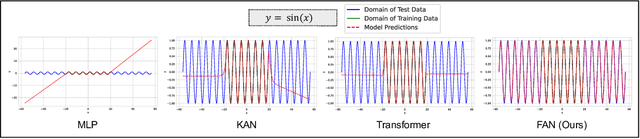


Despite the remarkable success achieved by neural networks, particularly those represented by MLP and Transformer, we reveal that they exhibit potential flaws in the modeling and reasoning of periodicity, i.e., they tend to memorize the periodic data rather than genuinely understanding the underlying principles of periodicity. However, periodicity is a crucial trait in various forms of reasoning and generalization, underpinning predictability across natural and engineered systems through recurring patterns in observations. In this paper, we propose FAN, a novel network architecture based on Fourier Analysis, which empowers the ability to efficiently model and reason about periodic phenomena. By introducing Fourier Series, the periodicity is naturally integrated into the structure and computational processes of the neural network, thus achieving a more accurate expression and prediction of periodic patterns. As a promising substitute to multi-layer perceptron (MLP), FAN can seamlessly replace MLP in various models with fewer parameters and FLOPs. Through extensive experiments, we demonstrate the effectiveness of FAN in modeling and reasoning about periodic functions, and the superiority and generalizability of FAN across a range of real-world tasks, including symbolic formula representation, time series forecasting, and language modeling.