 Add to Chrome
 Add to Firefox
 Add to Edge
Learning to Predict Middle-Layer Attention in MLLMs for Visual Token Prunin
Aug 04, 2026
Multimodal large language models (MLLMs) achieve strong performance across diverse vision-language tasks, but their efficiency is limited by the cost of processing numerous visual tokens. Visual token pruning can reduce this cost, but requires accurate token importance estimates. Recent studies have demonstrated that text-to-vision attention from middle language model layers can effectively guide visual token pruning, typically using attention from a predefined middle layer to select the visual tokens to retain. Two problems therefore remain. First, our analysis shows that the layer whose attention is most responsive to the question varies substantially across samples, making a fixed layer suboptimal. Second, obtaining attention from the appropriate middle layer requires processing numerous visual tokens through several language model layers, by which point considerable computation has already been spent. To address both problems, we propose Middle-layer Attention Prediction (MAP), which uses Question Contrastive Teacher Selection to identify a sample-specific teacher layer by contrasting attention under the original and reference questions, and distills attention from the selected layer into a lightweight predictor that estimates visual token importance from multi-modal input features. During inference, MAP combines the predicted importance scores with a diversity criterion to prune visual tokens before the first language model layer. Thus, MAP requires no attention maps for pruning and remains compatible with existing inference acceleration techniques. Across ten benchmarks on LLaVA-NeXT-7B, MAP retains 97.5% of the unpruned model performance with only 5.56% of the visual tokens, yielding a 3.09x end-to-end speedup.

Deferred Exposure of Future Trajectories for Verifiable Reasoning in Autonomous Driving VLMs
Aug 03, 2026Recent Vision-Language-Action (VLA) models for autonomous driving (AD) increasingly utilize chain-of-thought (CoT) supervision to enhance the reasoning capabilities of their Vision-Language Model (VLM) components, yet existing annotation pipelines commonly expose the teacher model to the logged ground-truth (GT) future trajectory. We empirically show that this induces trajectory anchoring bias: teacher models rationalize the revealed outcome rather than infer a decision from scene evidence, producing less causally faithful CoTs and substantially more severe hallucinations, especially in causally challenging scenes. Removing the GT trajectory eliminates this shortcut, but open-ended trajectory generation entangles high-level decision-making with precise geometric synthesis and low-level dynamics. To make trajectory-level driving decisions verifiable without requiring open-ended trajectory synthesis, we introduce Autonomous-Driving Multiple-Choice Question (AD-MCQ), which casts planning as selection among explicit trajectory candidates. Taking this a step further, we propose Deferred Exposure of Future Trajectories for RLVR (DEFT-RLVR) to transform future trajectories from pre-decision anchors into post-decision verification targets. Experimental results show that DEFT-RLVR improves AD reasoning while preserving or even enhancing general visual capabilities. With VLM-only inference and controllable difficulty through candidate construction, AD-MCQ provides a flexible, scalable, and extensible foundation for future research on verifiable AD reasoning.
LMM-IR: Large-Scale Netlist-Aware Multimodal Framework for Static IR-Drop Prediction
Nov 16, 2025Static IR drop analysis is a fundamental and critical task in the field of chip design. Nevertheless, this process can be quite time-consuming, potentially requiring several hours. Moreover, addressing IR drop violations frequently demands iterative analysis, thereby causing the computational burden. Therefore, fast and accurate IR drop prediction is vital for reducing the overall time invested in chip design. In this paper, we firstly propose a novel multimodal approach that efficiently processes SPICE files through large-scale netlist transformer (LNT). Our key innovation is representing and processing netlist topology as 3D point cloud representations, enabling efficient handling of netlist with up to hundreds of thousands to millions nodes. All types of data, including netlist files and image data, are encoded into latent space as features and fed into the model for static voltage drop prediction. This enables the integration of data from multiple modalities for complementary predictions. Experimental results demonstrate that our proposed algorithm can achieve the best F1 score and the lowest MAE among the winning teams of the ICCAD 2023 contest and the state-of-the-art algorithms.
Path Planning on Multi-level Point Cloud with a Weighted Traversability Graph
Apr 30, 2025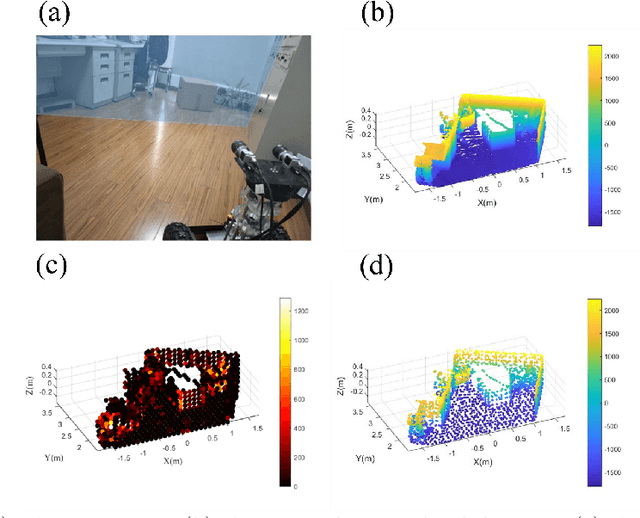
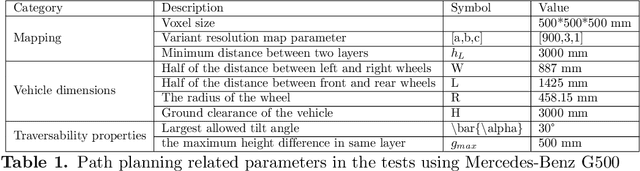
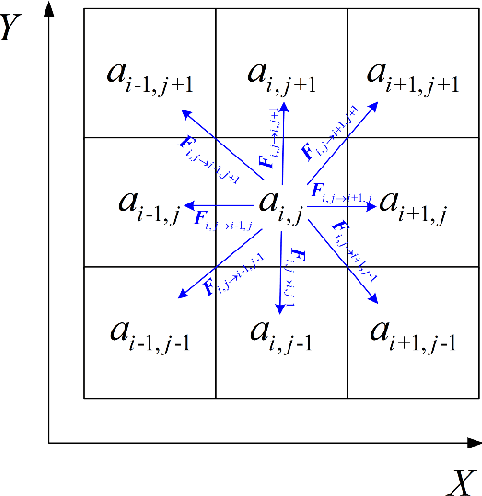
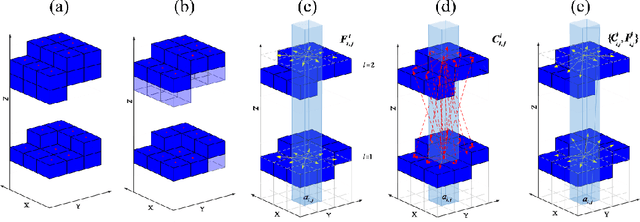
This article proposes a new path planning method for addressing multi-level terrain situations. The proposed method includes innovations in three aspects: 1) the pre-processing of point cloud maps with a multi-level skip-list structure and data-slimming algorithm for well-organized and simplified map formalization and management, 2) the direct acquisition of local traversability indexes through vehicle and point cloud interaction analysis, which saves work in surface fitting, and 3) the assignment of traversability indexes on a multi-level connectivity graph to generate a weighted traversability graph for generally search-based path planning. The A* algorithm is modified to utilize the traversability graph to generate a short and safe path. The effectiveness and reliability of the proposed method are verified through indoor and outdoor experiments conducted in various environments, including multi-floor buildings, woodland, and rugged mountainous regions. The results demonstrate that the proposed method can properly address 3D path planning problems for ground vehicles in a wide range of situations.
Modeling Dynamic Heterogeneous Graph and Node Importance for Future Citation Prediction
May 27, 2023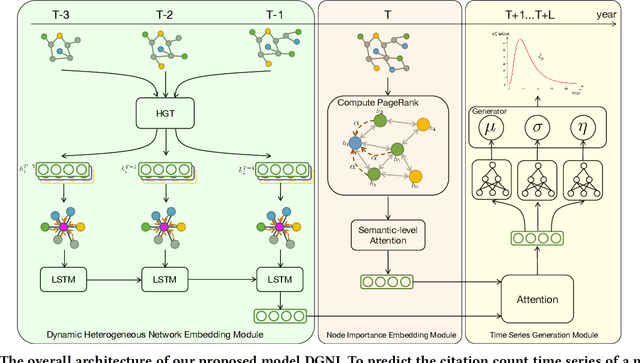

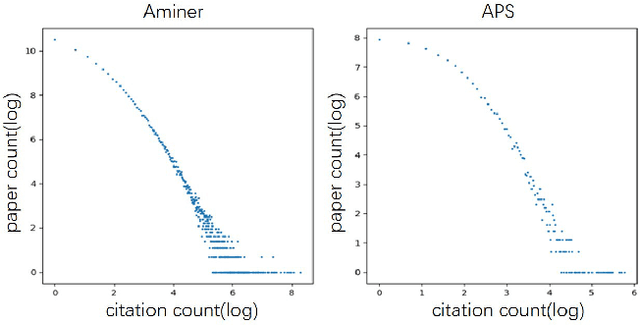

Accurate citation count prediction of newly published papers could help editors and readers rapidly figure out the influential papers in the future. Though many approaches are proposed to predict a paper's future citation, most ignore the dynamic heterogeneous graph structure or node importance in academic networks. To cope with this problem, we propose a Dynamic heterogeneous Graph and Node Importance network (DGNI) learning framework, which fully leverages the dynamic heterogeneous graph and node importance information to predict future citation trends of newly published papers. First, a dynamic heterogeneous network embedding module is provided to capture the dynamic evolutionary trends of the whole academic network. Then, a node importance embedding module is proposed to capture the global consistency relationship to figure out each paper's node importance. Finally, the dynamic evolutionary trend embeddings and node importance embeddings calculated above are combined to jointly predict the future citation counts of each paper, by a log-normal distribution model according to multi-faced paper node representations. Extensive experiments on two large-scale datasets demonstrate that our model significantly improves all indicators compared to the SOTA models.
VLSI Mask Optimization: From Shallow To Deep Learning
Dec 16, 2019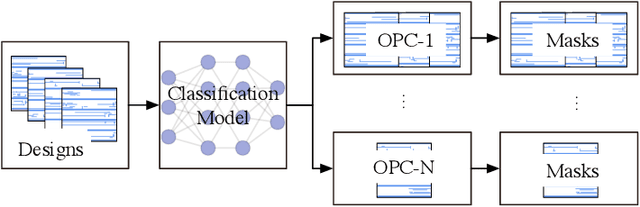
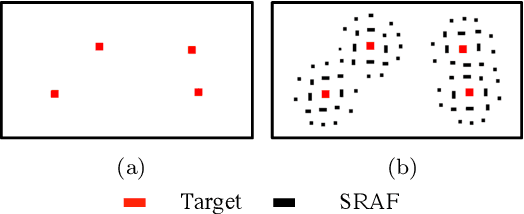
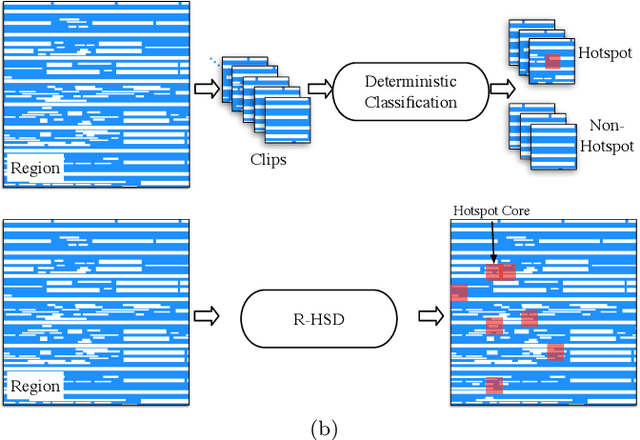
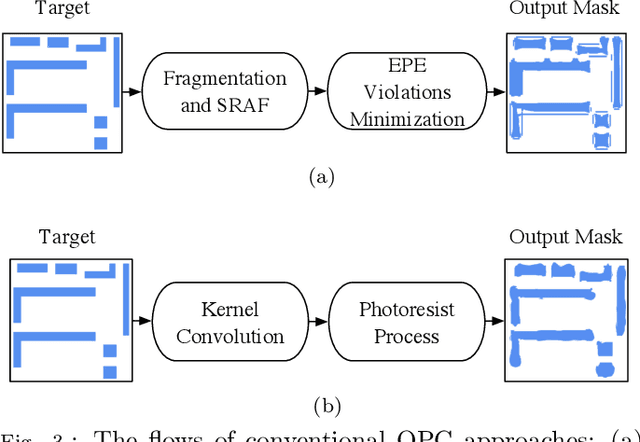
VLSI mask optimization is one of the most critical stages in manufacturability aware design, which is costly due to the complicated mask optimization and lithography simulation. Recent researches have shown prominent advantages of machine learning techniques dealing with complicated and big data problems, which bring potential of dedicated machine learning solution for DFM problems and facilitate the VLSI design cycle. In this paper, we focus on a heterogeneous OPC framework that assists mask layout optimization. Preliminary results show the efficiency and effectiveness of proposed frameworks that have the potential to be alternatives to existing EDA solutions.