 Add to Chrome
 Add to Firefox
 Add to Edge
Gen2Balance: Generative Balancing for Long-Tailed Video Action Recognition
Jun 21, 2026
We address the problem of training on long-tailed data for video action recognition. We propose to augment the training set using a text-to-video generative model, conditioned on diverse text prompts grounded in action profiles and training exemplars. Our approach, called Gen2Balance, converts an imbalanced training set into a balanced combination of real and generated video clips. To effectively learn from such data, we employ a two-stage training strategy that mitigates domain shift and yields significant improvements. We evaluate on long-tailed versions of standard benchmarks: UCF-101 (UCF-LT) and a 100-class subset of Kinetics (K100-LT) selected to prioritise temporally challenging actions. Gen2Balance improves accuracy over the strongest baselines for long-tailed learning by 5.1% and 7.0% on the respective datasets. On rare actions from the RareAct dataset (e.g., cut keyboard), Gen2Balance improves accuracy by 31.9%, demonstrating effectiveness for scarce actions. By varying the amount of synthetic data added, we show that partial balancing already achieves 79% of the performance gains at 27% of the compute cost on K100-LT, highlighting the practical scalability of Gen2Balance.

The Indra Representation Hypothesis for Multimodal Alignment
Apr 06, 2026Recent studies have uncovered an interesting phenomenon: unimodal foundation models tend to learn convergent representations, regardless of differences in architecture, training objectives, or data modalities. However, these representations are essentially internal abstractions of samples that characterize samples independently, leading to limited expressiveness. In this paper, we propose The Indra Representation Hypothesis, inspired by the philosophical metaphor of Indra's Net. We argue that representations from unimodal foundation models are converging to implicitly reflect a shared relational structure underlying reality, akin to the relational ontology of Indra's Net. We formalize this hypothesis using the V-enriched Yoneda embedding from category theory, defining the Indra representation as a relational profile of each sample with respect to others. This formulation is shown to be unique, complete, and structure-preserving under a given cost function. We instantiate the Indra representation using angular distance and evaluate it in cross-model and cross-modal scenarios involving vision, language, and audio. Extensive experiments demonstrate that Indra representations consistently enhance robustness and alignment across architectures and modalities, providing a theoretically grounded and practical framework for training-free alignment of unimodal foundation models. Our code is available at https://github.com/Jianglin954/Indra.
Seeing Through Words: Controlling Visual Retrieval Quality with Language Models
Feb 24, 2026Text-to-image retrieval is a fundamental task in vision-language learning, yet in real-world scenarios it is often challenged by short and underspecified user queries. Such queries are typically only one or two words long, rendering them semantically ambiguous, prone to collisions across diverse visual interpretations, and lacking explicit control over the quality of retrieved images. To address these issues, we propose a new paradigm of quality-controllable retrieval, which enriches short queries with contextual details while incorporating explicit notions of image quality. Our key idea is to leverage a generative language model as a query completion function, extending underspecified queries into descriptive forms that capture fine-grained visual attributes such as pose, scene, and aesthetics. We introduce a general framework that conditions query completion on discretized quality levels, derived from relevance and aesthetic scoring models, so that query enrichment is not only semantically meaningful but also quality-aware. The resulting system provides three key advantages: 1) flexibility, it is compatible with any pretrained vision-language model (VLMs) without modification; 2) transparency, enriched queries are explicitly interpretable by users; and 3) controllability, enabling retrieval results to be steered toward user-preferred quality levels. Extensive experiments demonstrate that our proposed approach significantly improves retrieval results and provides effective quality control, bridging the gap between the expressive capacity of modern VLMs and the underspecified nature of short user queries. Our code is available at https://github.com/Jianglin954/QCQC.
RetouchIQ: MLLM Agents for Instruction-Based Image Retouching with Generalist Reward
Feb 19, 2026Recent advances in multimodal large language models (MLLMs) have shown great potential for extending vision-language reasoning to professional tool-based image editing, enabling intuitive and creative editing. A promising direction is to use reinforcement learning (RL) to enable MLLMs to reason about and execute optimal tool-use plans within professional image-editing software. However, training remains challenging due to the lack of reliable, verifiable reward signals that can reflect the inherently subjective nature of creative editing. In this work, we introduce RetouchIQ, a framework that performs instruction-based executable image editing through MLLM agents guided by a generalist reward model. RetouchIQ interprets user-specified editing intentions and generates corresponding, executable image adjustments, bridging high-level aesthetic goals with precise parameter control. To move beyond conventional, rule-based rewards that compute similarity against a fixed reference image using handcrafted metrics, we propose a generalist reward model, an RL fine-tuned MLLM that evaluates edited results through a set of generated metrics on a case-by-case basis. Then, the reward model provides scalar feedback through multimodal reasoning, enabling reinforcement learning with high-quality, instruction-consistent gradients. We curate an extended dataset with 190k instruction-reasoning pairs and establish a new benchmark for instruction-based image editing. Experiments show that RetouchIQ substantially improves both semantic consistency and perceptual quality over previous MLLM-based and diffusion-based editing systems. Our findings demonstrate the potential of generalist reward-driven MLLM agents as flexible, explainable, and executable assistants for professional image editing.
Stress Tests REVEAL Fragile Temporal and Visual Grounding in Video-Language Models
Feb 11, 2026This work investigates a fundamental question: Do Video-Language Models (VidLMs) robustly account for video content, temporal sequence, and motion? Our investigation shows that, surprisingly, they often do not. We introduce REVEAL{}, a diagnostic benchmark that probes fundamental weaknesses of contemporary VidLMs through five controlled stress tests; assessing temporal expectation bias, reliance on language-only shortcuts, video sycophancy, camera motion sensitivity, and robustness to spatiotemporal occlusion. We test leading open- and closed-source VidLMs and find that these models confidently describe reversed scenes as forward, answer questions while neglecting video content, agree with false claims, struggle with basic camera motion, and fail to aggregate temporal information amidst simple spatiotemporal masking. Humans, on the other hand, succeed at these tasks with ease. Alongside our benchmark, we provide a data pipeline that automatically generates diagnostic examples for our stress tests, enabling broader and more scalable evaluation. We will release our benchmark and code to support future research.
More Than the Final Answer: Improving Visual Extraction and Logical Consistency in Vision-Language Models
Dec 13, 2025Reinforcement learning from verifiable rewards (RLVR) has recently been extended from text-only LLMs to vision-language models (VLMs) to elicit long-chain multimodal reasoning. However, RLVR-trained VLMs still exhibit two persistent failure modes: inaccurate visual extraction (missing or hallucinating details) and logically inconsistent chains-of-thought, largely because verifiable signals supervise only the final answer. We propose PeRL-VL (Perception and Reasoning Learning for Vision-Language Models), a decoupled framework that separately improves visual perception and textual reasoning on top of RLVR. For perception, PeRL-VL introduces a VLM-based description reward that scores the model's self-generated image descriptions for faithfulness and sufficiency. For reasoning, PeRL-VL adds a text-only Reasoning SFT stage on logic-rich chain-of-thought data, enhancing coherence and logical consistency independently of vision. Across diverse multimodal benchmarks, PeRL-VL improves average Pass@1 accuracy from 63.3% (base Qwen2.5-VL-7B) to 68.8%, outperforming standard RLVR, text-only reasoning SFT, and naive multimodal distillation from GPT-4o.
FRAME: Pre-Training Video Feature Representations via Anticipation and Memory
Jun 05, 2025Dense video prediction tasks, such as object tracking and semantic segmentation, require video encoders that generate temporally consistent, spatially dense features for every frame. However, existing approaches fall short: image encoders like DINO or CLIP lack temporal awareness, while video models such as VideoMAE underperform compared to image encoders on dense prediction tasks. We address this gap with FRAME, a self-supervised video frame encoder tailored for dense video understanding. FRAME learns to predict current and future DINO patch features from past and present RGB frames, leading to spatially precise and temporally coherent representations. To our knowledge, FRAME is the first video encoder to leverage image-based models for dense prediction while outperforming them on tasks requiring fine-grained visual correspondence. As an auxiliary capability, FRAME aligns its class token with CLIP's semantic space, supporting language-driven tasks such as video classification. We evaluate FRAME across six dense prediction tasks on seven datasets, where it consistently outperforms image encoders and existing self-supervised video models. Despite its versatility, FRAME maintains a compact architecture suitable for a range of downstream applications.
MAGNET: Augmenting Generative Decoders with Representation Learning and Infilling Capabilities
Jan 15, 2025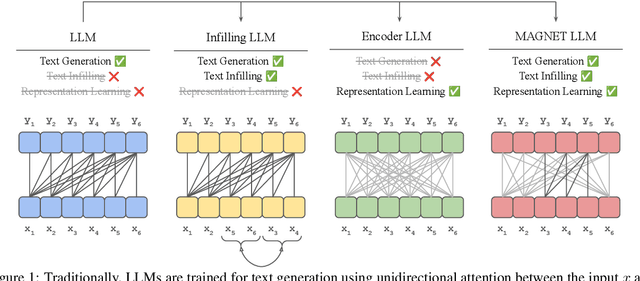
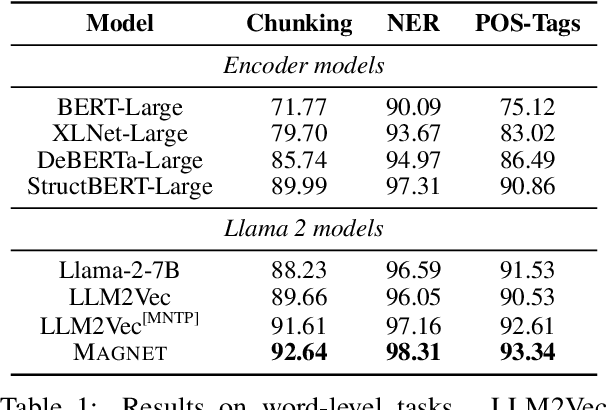
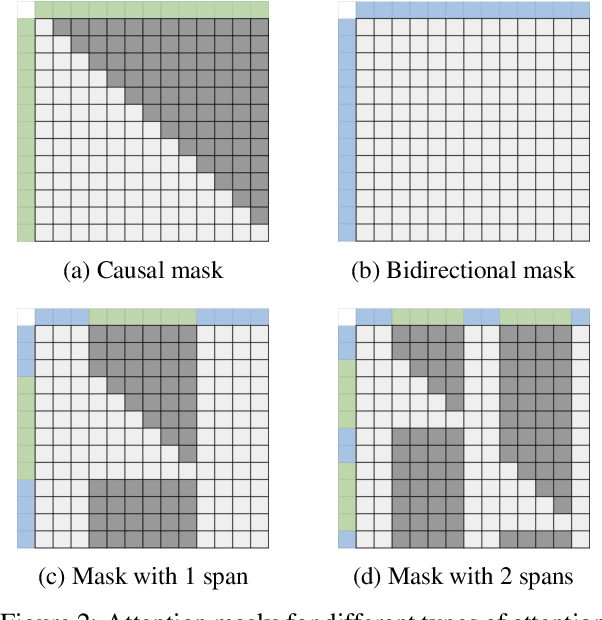
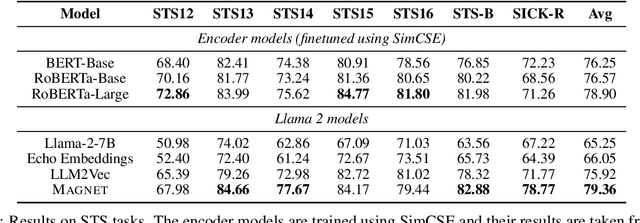
While originally designed for unidirectional generative modeling, decoder-only large language models (LLMs) are increasingly being adapted for bidirectional modeling. However, unidirectional and bidirectional models are typically trained separately with distinct objectives (generation and representation learning, respectively). This separation overlooks the opportunity for developing a more versatile language model and for these objectives to complement each other. In this work, we introduce MAGNET, an adaptation of decoder-only LLMs that enhances their ability to generate robust representations and infill missing text spans, while preserving their knowledge and text generation capabilities. MAGNET employs three self-supervised training objectives and introduces an attention mechanism that combines bidirectional and causal attention, enabling unified training across all objectives. Our results demonstrate that LLMs adapted with MAGNET (1) surpass strong text encoders on token-level and sentence-level representation learning tasks, (2) generate contextually appropriate text infills by leveraging future context, (3) retain the ability for open-ended text generation without exhibiting repetition problem, and (4) preserve the knowledge gained by the LLM during pretraining.
Sync from the Sea: Retrieving Alignable Videos from Large-Scale Datasets
Sep 02, 2024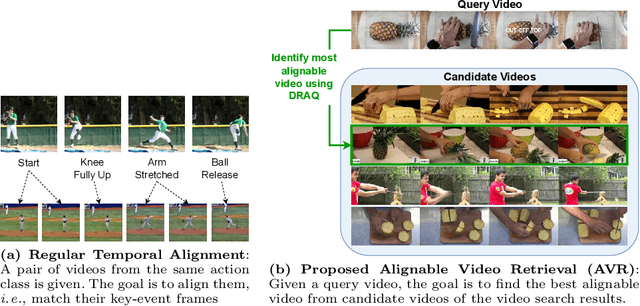
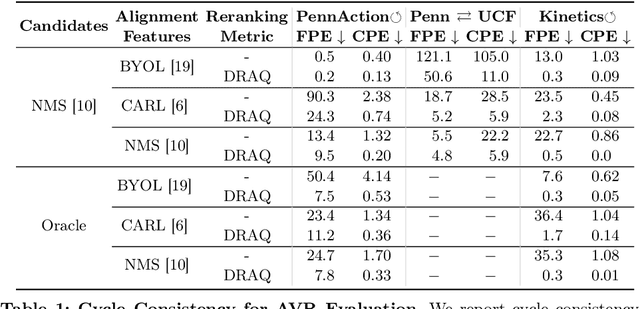
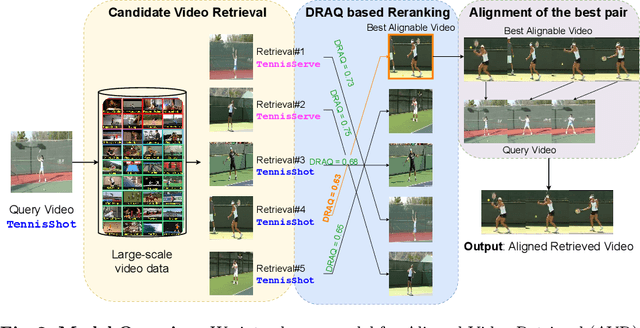
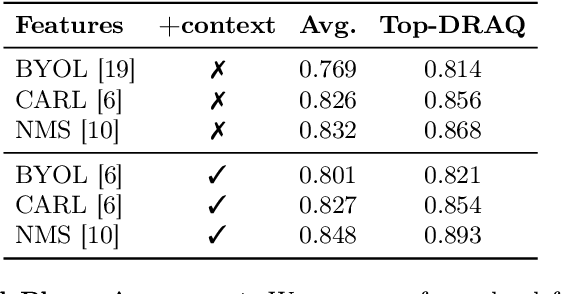
Temporal video alignment aims to synchronize the key events like object interactions or action phase transitions in two videos. Such methods could benefit various video editing, processing, and understanding tasks. However, existing approaches operate under the restrictive assumption that a suitable video pair for alignment is given, significantly limiting their broader applicability. To address this, we re-pose temporal alignment as a search problem and introduce the task of Alignable Video Retrieval (AVR). Given a query video, our approach can identify well-alignable videos from a large collection of clips and temporally synchronize them to the query. To achieve this, we make three key contributions: 1) we introduce DRAQ, a video alignability indicator to identify and re-rank the best alignable video from a set of candidates; 2) we propose an effective and generalizable frame-level video feature design to improve the alignment performance of several off-the-shelf feature representations, and 3) we propose a novel benchmark and evaluation protocol for AVR using cycle-consistency metrics. Our experiments on 3 datasets, including large-scale Kinetics700, demonstrate the effectiveness of our approach in identifying alignable video pairs from diverse datasets. Project Page: https://daveishan.github.io/avr-webpage/.
FINEMATCH: Aspect-based Fine-grained Image and Text Mismatch Detection and Correction
Apr 23, 2024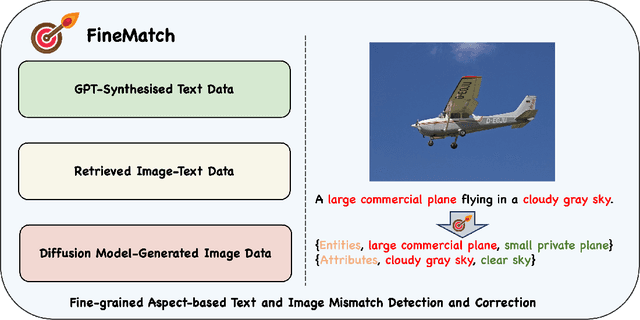

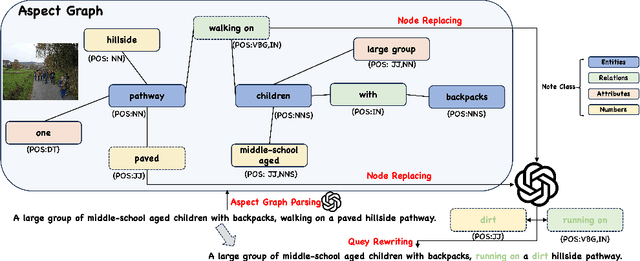
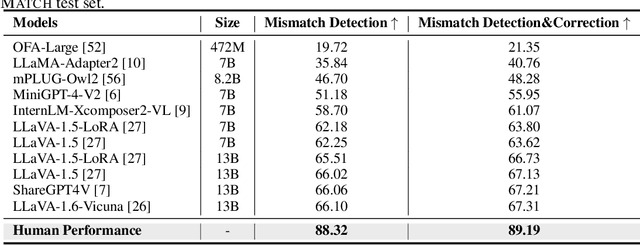
Recent progress in large-scale pre-training has led to the development of advanced vision-language models (VLMs) with remarkable proficiency in comprehending and generating multimodal content. Despite the impressive ability to perform complex reasoning for VLMs, current models often struggle to effectively and precisely capture the compositional information on both the image and text sides. To address this, we propose FineMatch, a new aspect-based fine-grained text and image matching benchmark, focusing on text and image mismatch detection and correction. This benchmark introduces a novel task for boosting and evaluating the VLMs' compositionality for aspect-based fine-grained text and image matching. In this task, models are required to identify mismatched aspect phrases within a caption, determine the aspect's class, and propose corrections for an image-text pair that may contain between 0 and 3 mismatches. To evaluate the models' performance on this new task, we propose a new evaluation metric named ITM-IoU for which our experiments show a high correlation to human evaluation. In addition, we also provide a comprehensive experimental analysis of existing mainstream VLMs, including fully supervised learning and in-context learning settings. We have found that models trained on FineMatch demonstrate enhanced proficiency in detecting fine-grained text and image mismatches. Moreover, models (e.g., GPT-4V, Gemini Pro Vision) with strong abilities to perform multimodal in-context learning are not as skilled at fine-grained compositional image and text matching analysis. With FineMatch, we are able to build a system for text-to-image generation hallucination detection and correction.