 Add to Chrome
 Add to Firefox
 Add to Edge
Edge-Constrained UAV Small-Object Detection with P2 Enhancement and Quantum-Inspired Lightweight Structure Search
Jun 08, 2026
Unmanned aerial vehicle (UAV) object detection requires compact detectors that retain small-object details under onboard computation and memory constraints. Repeated downsampling inlightweight networks weakens shallow spatial information, while manually adding attention orfusion modules may increase cost without stable gains. This study analyzes YOLOX-Nano underedge-deployment constraints by combining a P2 high-resolution detection branch with a quantum-inspired evolutionary algorithm (QIEA) for lightweight structure screening. The search space isdefined by lightweight priority and task specificity, and the evaluation jointly considers accuracy,floating-point operations (FLOPs), latency, memory consumption, and recall. On VisDrone, theP2 branch increases APamall by 31.10% over the YOLOX-Nano baseline. Compared with NanoDet-Plus with similar model size, YOLOX-Nano+-P2 improves APs0.ss by 17.5% and APamal by 44.9%.The QIEA-selected candidate obtains the highest Recallso, but +P2 remains the strongest AP-oriented variant after full training. Full 100-epoch verification of Random-best, GA-best, andSA/QUBO-best candidates further shows that proxy rankings do not necessarily transfer to finalAPse9s. These results support using P2 as the main small-object enhancement path and QIEA as alightweight tool for candidate screening and accuracy-cost analysis. The source code, configurationfiles, diagnostic scripts, and summarized results are available at https://github.com/Ming23233/UAV-QIEA-Edge-Detection

SagnacAssisted Enhanced OTDR for Distributed Acoustic Sensing: A Standardized Benchmark and Engineering Evaluation Framework
Jun 04, 2026Phase-sensitive optical time-domain reflectometry ($φ$-OTDR) is widely used in large-scale distributed acoustic sensing (DAS) because it provides distributed spatiotemporal monitoring over long sensing distances. Its field performance can still deteriorate because of polarization-induced fading (PIF), local signal degradation, and strong environmental interference. This study develops a Sagnac-assisted enhanced $φ$-OTDR sensing architecture and a standardized benchmark framework for engineering-oriented DAS event recognition. The Sagnac interferometer provides a continuous phase response that supplements fading-prone observations in the $φ$-OTDR channel, and heterogeneous signal alignment is achieved using a cross-correlation procedure implemented on an FPGA platform. The benchmark protocol compares conventional feature-engineering methods, probabilistic shallow classifiers, single-branch deep models, and dual-branch fusion models under consistent data partitioning, preprocessing, and metric definitions. Experiments on a 10-km sensing fiber with six representative acoustic event classes show that the dual-branch fusion model provides the most favorable trade-off among the evaluated methods, reaching 89.79\% accuracy, 89.83\% macro-F1, and a nuisance alarm rate of 5.00\% on the balanced test set. The results also show that channel grouping strongly affects dual-branch evaluation, indicating that deployment-oriented conclusions should be based on accuracy, macro-F1, nuisance alarm rate, false negative rate, and latency rather than accuracy alone. This work provides a physically motivated enhancement strategy for $φ$-OTDR-based DAS and a reproducible benchmark protocol for future fusion-oriented sensing research. The implementation and scripts for reproducing the DAS event-recognition experiments are publicly available at https://github.com/wawa-abc/das.
Coordinated optimization of departure sequencing and section-track allocation in railway short-term concentrated departure scenarios based on qubo and hybrid quantum algorithms
Jun 04, 2026This study examines the coordinated optimization of departure sequencing and section-track allocation in railway short-term concentrated departure scenarios. A quadratic unconstrained binary optimization (QUBO) model is formulated to represent departure-position assignment and section-track selection within a unified binary framework. Because the quality of a dispatching scheme depends on time-dependent operational interactions that cannot be fully captured by a static combinatorial model, a simulation-based evaluation layer is introduced to assess section occupation, intermediate-station waiting, platform-capacity pressure, running-time fluctuations, and delay propagation. Within this layered framework, conventional heuristics, quantum-inspired algorithms, and hybrid algorithms are compared on the same decision structure. The results show that the QUBO model can generate feasible candidate schemes after decoding, while the simulation layer clearly differentiates the operational performance of the competing algorithms under both normal and disturbed conditions. In the tested scenarios, QPSO-QAOA performs best under normal conditions, and the quantum-enhanced methods reduce comprehensive cost by 4.28\%--26.26\% and total delay by 4.37\%--24.25\% on average under dynamic conditions relative to their conventional counterparts. These findings suggest that the integration of QUBO-based modeling and simulation-based evaluation provides a useful methodological framework for railway short-term concentrated departure scheduling, although validation with real operational data remains necessary.
Machine Learning methods for event classification and vertex reconstruction of the 12C + 12C reaction with the MATE-TPC
May 27, 2026In modern nuclear physics experiments, identifying events of interest is challenging for nuclear reaction studies with the active target Time Projection Chamber (TPC). In this work, machine learning techniques are employed to analyze the complex data of the 12C + 12C fusion reaction from a TPC named MATE (multi-purpose active-target time projection chamber for nuclear experiments). Specifically, we successfully applied Residual Neural Network (ResNet-50, ResNet-34 and ResNet-18) and Visual Geometry Group (VGG-19) to classify elastic scattering and fusion reaction events from the 12C + 12C reaction. The classification results of the four models are nearly identical, with accuracies of approximately 97% for the simulated data and 90% for the experimental data. Moreover, these approaches successfully identify some events that are misclassified by traditional methods. These models are also applied to classify events from different fusion reaction channels, with classification accuracies of approximately 95% on simulated data. In addition, a Convolutional Neural Network (CNN) model is developed to reconstruct the reaction vertex, providing an alternative strategy for vertex reconstruction. These results indicate that machine learning techniques can effectively classify reaction events from different channels and reconstruct the reaction vertex, thereby paving the way for future analyses of complex nuclear reaction data.
Understanding and Improving UMAP with Geometric and Topological Priors: The JORC-UMAP Algorithm
Jan 23, 2026Nonlinear dimensionality reduction techniques, particularly UMAP, are widely used for visualizing high-dimensional data. However, UMAP's local Euclidean distance assumption often fails to capture intrinsic manifold geometry, leading to topological tearing and structural collapse. We identify UMAP's sensitivity to the k-nearest neighbor graph as a key cause. To address this, we introduce Ollivier-Ricci curvature as a geometric prior, reinforcing edges at geometric bottlenecks and reducing redundant links. Since curvature estimation is noise-sensitive, we also incorporate a topological prior using Jaccard similarity to ensure neighborhood consistency. The resulting method, JORC-UMAP, better distinguishes true manifold structure from spurious connections. Experiments on synthetic and real-world datasets show that JORC-UMAP reduces tearing and collapse more effectively than standard UMAP and other DR methods, as measured by SVM accuracy and triplet preservation scores, while maintaining computational efficiency. This work offers a geometry-aware enhancement to UMAP for more faithful data visualization.
ELBO-T2IAlign: A Generic ELBO-Based Method for Calibrating Pixel-level Text-Image Alignment in Diffusion Models
Jun 11, 2025Diffusion models excel at image generation. Recent studies have shown that these models not only generate high-quality images but also encode text-image alignment information through attention maps or loss functions. This information is valuable for various downstream tasks, including segmentation, text-guided image editing, and compositional image generation. However, current methods heavily rely on the assumption of perfect text-image alignment in diffusion models, which is not the case. In this paper, we propose using zero-shot referring image segmentation as a proxy task to evaluate the pixel-level image and class-level text alignment of popular diffusion models. We conduct an in-depth analysis of pixel-text misalignment in diffusion models from the perspective of training data bias. We find that misalignment occurs in images with small sized, occluded, or rare object classes. Therefore, we propose ELBO-T2IAlign, a simple yet effective method to calibrate pixel-text alignment in diffusion models based on the evidence lower bound (ELBO) of likelihood. Our method is training-free and generic, eliminating the need to identify the specific cause of misalignment and works well across various diffusion model architectures. Extensive experiments on commonly used benchmark datasets on image segmentation and generation have verified the effectiveness of our proposed calibration approach.
GLHF: General Learned Evolutionary Algorithm Via Hyper Functions
May 06, 2024Pretrained Optimization Models (POMs) leverage knowledge gained from optimizing various tasks, providing efficient solutions for new optimization challenges through direct usage or fine-tuning. Despite the inefficiencies and limited generalization abilities observed in current POMs, our proposed model, the general pre-trained optimization model (GPOM), addresses these shortcomings. GPOM constructs a population-based pretrained Black-Box Optimization (BBO) model tailored for continuous optimization. Evaluation on the BBOB benchmark and two robot control tasks demonstrates that GPOM outperforms other pretrained BBO models significantly, especially for high-dimensional tasks. Its direct optimization performance exceeds that of state-of-the-art evolutionary algorithms and POMs. Furthermore, GPOM exhibits robust generalization capabilities across diverse task distributions, dimensions, population sizes, and optimization horizons.
B2Opt: Learning to Optimize Black-box Optimization with Little Budget
Apr 24, 2023Learning to optimize (L2O) has emerged as a powerful framework for black-box optimization (BBO). L2O learns the optimization strategies from the target task automatically without human intervention. This paper focuses on obtaining better performance when handling high-dimensional and expensive BBO with little function evaluation cost, which is the core challenge of black-box optimization. However, current L2O-based methods are weak for this due to a large number of evaluations on expensive black-box functions during training and poor representation of optimization strategy. To achieve this, 1) we utilize the cheap surrogate functions of the target task to guide the design of the optimization strategies; 2) drawing on the mechanism of evolutionary algorithm (EA), we propose a novel framework called B2Opt, which has a stronger representation of optimization strategies. Compared to the BBO baselines, B2Opt can achieve 3 to $10^6$ times performance improvement with less function evaluation cost. We test our proposal in high-dimensional synthetic functions and two real-world applications. We also find that deep B2Opt performs better than shallow ones.
Robustness-aware 2-bit quantization with real-time performance for neural network
Oct 19, 2020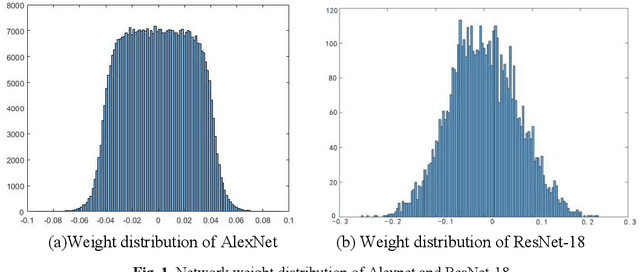
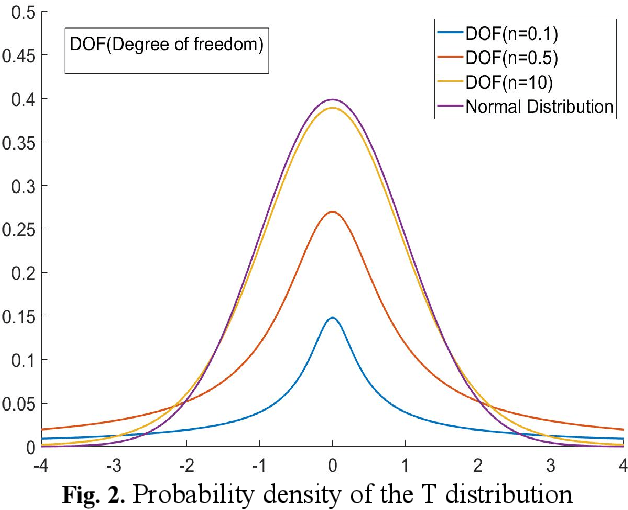
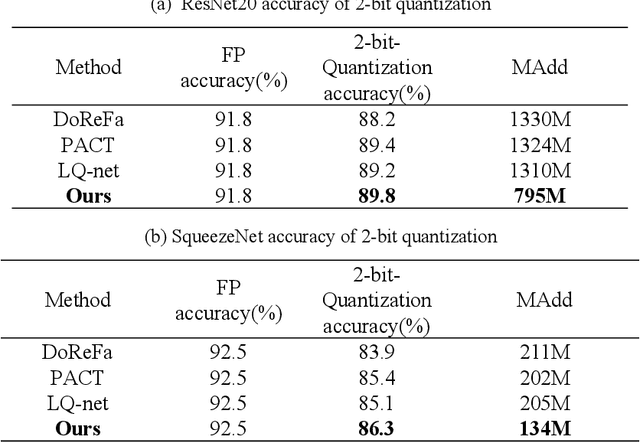
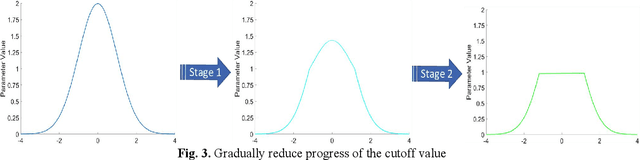
Quantized neural network (NN) with a reduced bit precision is an effective solution to reduces the computational and memory resource requirements and plays a vital role in machine learning. However, it is still challenging to avoid the significant accuracy degradation due to its numerical approximation and lower redundancy. In this paper, a novel robustness-aware 2-bit quantization scheme is proposed for NN base on binary NN and generative adversarial network(GAN), witch improves the performance by enriching the information of binary NN, efficiently extract the structural information and considering the robustness of the quantized NN. Specifically, using shift addition operation to replace the multiply-accumulate in the quantization process witch can effectively speed the NN. Meanwhile, a structural loss between the original NN and quantized NN is proposed to such that the structural information of data is preserved after quantization. The structural information learned from NN not only plays an important role in improving the performance but also allows for further fine tuning of the quantization network by applying the Lipschitz constraint to the structural loss. In addition, we also for the first time take the robustness of the quantized NN into consideration and propose a non-sensitive perturbation loss function by introducing an extraneous term of spectral norm. The experiments are conducted on CIFAR-10 and ImageNet datasets with popular NN( such as MoblieNetV2, SqueezeNet, ResNet20, etc). The experimental results show that the proposed algorithm is more competitive under 2-bit-precision than the state-of-the-art quantization methods. Meanwhile, the experimental results also demonstrate that the proposed method is robust under the FGSM adversarial samples attack.