 Add to Chrome
 Add to Firefox
 Add to Edge
Compressive Sensing-Based Grant-Free Massive Access for 6G Massive Communication
Nov 12, 2023
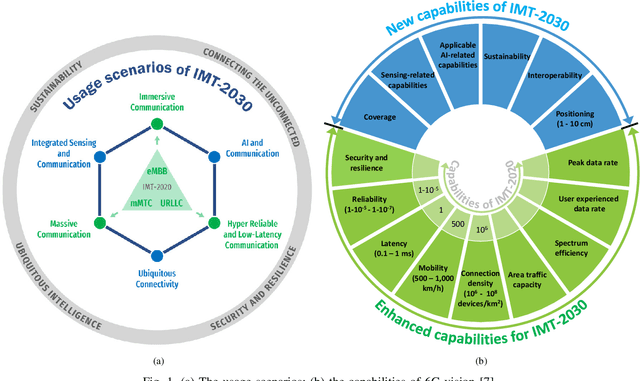
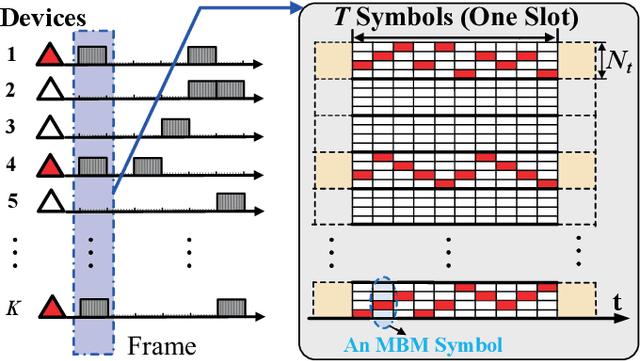
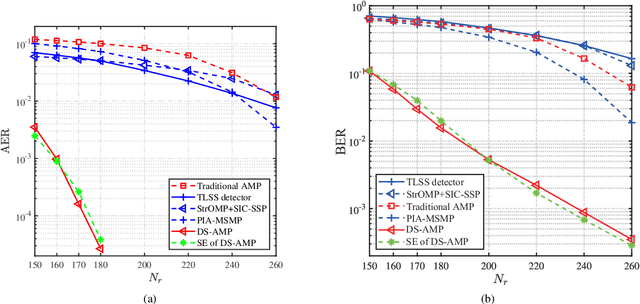
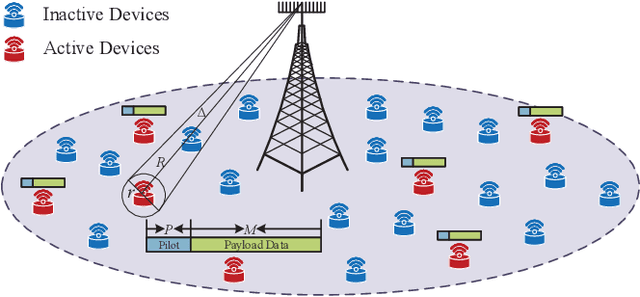
The advent of the sixth-generation (6G) of wireless communications has given rise to the necessity to connect vast quantities of heterogeneous wireless devices, which requires advanced system capabilities far beyond existing network architectures. In particular, such massive communication has been recognized as a prime driver that can empower the 6G vision of future ubiquitous connectivity, supporting Internet of Human-Machine-Things for which massive access is critical. This paper surveys the most recent advances toward massive access in both academic and industry communities, focusing primarily on the promising compressive sensing-based grant-free massive access paradigm. We first specify the limitations of existing random access schemes and reveal that the practical implementation of massive communication relies on a dramatically different random access paradigm from the current ones mainly designed for human-centric communications. Then, a compressive sensing-based grant-free massive access roadmap is presented, where the evolutions from single-antenna to large-scale antenna array-based base stations, from single-station to cooperative massive multiple-input multiple-output systems, and from unsourced to sourced random access scenarios are detailed. Finally, we discuss the key challenges and open issues to shed light on the potential future research directions of grant-free massive access.

Deep Learning Assisted Multiuser MIMO Load Modulated Systems for Enhanced Downlink mmWave Communications
Nov 08, 2023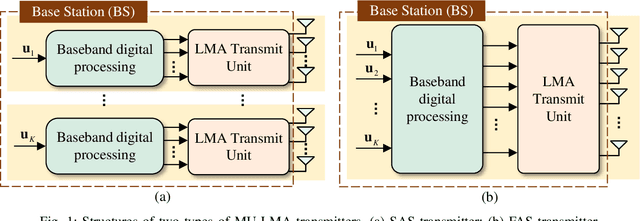
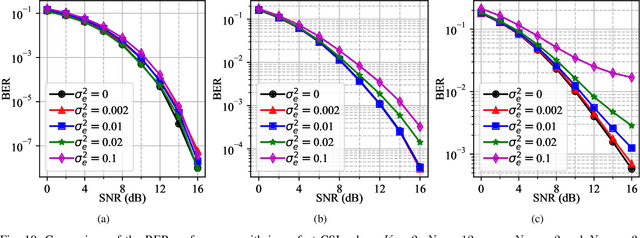
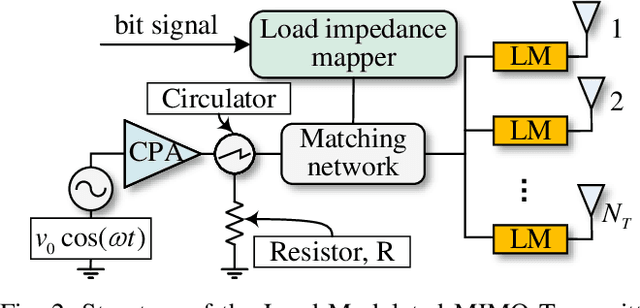
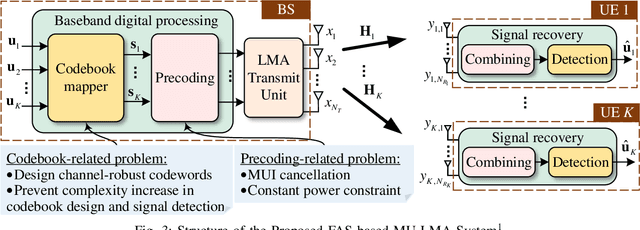
This paper is focused on multiuser load modulation arrays (MU-LMAs) which are attractive due to their low system complexity and reduced cost for millimeter wave (mmWave) multi-input multi-output (MIMO) systems. The existing precoding algorithm for downlink MU-LMA relies on a sub-array structured (SAS) transmitter which may suffer from decreased degrees of freedom and complex system configuration. Furthermore, a conventional LMA codebook with codewords uniformly distributed on a hypersphere may not be channel-adaptive and may lead to increased signal detection complexity. In this paper, we conceive an MU-LMA system employing a full-array structured (FAS) transmitter and propose two algorithms accordingly. The proposed FAS-based system addresses the SAS structural problems and can support larger numbers of users. For LMA-imposed constant-power downlink precoding, we propose an FAS-based normalized block diagonalization (FAS-NBD) algorithm. However, the forced normalization may result in performance degradation. This degradation, together with the aforementioned codebook design problems, is difficult to solve analytically. This motivates us to propose a Deep Learning-enhanced (FAS-DL-NBD) algorithm for adaptive codebook design and codebook-independent decoding. It is shown that the proposed algorithms are robust to imperfect knowledge of channel state information and yield excellent error performance. Moreover, the FAS-DL-NBD algorithm enables signal detection with low complexity as the number of bits per codeword increases.
Federated Learning via Active RIS Assisted Over-the-Air Computation
Nov 07, 2023In this paper, we propose leveraging the active reconfigurable intelligence surface (RIS) to support reliable gradient aggregation for over-the-air computation (AirComp) enabled federated learning (FL) systems. An analysis of the FL convergence property reveals that minimizing gradient aggregation errors in each training round is crucial for narrowing the convergence gap. As such, we formulate an optimization problem, aiming to minimize these errors by jointly optimizing the transceiver design and RIS configuration. To handle the formulated highly non-convex problem, we devise a two-layer alternative optimization framework to decompose it into several convex subproblems, each solvable optimally. Simulation results demonstrate the superiority of the active RIS in reducing gradient aggregation errors compared to its passive counterpart.
Utilizing Imperfect Resolution of Near-Field Beamforming: A Hybrid-NOMA Perspective
Nov 04, 2023This letter studies how the imperfect resolution of near-field beamforming, the key feature of near-field communications, can be used to improve the throughput and connectivity of wireless networks. In particular, a hybrid non-orthogonal multiple access (NOMA) transmission strategy is developed to use preconfigured near-field beams for serving additional users. An energy consumption minimization problem is first formulated and then solved by using different successive interference cancellation strategies. Both analytical and simulation results are presented to illustrate the impact of the resolution of near-field beamforming on the design of hybrid NOMA transmission.
Stacked Intelligent Metasurface Performs a 2D DFT in the Wave Domain for DOA Estimation
Oct 15, 2023Staked intelligent metasurface (SIM) based techniques are developed to perform two-dimensional (2D) direction-of-arrival (DOA) estimation. In contrast to the conventional designs, an advanced SIM in front of the receiving array automatically performs the 2D discrete Fourier transform (DFT) as the incident waves propagate through it. To arrange for the SIM to carry out this task, we design a gradient descent algorithm for iteratively updating the phase shift of each meta-atom in the SIM to minimize the fitting error between the SIM's response and the 2D DFT matrix. To further improve the DOA estimation accuracy, we configure the phase shifts in the input layer of SIM to generate a set of 2D DFT matrices having orthogonal spatial frequency bins. Extensive numerical simulations verify the capability of a well-trained SIM to perform 2D DFT. Specifically, it is demonstrated that the SIM having an optical computational speed achieves an MSE of $10^{-4}$ in 2D DOA estimation.
IRS Assisted Federated Learning A Broadband Over-the-Air Aggregation Approach
Oct 11, 2023We consider a broadband over-the-air computation empowered model aggregation approach for wireless federated learning (FL) systems and propose to leverage an intelligent reflecting surface (IRS) to combat wireless fading and noise. We first investigate the conventional node-selection based framework, where a few edge nodes are dropped in model aggregation to control the aggregation error. We analyze the performance of this node-selection based framework and derive an upper bound on its performance loss, which is shown to be related to the selected edge nodes. Then, we seek to minimize the mean-squared error (MSE) between the desired global gradient parameters and the actually received ones by optimizing the selected edge nodes, their transmit equalization coefficients, the IRS phase shifts, and the receive factors of the cloud server. By resorting to the matrix lifting technique and difference-of-convex programming, we successfully transform the formulated optimization problem into a convex one and solve it using off-the-shelf solvers. To improve learning performance, we further propose a weight-selection based FL framework. In such a framework, we assign each edge node a proper weight coefficient in model aggregation instead of discarding any of them to reduce the aggregation error, i.e., amplitude alignment of the received local gradient parameters from different edge nodes is not required. We also analyze the performance of this weight-selection based framework and derive an upper bound on its performance loss, followed by minimizing the MSE via optimizing the weight coefficients of the edge nodes, their transmit equalization coefficients, the IRS phase shifts, and the receive factors of the cloud server. Furthermore, we use the MNIST dataset for simulations to evaluate the performance of both node-selection and weight-selection based FL frameworks.
NOMA-Based Coexistence of Near-Field and Far-Field Massive MIMO Communications
Sep 17, 2023This letter considers a legacy massive multiple-input multiple-output (MIMO) network, in which spatial beams have been preconfigured for near-field users, and proposes to use the non-orthogonal multiple access (NOMA) principle to serve additional far-field users by exploiting the spatial beams preconfigured for the legacy near-field users. Our results reveal that the coexistence between near-field and far-field communications can be effectively supported via NOMA, and that the performance of NOMA-assisted massive MIMO can be efficiently improved by increasing the number of antennas at the base station.
$L^1$ Estimation: On the Optimality of Linear Estimators
Sep 17, 2023Consider the problem of estimating a random variable $X$ from noisy observations $Y = X+ Z$, where $Z$ is standard normal, under the $L^1$ fidelity criterion. It is well known that the optimal Bayesian estimator in this setting is the conditional median. This work shows that the only prior distribution on $X$ that induces linearity in the conditional median is Gaussian. Along the way, several other results are presented. In particular, it is demonstrated that if the conditional distribution $P_{X|Y=y}$ is symmetric for all $y$, then $X$ must follow a Gaussian distribution. Additionally, we consider other $L^p$ losses and observe the following phenomenon: for $p \in [1,2]$, Gaussian is the only prior distribution that induces a linear optimal Bayesian estimator, and for $p \in (2,\infty)$, infinitely many prior distributions on $X$ can induce linearity. Finally, extensions are provided to encompass noise models leading to conditional distributions from certain exponential families.
Massive Access of Static and Mobile Users via Reconfigurable Intelligent Surfaces: Protocol Design and Performance Analysis
Sep 12, 2023


The envisioned wireless networks of the future entail the provisioning of massive numbers of connections, heterogeneous data traffic, ultra-high spectral efficiency, and low latency services. This vision is spurring research activities focused on defining a next generation multiple access (NGMA) protocol that can accommodate massive numbers of users in different resource blocks, thereby, achieving higher spectral efficiency and increased connectivity compared to conventional multiple access schemes. In this article, we present a multiple access scheme for NGMA in wireless communication systems assisted by multiple reconfigurable intelligent surfaces (RISs). In this regard, considering the practical scenario of static users operating together with mobile ones, we first study the interplay of the design of NGMA schemes and RIS phase configuration in terms of efficiency and complexity. Based on this, we then propose a multiple access framework for RIS-assisted communication systems, and we also design a medium access control (MAC) protocol incorporating RISs. In addition, we give a detailed performance analysis of the designed RIS-assisted MAC protocol. Our extensive simulation results demonstrate that the proposed MAC design outperforms the benchmarks in terms of system throughput and access fairness, and also reveal a trade-off relationship between the system throughput and fairness.
Stacked Intelligent Metasurfaces for Multiuser Downlink Beamforming in the Wave Domain
Sep 06, 2023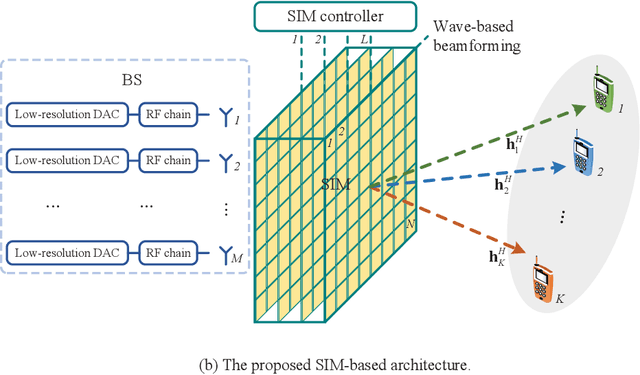
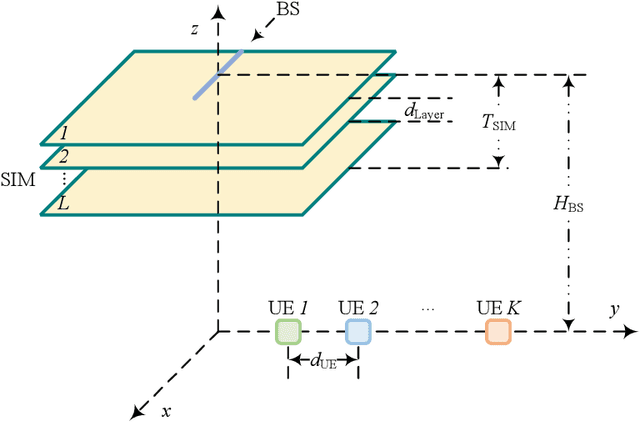
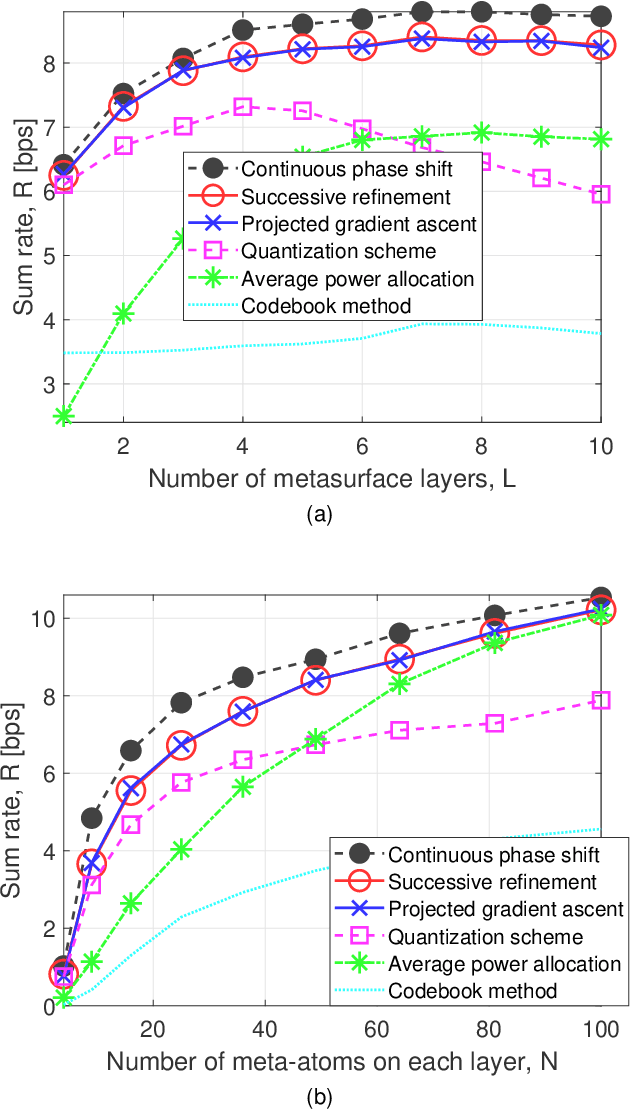
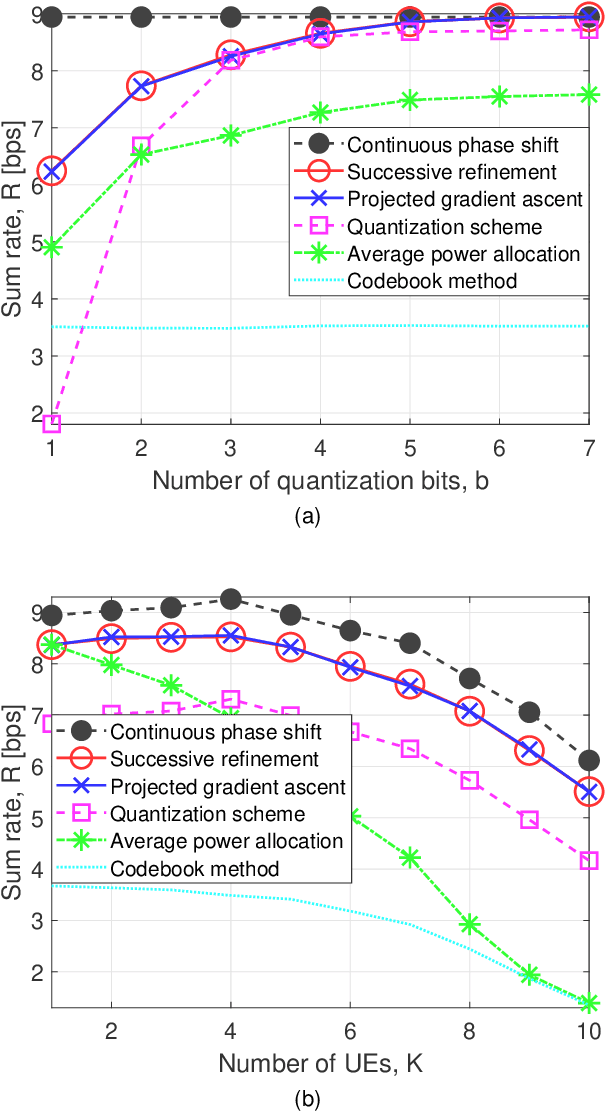
Intelligent metasurface has recently emerged as a promising technology that enables the customization of wireless environments by harnessing large numbers of inexpensive configurable scattering elements. However, prior studies have predominantly focused on single-layer metasurfaces, which have limitations in terms of the number of beam patterns they can steer accurately due to practical hardware restrictions. In contrast, this paper introduces a novel stacked intelligent metasurface (SIM) design. Specifically, we investigate the integration of SIM into the downlink of a multiuser multiple-input single-output (MISO) communication system, where a SIM, consisting of a multilayer metasurface structure, is deployed at the base station (BS) to facilitate transmit beamforming in the electromagnetic wave domain. This eliminates the need for conventional digital beamforming and high-resolution digital-to-analog converters at the BS. To this end, we formulate an optimization problem that aims to maximize the sum rate of all user equipments by jointly optimizing the transmit power allocation at the BS and the wave-based beamforming at the SIM, subject to both the transmit power budget and discrete phase shift constraints. Furthermore, we propose a computationally efficient algorithm for solving this joint optimization problem and elaborate on the potential benefits of employing SIM in wireless networks. Finally, the numerical results corroborate the effectiveness of the proposed SIM-enabled wave-based beamforming design and evaluate the performance improvement achieved by the proposed algorithm compared to various benchmark schemes. It is demonstrated that considering the same number of transmit antennas, the proposed SIM-based system achieves about 200\% improvement in terms of sum rate compared to conventional MISO systems.