 Add to Chrome
 Add to Firefox
 Add to Edge
video-SALMONN-R$^3$: Learning to ReWatch, ReAsk, and ReAnswer for Efficient Video Understanding
Jun 23, 2026
Video large language models (LLMs) are often constrained by computation and memory budgets, leading them to use reduced frame rates and spatial resolutions, which may cause them to miss critical information for question answering (QA). A practical and efficient solution is a two-stage paradigm: first perform coarse video understanding to localize relevant segments, and then re-watch these segments at higher temporal or spatial fidelity. In this paper, we present video-SALMONN-R$^3$, the first end-to-end video-LLM that enables re-watch through reinforcement learning without relying on chain-of-thought (CoT) cold-start. This design removes the need for costly CoT data annotations and avoids CoT-based supervised fine-tuning (SFT), which can otherwise degrade the pretrained video understanding abilities. To address the mismatch between the reasoning-first behavior induced by re-watch and the answer-first tendency of pretrained video-LLMs, we propose a re-answer strategy, in which the model first produces a direct answer in the first watch and then refines it after re-watching. Finally, to improve question adherence during re-watching, we propose a re-ask mechanism that re-injects the query when revisiting localized segments. Experimental results show that video-SALMONN-R$^3$ consistently outperforms both the base model and the QA-SFT baseline, while surpassing prior re-watch-based approaches with significantly lower computational cost. Code, models, and data will be publicly released upon acceptance.

video-SALMONN-o1: Reasoning-enhanced Audio-visual Large Language Model
Feb 17, 2025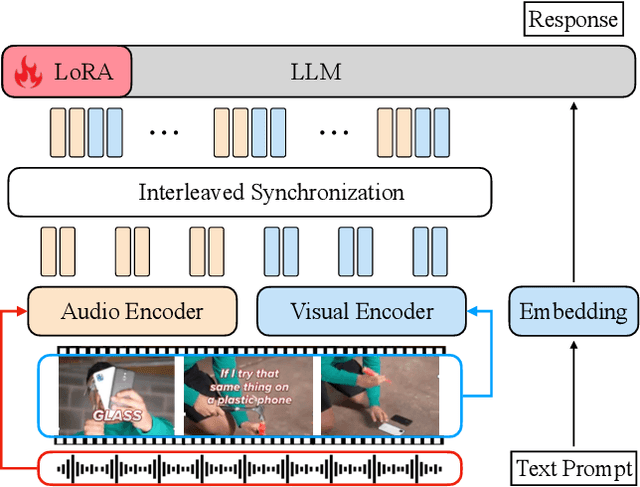
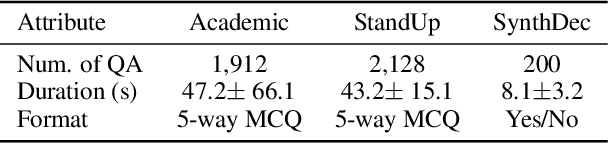
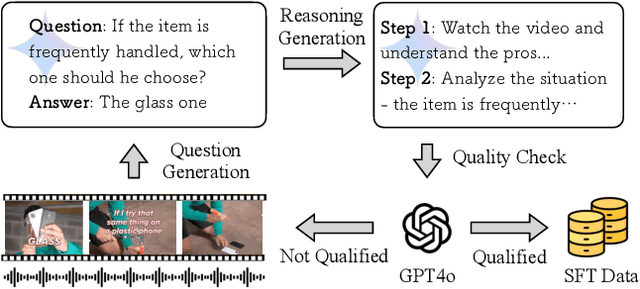
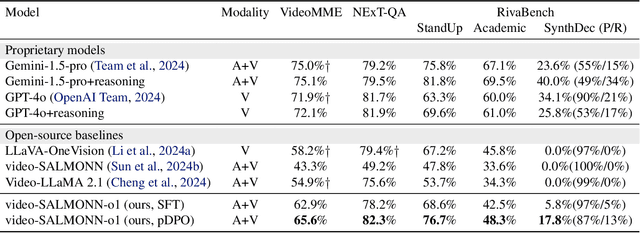
While recent advancements in reasoning optimization have significantly enhanced the capabilities of large language models (LLMs), existing efforts to improve reasoning have been limited to solving mathematical problems and focusing on visual graphical inputs, neglecting broader applications in general video understanding.This paper proposes video-SALMONN-o1, the first open-source reasoning-enhanced audio-visual LLM designed for general video understanding tasks. To enhance its reasoning abilities, we develop a reasoning-intensive dataset featuring challenging audio-visual questions with step-by-step solutions. We also propose process direct preference optimization (pDPO), which leverages contrastive step selection to achieve efficient step-level reward modelling tailored for multimodal inputs. Additionally, we introduce RivaBench, the first reasoning-intensive video understanding benchmark, featuring over 4,000 high-quality, expert-curated question-answer pairs across scenarios such as standup comedy, academic presentations, and synthetic video detection. video-SALMONN-o1 achieves 3-8% accuracy improvements over the LLaVA-OneVision baseline across different video reasoning benchmarks. Besides, pDPO achieves 6-8% improvements compared to the supervised fine-tuning model on RivaBench. Enhanced reasoning enables video-SALMONN-o1 zero-shot synthetic video detection capabilities.