 Add to Chrome
 Add to Firefox
 Add to Edge
Uncertainty-based Debiasing and Unlearning for Decontamination
Jun 22, 2026
Benchmark-based evaluation is the dominant paradigm for assessing large language model (LLM) capabilities, yet data contamination inflates reported performance and undermines fair comparison. Existing decontamination methods are evaluated solely through aggregate accuracy, which can obscure substantial differences in per-sample model behaviour, and many require access to an uncontaminated model. In this paper, we propose a sample-level evaluation framework for decontamination that complements accuracy-based assessment with distributional distance metrics, measuring how closely a decontaminated model recovers the output distribution of an uncontaminated model on each sample. Building on this framework, we introduce Uncertainty-Based Decontamination (UBD), a family of methods that leverage deep ensembles of the contaminated model to estimate per-sample memorization without requiring a uncontaminated model or knowledge of which samples are contaminated. UBD estimates a per-sample correction scalar from ensemble uncertainty, which is used to construct a debiased target distribution that suppresses the inflated probability mass on correct answers induced by contamination. This target is then used either as a post-hoc output correction (debiasing) or as a soft training signal for parameter update (unlearning). Experiments on MMLU-Pro and MATH-MCQA across multiple LLM backbones demonstrate that UBD produces per-sample output distributions substantially closer to those of an uncontaminated model than paraphrasing or choice-permutation baselines, while preserving model performance on uncontaminated data.

To Be Multimodal or Not to Be: Query-Adaptive Audio-Visual Person Retrieval via Active Modality Detection
Jun 04, 2026When retrieving a person from a video archive by voice and face, should the system be multimodal or not? In real-world broadcast archives, unlike curated benchmarks, a target may be heard but unseen, seen but unheard, or both. Fusing scores from an absent modality injects noise, degrading precision below the best unimodal system. We propose a query-adaptive framework that detects active modalities via cross-modal score consistency: when both modalities are active, files retrieved by one also score highly on the other; this agreement breaks down when a modality is absent. Classifiers driven by these cross-modal features achieve 89% detection accuracy. On the BBC Rewind corpus (with over 12,000 broadcast videos) the adaptive system attains 94.2% P@1, outperforming speaker-only (82.9%), face-only (93.4%), and fixed fusion (90.0%), recovering 64% of the gap to an oracle with ground-truth modality labels (96.6%).
The Impact of Editorial Intervention on Detecting Native Language Traces
May 11, 2026Native Language Identification (NLI) is the task of determining an author's native language (L1) from their non-native writings. With the advent of human-AI co-authorship, non-native texts are routinely corrected and rewritten by large language models, fundamentally altering the linguistic features NLI models depend on. In this paper, we investigate the robustness of L1 traces across increasing degrees of editorial intervention. By processing 450 essays from the Write & Improve 2024 corpus through varying levels of grammatical error correction (GEC) and paraphrasing, we demonstrate that L1 attribution does not entirely depend on surface-level errors. Instead, the detection models leverage deeper L1 features: unidiomatic lexico-semantic choices, pragmatic transfer, and the author's underlying cultural perspective. We find that minimal edits preserve these structural traces and maintain high profiling accuracy. In contrast, fluency edits and paraphrasing normalize these L1 features, leading to a severe degradation in performance.
Towards Self-Referential Analytic Assessment: A Profile-Based Approach to L2 Writing Evaluation with LLMs
May 05, 2026Automated essay scoring (AES) research often relies on rank-based correlation metrics to validate analytic assessment. However, such metrics obscure both intrinsic intercorrelations among analytic dimensions that arise from the structure of writing proficiency itself and halo effects, whereby holistic impressions bleed into fine-grained component scores. As a result, high correlations may mask a system's true diagnostic behaviour. In this study, we propose a novel self-referential assessment evaluation framework that focuses on identifying intra-learner strengths and weaknesses rather than assessing inter-learner rankings. We conduct experiments on the publicly available ICNALE GRA, a uniquely dense second-language writing dataset annotated holistically and analytically by up to 80 trained raters. To obtain reliable reference scores, we apply two-facet Rasch modelling to calibrate rater severity and derive fair average scores across ten analytic aspects and holistic proficiency. We compare the analytic scoring performance of human operational raters and three large language models (LLMs) in a zero-shot setting. Our results show that LLMs tend to outperform single human raters in identifying relative weaknesses (negative feedback) across several proficiency aspects, while human raters remain stronger at identifying relative strengths (positive feedback). Overall, our findings highlight the limitations of rank-based evaluation for analytic assessment and demonstrate the value of intra-learner, profile-based methods for assessing and deploying LLMs in AES.
Exploiting the English Grammar Profile for L2 grammatical analysis with LLMs
Mar 17, 2026Evaluating the grammatical competence of second language (L2) learners is essential both for providing targeted feedback and for assessing proficiency. To achieve this, we propose a novel framework leveraging the English Grammar Profile (EGP), a taxonomy of grammatical constructs mapped to the proficiency levels of the Common European Framework of Reference (CEFR), to detect learners' attempts at grammatical constructs and classify them as successful or unsuccessful. This detection can then be used to provide fine-grained feedback. Moreover, the grammatical constructs are used as predictors of proficiency assessment by using automatically detected attempts as predictors of holistic CEFR proficiency. For the selection of grammatical constructs derived from the EGP, rule-based and LLM-based classifiers are compared. We show that LLMs outperform rule-based methods on semantically and pragmatically nuanced constructs, while rule-based approaches remain competitive for constructs that rely purely on morphological or syntactic features and do not require semantic interpretation. For proficiency assessment, we evaluate both rule-based and hybrid pipelines and show that a hybrid approach combining a rule-based pre-filter with an LLM consistently yields the strongest performance. Since our framework operates on pairs of original learner sentences and their corrected counterparts, we also evaluate a fully automated pipeline using automatic grammatical error correction. This pipeline closely approaches the performance of semi-automated systems based on manual corrections, particularly for the detection of successful attempts at grammatical constructs. Overall, our framework emphasises learners' successful attempts in addition to unsuccessful ones, enabling positive, formative feedback and providing actionable insights into grammatical development.
Detect, Attend and Extract: Keyword Guided Target Speaker Extraction
Feb 08, 2026Target speaker extraction (TSE) aims to extract the speech of a target speaker from mixtures containing multiple competing speakers. Conventional TSE systems predominantly rely on speaker cues, such as pre-enrolled speech, to identify and isolate the target speaker. However, in many practical scenarios, clean enrollment utterances are unavailable, limiting the applicability of existing approaches. In this work, we propose DAE-TSE, a keyword-guided TSE framework that specifies the target speaker through distinct keywords they utter. By leveraging keywords (i.e., partial transcriptions) as cues, our approach provides a flexible and practical alternative to enrollment-based TSE. DAE-TSE follows the Detect-Attend-Extract (DAE) paradigm: it first detects the presence of the given keywords, then attends to the corresponding speaker based on the keyword content, and finally extracts the target speech. Experimental results demonstrate that DAE-TSE outperforms standard TSE systems that rely on clean enrollment speech. To the best of our knowledge, this is the first study to utilize partial transcription as a cue for specifying the target speaker in TSE, offering a flexible and practical solution for real-world scenarios. Our code and demo page are now publicly available.
Universal Acoustic Adversarial Attacks for Flexible Control of Speech-LLMs
May 20, 2025The combination of pre-trained speech encoders with large language models has enabled the development of speech LLMs that can handle a wide range of spoken language processing tasks. While these models are powerful and flexible, this very flexibility may make them more vulnerable to adversarial attacks. To examine the extent of this problem, in this work we investigate universal acoustic adversarial attacks on speech LLMs. Here a fixed, universal, adversarial audio segment is prepended to the original input audio. We initially investigate attacks that cause the model to either produce no output or to perform a modified task overriding the original prompt. We then extend the nature of the attack to be selective so that it activates only when specific input attributes, such as a speaker gender or spoken language, are present. Inputs without the targeted attribute should be unaffected, allowing fine-grained control over the model outputs. Our findings reveal critical vulnerabilities in Qwen2-Audio and Granite-Speech and suggest that similar speech LLMs may be susceptible to universal adversarial attacks. This highlights the need for more robust training strategies and improved resistance to adversarial attacks.
Unlearning vs. Obfuscation: Are We Truly Removing Knowledge?
May 05, 2025Unlearning has emerged as a critical capability for large language models (LLMs) to support data privacy, regulatory compliance, and ethical AI deployment. Recent techniques often rely on obfuscation by injecting incorrect or irrelevant information to suppress knowledge. Such methods effectively constitute knowledge addition rather than true removal, often leaving models vulnerable to probing. In this paper, we formally distinguish unlearning from obfuscation and introduce a probing-based evaluation framework to assess whether existing approaches genuinely remove targeted information. Moreover, we propose DF-MCQ, a novel unlearning method that flattens the model predictive distribution over automatically generated multiple-choice questions using KL-divergence, effectively removing knowledge about target individuals and triggering appropriate refusal behaviour. Experimental results demonstrate that DF-MCQ achieves unlearning with over 90% refusal rate and a random choice-level uncertainty that is much higher than obfuscation on probing questions.
Speaker Retrieval in the Wild: Challenges, Effectiveness and Robustness
Apr 29, 2025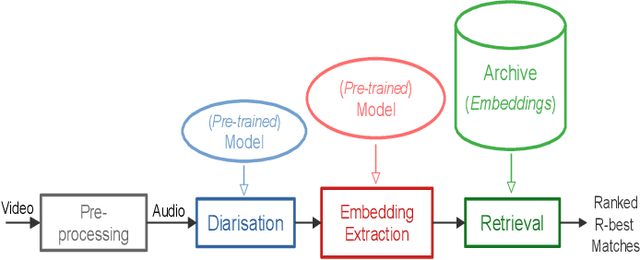
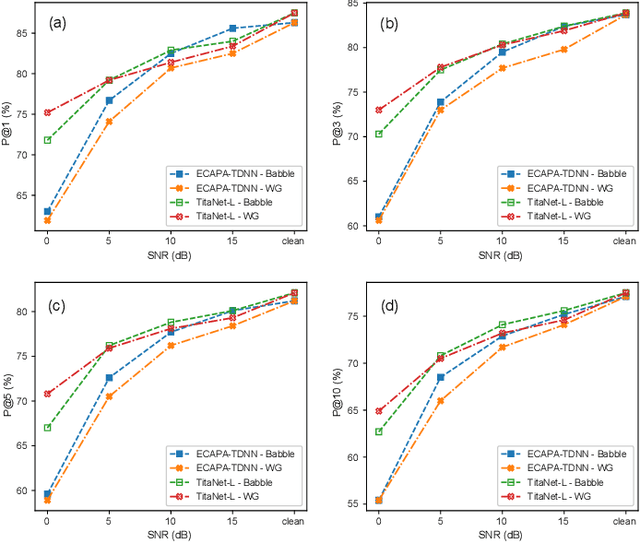
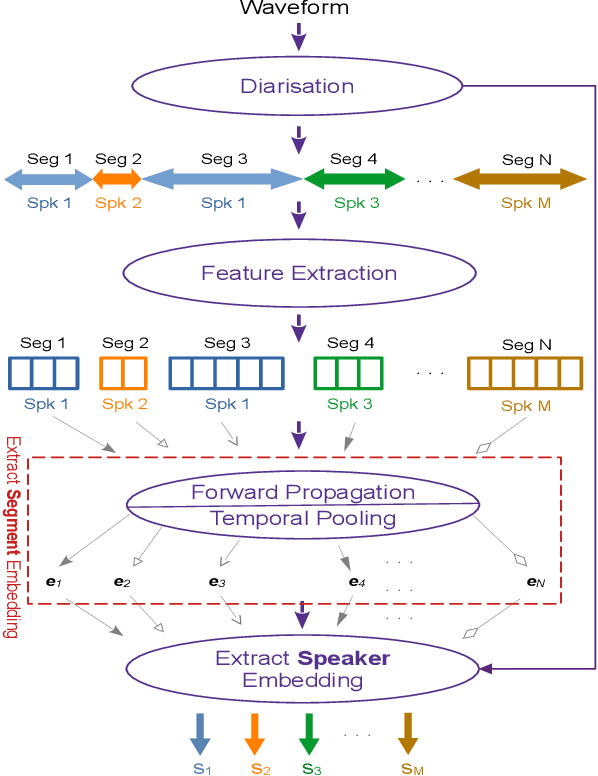
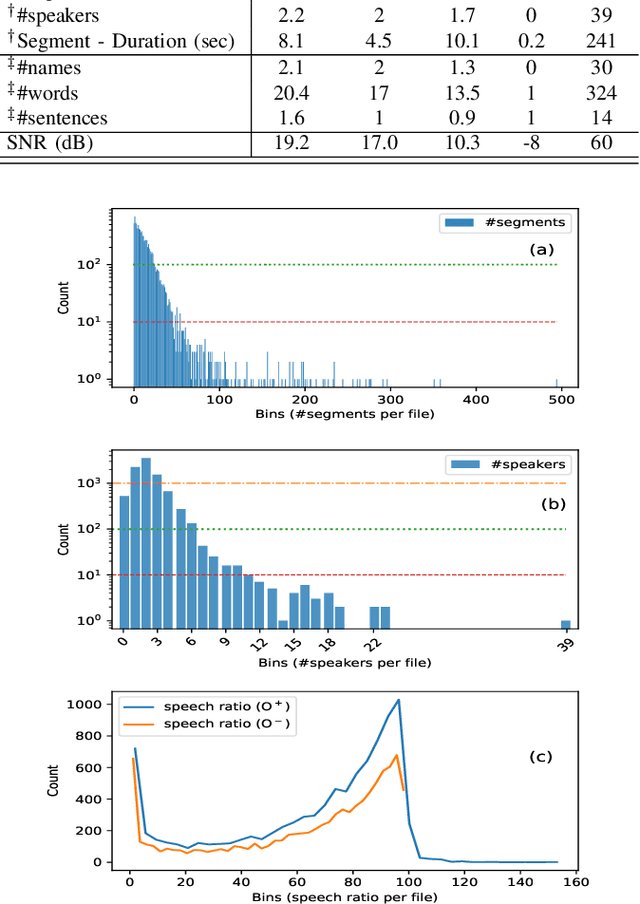
There is a growing abundance of publicly available or company-owned audio/video archives, highlighting the increasing importance of efficient access to desired content and information retrieval from these archives. This paper investigates the challenges, solutions, effectiveness, and robustness of speaker retrieval systems developed "in the wild" which involves addressing two primary challenges: extraction of task-relevant labels from limited metadata for system development and evaluation, as well as the unconstrained acoustic conditions encountered in the archive, ranging from quiet studios to adverse noisy environments. While we focus on the publicly-available BBC Rewind archive (spanning 1948 to 1979), our framework addresses the broader issue of speaker retrieval on extensive and possibly aged archives with no control over the content and acoustic conditions. Typically, these archives offer a brief and general file description, mostly inadequate for specific applications like speaker retrieval, and manual annotation of such large-scale archives is unfeasible. We explore various aspects of system development (e.g., speaker diarisation, embedding extraction, query selection) and analyse the challenges, possible solutions, and their functionality. To evaluate the performance, we conduct systematic experiments in both clean setup and against various distortions simulating real-world applications. Our findings demonstrate the effectiveness and robustness of the developed speaker retrieval systems, establishing the versatility and scalability of the proposed framework for a wide range of applications beyond the BBC Rewind corpus.
SkillAggregation: Reference-free LLM-Dependent Aggregation
Oct 14, 2024Large Language Models (LLMs) are increasingly used to assess NLP tasks due to their ability to generate human-like judgments. Single LLMs were used initially, however, recent work suggests using multiple LLMs as judges yields improved performance. An important step in exploiting multiple judgements is the combination stage, aggregation. Existing methods in NLP either assign equal weight to all LLM judgments or are designed for specific tasks such as hallucination detection. This work focuses on aggregating predictions from multiple systems where no reference labels are available. A new method called SkillAggregation is proposed, which learns to combine estimates from LLM judges without needing additional data or ground truth. It extends the Crowdlayer aggregation method, developed for image classification, to exploit the judge estimates during inference. The approach is compared to a range of standard aggregation methods on HaluEval-Dialogue, TruthfulQA and Chatbot Arena tasks. SkillAggregation outperforms Crowdlayer on all tasks, and yields the best performance over all approaches on the majority of tasks.